I’m spending quite a lot of my reading time with Dietrich Bonhoeffer these days. Ever since 1976, when I read Mary Bosanquet’s exceptional biography, Bonhoeffer has been a regular conversation partner. I till have that book. Published in 1968, it is now seriously dated, but still has value as an early, readable, well researched, and sympathetic but not uncritical account of Bonhoeffer’s life and subsequent influence. It has the added value as a biography because it carries a Foreword written by Bonhoeffer’s sister Sabine Leibholz-Bonhoeffer. She commends the honesty, sensitivity and theological perception with which Bosanquet interpreted Bonhoeffer’s life and thought.
Forty years later I attended a lecture by Dr Jennifer McBride as part of the Bonhoeffer for Pastors day at the University of Aberdeen. The title was ‘Who is Bonhoeffer for Today?’, and it was a tour de force in which she argued strongly against those who find in Bonhoeffer whatever they go looking for, with no regard for the overall context within which Bonhoeffer lived, and spoke and wrote. For example, ‘Religionless Christianity’, ripped from context and made into a vehicle for radical, at times radically negative theology, is a phrase that can only be understood within the overall Christological focus and cruciform shape of Bonhoeffer’s later theology.
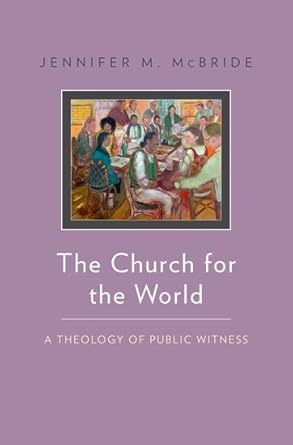
Mcbride’s major work, The Church for the World: A Theology of Public Witness, (OUP, 2012), examines Bonhoeffer’s insistence that Christian discipleship and the church as the Body of Christ are authentic only insofar as they engage with the world, and do so as expressions of the Lordship of the incarnate and crucified Jesus. The book explores the three primary and inter-related realities in Bonhoeffer’s theology – Christ, the Church, and the World.
One of the genuinely creative points McBride made in her lecture was to warn the church against a moral triumphalism by which Christian communities see themselves as the moral and ethical judges of society. The church, rather, is the Body of the Christ who took upon himself the sins of the world, and was ‘numbered with the transgressors’.
Far from being the judge and moral watchdog of society, the church is called by God to be a community of repentance, acknowledging its solidarity with human, social, and public life in all its ethical complexity and compromise. As the Body of Christ in its human form the church confesses its implication in the structures of sin, and witnesses to an alternative way of being. The new being that is the church is called to express repentance as turning away from the practices of domination to the practices of redemptive action, and these based on a discipleship of the crucified, risen Lord, whose life they embody.
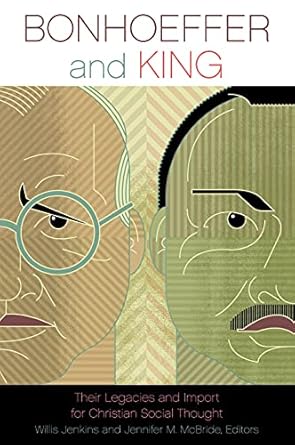
That at any rate was what I took away, and it still provides much to ponder. McBride’s work then and since has been a substantial reclaiming of Bonhoeffer as a primary resource for a theology both culturally critical and Christologically confessional. Her more recent books include Radical Discipleship: A Liturgical Politics of the Gospel, and a co-edited volume of essays on Bonhoeffer and King: Their Legacies and Import for Christian Social Thought. This volume brings Bonhoeffer’s struggle into dialogue with Martin Luther King’s struggle – both of them advocates of the radical Gospel of Jesus as cross-carrying agents of resistance to the powers that be and of transformational change in the real world of human affairs.
At a time when, in many places, the church and the faith to which we bear witness is being co-opted by ideologies of nationalism and power seeking, there is much to be learned from the writings of Bonhoeffer, a flawed and brilliant pastor whose discipleship, ministry, writing and theological struggles, were worked out in the church struggles of his time. That’s what gives his voice relevance and urgency for our own time.
Leave a Reply