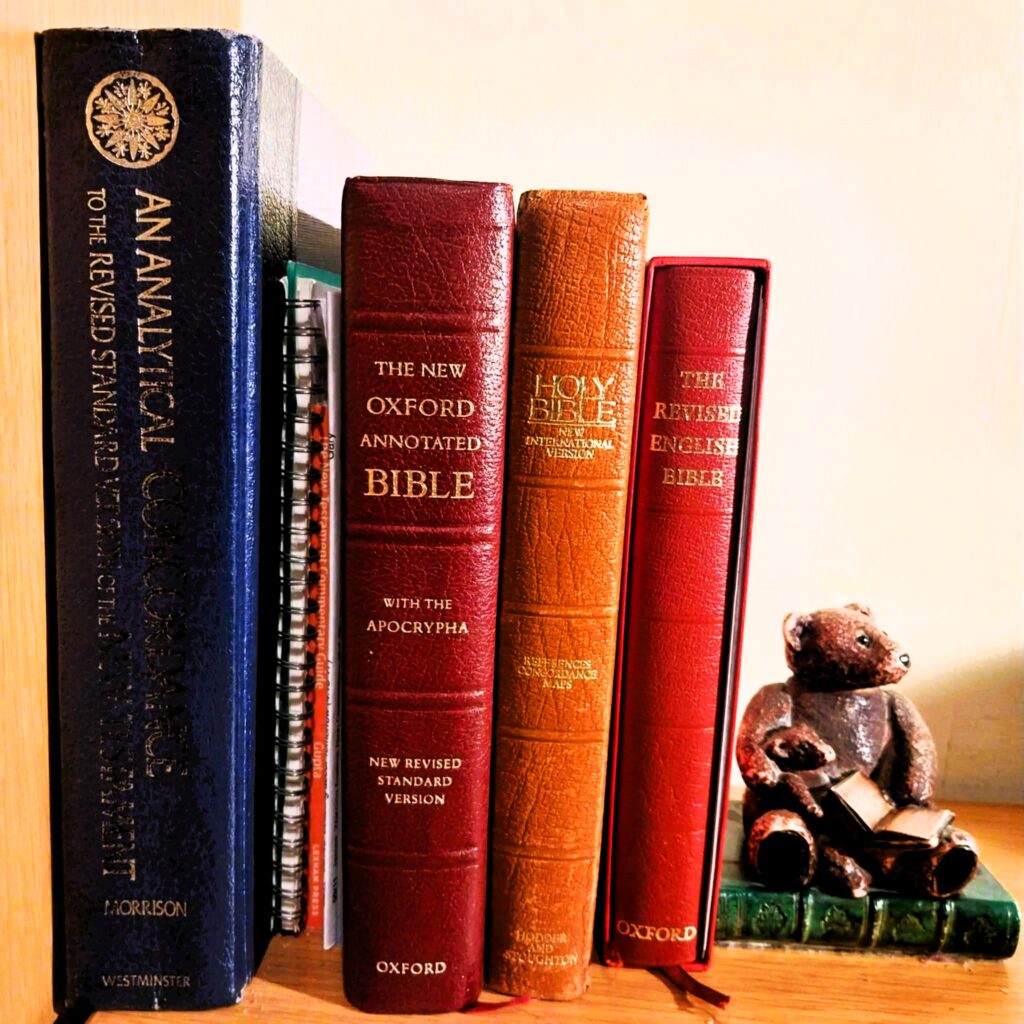
Earlier today I was reflecting on what happened to my first Bible. In 1967 when I first committed my life to Jesus and needed a bible of my own, I used the King James Version (known then as the Authorised Version). It was a chunky black imitation leather edition with a zip, red edged pages, and it fell to bits in a few years. I bought it in Pickering and Inglis in Bothwell Street, Glasgow. I loved that shop until it was absorbed into other companies (Wesley Owen).
Alongside it I had one of the first copies of the Good News New Testament or Today’s English Version. I still have the original hardback copy. By the early 1970s at University and then College, I had changed to the Revised Standard Version (RSV) which I used until the mid 1980s.
I never had a New English Bible which was deemed in more conservative Christian circles to be a ‘liberal’ translation. Our College Principal R. E. O. White repeatedly insisted the primary criterion for choosing a Bible was its accuracy and faithfulness to the original language text. Adjectives such as liberal or evangelical had no place in the work of faithful translation – accuracy, style, readability and liturgical usefulness were more reliable criteria, and in that order. Well, REO was a traditional nonconformist!
In the 1980s the New International Version (NIV) became the preferred bible in the circles where I moved and ministered, and I started to use it as my default translation when preaching. It has gone through several revisions to remove, wherever possible, gender exclusive language, and to edit the whole in the interests of ongoing improvement in translation as contemporary usages change.
The New Revised Standard Version from the 90s is now the most widely used English translation in academic contexts in the UK, and along with a couple of others, it sits on my desk. It too has since been revised – again. In the study I have always used multiple translations for comparison, including each of these mentioned.
For my personal reading I happen to value the Revised English Bible (REB) for its accuracy (so far as I can judge), its readability and style, and a general sense that the biblical text is rendered in language that is contemporary while careful to avoid transient colloquialisms. On this I am in a barely visible minority, as the REB has never commanded major take-up in the market or the church.
The market and the church. I guess why I think this is worth mentioning is because when I quote the Bible from memory it might actually be a hybrid version from close reading of different translations  So I do wonder and worry about the future health of biblical translation given the powerful persuaders of the market, and influential religious ideologies now seeking translations that reinforce already held prejudices. Then there’s the marketability of specialist niche Bibles, and the proliferation of study Bibles. These sometimes come with helpful notes for guidance. But they can also contain firmly laid rail-tracks of interpretive bias, intended for niche groups who might prefer a text that reinforces positions already held, and give support to prejudices perhaps too embedded in identity to tolerate questioning.
But as Spurgeon is alleged to have said, the Bible is a lion. Let it out of its cage and it will defend itself. Mind you, he was speaking at a time when the King James Version was the unrivalled and near universally used English translation. The advent of the Revised Version in 1881 started a trickle of alternative translations that has since become a deluge.
I guess that’s simply another example of a complex culture which presents us with too many, and seemingly endless consumer choices. Think of the long supermarket aisles dedicated to the varieties of bread. Any one of those loaves will deal with the hunger that prompts the petition, “Give us this day our daily bread.” And in good old fashioned children’s talk language, “And that’s a bit like the Bible.”
With daily bread, “Take and eat.” And with any half-decent Bible, “Take and read.”
Leave a Reply