Monday
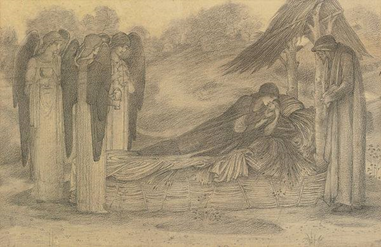
Mine are riches from your poverty, from your innocence eternity;
Mine forgiveness by your death for me, child of sorrow for my joy.
From the 1960s, the Calypso Carol has been a regular favourite, not least because the tune and words have an impetus that contrasts with more sedate traditional carols. This last verse takes a deep dive into Paul’s gospel – “he was rich but for our sake became poor”; “He did not count equality with God a thing to cling on to, but emptied himself…” Christmas is about God’s gift of his Son, Jesus, who came in obedience to the Father to save his people from their sins. His sorrow is our joy, our sins but God’s forgiveness. Across the nativity scene, cast by the light of the star, is the shadow of the cross, and the promise of joy in heaven over sinners who repent.
Tuesday
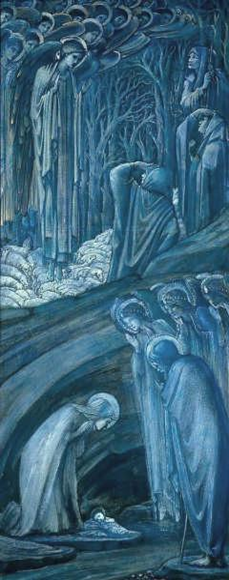
What can I give him, poor as I am?
If I were a shepherd I would bring a lamb;
If I were a wise man I would do my part –
Yet what I can I give him, give my heart.
I suppose we can be pedantic and sceptical about bleak midwinter and snow on snow around Bethlehem. But this carol captures exactly the bleak contrast between heaven and earth, and between the eternal security of God the Son and the vulnerability of “The Word become flesh and dwelling among us.” The poet’s line, “Our God heaven cannot hold him” tells the mystery of God’s condescension, when “a stable-place sufficed the Lord God Almighty, Jesus Christ.” And so that last verse becomes the wondering prayer of every Christian, faced with the truth about the One for whom “a stable place sufficed.” In all the giving of Christmas all God asks in return for his gift beyond words, is our heart’s gratitude and devotion.
Wednesday – Christmas Eve
Lo! Within a manger lies, he who built the starry skies,
He who throned in height sublime, sits amid the cherubim.
“All things were made by Him, and without Him nothing was made that was made.” John’s Gospel has no Christmas story. Instead John writes of the Word “who was in the beginning with God”, and who though he was God, “became flesh, and lived amongst us.” This carol condenses John’s vast vision of a God-created and God-loved and God-redeemed cosmos into these simple lines. Yes Christmas Eve is about crowded Bethlehem, animals in the downstairs stable, shepherds and angels, Mary and a manger and a child. But this is a drama that is eternal, heaven and earth meeting in the coming of Immanuel, God with us. “Sacred infant, all Divine, what a tender love was thine; thus to come from highest bliss down to such a world as this.”
Thursday – Christmas Day
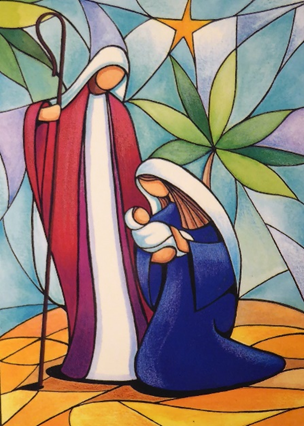
True God of true God, Light of Light eternal,
Lo! He abhors not the virgin’s womb
Very God, begotten not created.
O come let us adore him!
Yes it’s Christmas Day and the last thing we need is a theology lesson. Well, perhaps that’s just exactly what we do need! This verse is based on words from the Nicene Creed, hammered out by Christians in 325 and 381, affirming Jesus Christ’s true divinity. Yes, it was indeed the Eternal Word become flesh. That manger held the treasure of heaven. Jesus, the Christ child is true God of true God. The nativity story is a pivotal chapter in the unfolding drama of redemption. Christmas Day matters, and has its place in the liturgical cycles of the church, because the gift of heaven is the coming of God as Redeemer and Saviour. On Christmas day we celebrate the “Word of the Father, now in flesh appearing.”
O come let us adore him, Christ the Lord!
Friday – Boxing Day

How silently, how silently, the wondrous gift is given!
So God imparts to human hearts the blessings of his heaven.
No ear may hear his coming; but in this world of sin,
Where meek souls will receive him, still the dear Christ enters in.
We are all allowed a favourite Christmas carol. I have several! This one for its unsophisticated poetry. So much condensed into this description of Bethlehem as God’s chosen entry point in space and time: “The hopes and fears of all the years are met in you tonight.” The verse above invites us to a response this day after Christmas. The coming of Jesus, the Word made flesh, comes in obscurity, the child marginalised in a manger. Yes, I know, not all that silently if there’s a flash mob of angels with full orchestra at Bethlehem’s Glastonbury. But often enough, in the quietness of despair, in the ‘hungering dark’ of anxiety, in the unexplained longings of our hearts, if we listen and look for One we can trust, and are open to the advent of God’s love, miracles happen, not least, “the dear Christ enters in.”
Saturday

It came upon the midnight clear, that glorious song of old,
From angels bending near the earth to touch their harps of gold:
‘Peace on the earth good will to all from heaven’s all-gracious King!’
The world in solemn stillness lay to hear the angels sing.
Peace on the earth, good will to all – to men and women, to all humanity, to the whole creation. Peace on the earth. Shalom. Aye. I wish! I wish we could hear the angels sing o’er all the weary world and o’er all our Babel-sounds. I wish we could ‘hush the noise and still the strife to hear the angels sing.’ I wish those ‘beneath life’s crushing load’, who ‘toil along the way could rest beside the weary road, and hear the angels sing’. But. The whole point of Christmas is to redeem precisely those situations; to meet sin head on and defeat it; to confront persistent hate with the indefatigable resilience of divine love; to teach us again the things that make for peace by pointing us from the manger to the cross. Make time to read Colossians 1.15-20, where such peace is fully and finally explained. The Christmas connection is the astonishing truth: “God was pleased for all his fullness to dwell in him.”
Sunday

Hail the heav’n-born Prince of Peace!
Hail the Sun of righteousness!
Light and life to all He brings,
Ris’n with healing in His wings:
Mild He lays His glory by,
born that man no more may die;
Born to raise the sons of earth;
born to give them second birth.
Hark! The herald angels sing,
Glory to the new born King.
Perhaps the most theologically rich and complex of all our best known carols. The themes we have explored or touched on throughout the week are gathered by Wesley into a verse that is a mosaic of Scripture allusions. This final verse is one loud shout of Christmas faith, joy and hope. At the end of this week, with another Christmas behind us, this verse invites us to worship and praise, to wonder and give thanks, to rejoice and to hope. “We have beheld his glory, full of grace and truth.”
And so to respond in a prayer of longing and invocation:
O holy Child of Bethlehem, descend to us we pray;
Cast out our sin and enter in; be born in us today.
We hear the Christmas angels the great glad tidings tell;
O come to us, abide with us, our Lord Emmanuel.
………………………………..ooooooo……………………………
Leave a Reply