Love bade Me Welcome. Drawing Nearer to God with the Poems of George Herbert. Suzanne McDonald. (Cascade: Eugene, Oregon, 2026)
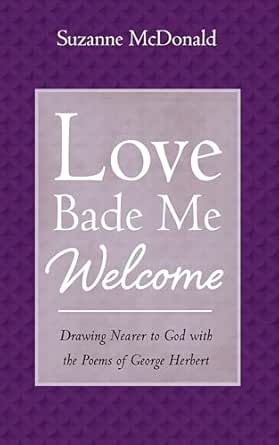
Thirty years ago Suzanne McDonald came to faith through reading the poetry of George Herbert. Now an accomplished theologian with a particular focus on Reformed theology, she is also steeped in the history, literature and thought of the 17th Century.
She has written this book on Herbert’s poetry with the primary intention of introducing others to the riches and rewards that come from spending time in the company of George Herbert. Love Bade Me Welcome is intended as a devotional book, offering informed reflection and guided study of 52 poems. It is more substantial in its structure and content than several other recent introductory books on Herbert’s poetry.
The book is carefully structured to facilitate reflective reading of the poems. Each poem is placed in the context of The Temple, with accompanying commentary and reflection bringing out the spiritual theology woven through the verse. There are footnotes but only where further explanation is necessary to follow the poet’s point or clarify obscure terminology. In each chapter there are recurring invitations to the reader to dwell on personal and theological questions suggested by the poem, then to bring each poem into conversation with a chosen Bible passage, and finishing with a prayer and a reminder ‘Going Forward’ to be attentive to and live into what has been learned.
The result is a book that is offered as a companion on a slow meditative journey through the year, nourished and guided by a poem each week. George Herbert’s poems deserve such thoughtful slowness and repeated reading, especially in the company of an author who is expert on the literature and the period, and who has been a long-time close reader and spiritual student of “the beloved poet.” The book is intended to be both informative and formative.
Those familiar with George Herbert’s Temple will have their favourites, and I am no exception. Choices for inclusion are always tricky, especially from a collection so carefully curated by the original author, and in which each poem is freighted with multiple interpretive possibilities, both inter-textually and intra-textually. For myself I would not have omitted any of those that are here included; and though a case can be made for further inclusions, the 52 week structure is a self-imposed discipline that is both practical and in my view, successful. And all of my personal Herbert favourites are included, so that’s all right then!
Perhaps one example might illustrate further the value of McDonald’s approach for those seeking to go deeper into Herbert’s poetry. And for newcomers, the book is an invitation to dive in and swim in the powerful currents of Seventeenth Century devotional poetry.
The challenge for any scholar seeking to probe and explore Herbert’s poems is how to deal with Love III, a poem many consider Herbert’s masterpiece, and which provides the title of the book. By this test, the book is confirmed as a reliable, perceptive and experientially accurate account of what Herbert himself called “the many spiritual conflicts that have passed betwixt God and my soul, before I could subject mine to the will of Jesus my Master, in whose service I have now found perfect freedom…”

Love III is the last poem in Herbert’s Temple, and the last to be considered in this book. The ‘Reflection’ section shows a sympathetic understanding of the psychology and spiritual experience of Herbert’s pendulum swings between desolation and assurance, shame and acceptance, guilt and forgiveness. This is where McDonald’s long personal journey with Herbert shows. She has been a deep listener and an attentive reader, not only to the poems, but to the heart of the poet. The ‘Scripture’ suggested as the conversation partner with the poem is itself a condensed argument about love as both imperative and initiative, bristling with the relational tensions and constant resolutions of love at its most powerful as motive and reward. (1 John 4.16-19) The concluding ‘Prayer’ uses familiar words by way of a personal invitation to the communion table, and therefore to communion with the One who ‘bids us welcome’.
As a book to be used weekly throughout the year in a way that is leisurely but intentional, and without being desultory, it is attractively produced, with clear readable sized font, and a well-planned layout. It is a generous larger format paperback (15cmx23cm), so the pages are not overcrowded with text. It will wear well with constant use – and there are lots of white spaces for personal annotations.
The book is deliberately accessible, but is supported within a strong theological framework of the spiritual life, and showing easy familiarity with current literature on Herbert. The whole project expresses the writer’s love for the subject, both poet and poems. I would be confident this well-conceived book will successfully fulfil the aim in the subtitle, of enabling the reader to “Draw Nearer to God with the Poems of George Herbert.”
Leave a Reply