Paul and John in Harmony. A Theological and Historical Exploration. Michael Gorman. (Baker Aademic: Grand Rapids, 2026)
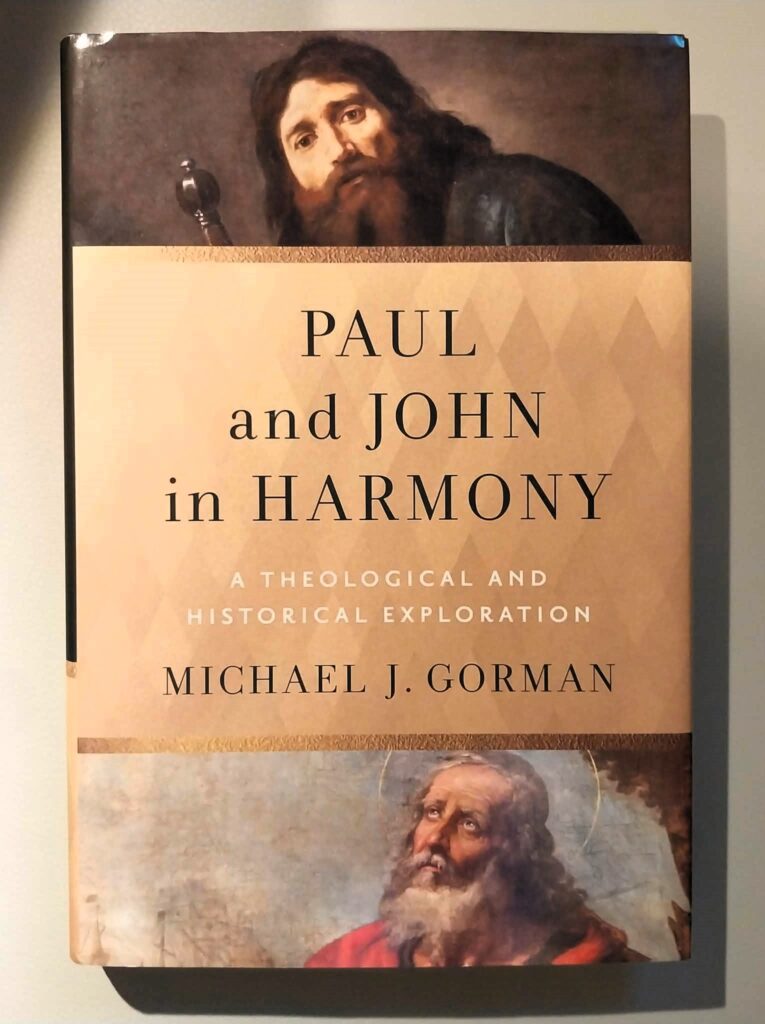
“John is not a Pauline Gospel; rather, Paul is a Johannine theologian.” That is the thesis of Michael Gorman’s latest book. The historical evidence for this assertion is laid out carefully in the final chapter, but it builds on all the previous chapters which represent a cumulative gathering of evidence based on certain acknowledged theological and textual overlaps in the spirituality of Paul and of John.
A general introduction sets out the options for understanding the theological similarities and differences between Paul and John, and why the question is important. Then chapter 2 provides a full and illuminating comparison of two master stories – the Christ hymn of Philippians 2.6-11, and the foot-washing episode in John 13. These two texts are explored and compared using five theses that emerge from careful textual and theological analysis.
The five theses are stated and established through an analysis of the two texts, exposing their foregrounded themes of Christology and soteriology, which together lead to the ‘participatory discipleship’ of Christian believers. Participatory discipleship is a key component in Gorman’s spiritual theology, and is tightly woven throughout Gorman’s more recent work on New Testament Theology. These two master stories are about God, incarnation and divine self-revelation; they both portray Christ’s divine vulnerability; they each display and mandate cruciform self-giving love; and both stories reveal the paradox of Christ’s freely chosen journey of obedience through the cross vindicated in resurrection.
Chapters 3 and 4 share the same title in a full examination of Pauline and Johannine spirituality: ‘Paul, John, and Participation in Christ: Spirituality and Its Roots in Christology’. First, chapter 3 offers an overview in which Gorman lays out the parameters of his argument. Union with Christ as koinonia and participation is a shared and focal emphasis in the spirituality of Paul and John. One of the most substantial sections of the book is then mapped out in Gorman’s detailed argument. What he calls ‘locative language’ and ‘residential rhetoric’ are his ways of describing phrases like ‘in Christ’ and into Christ’, as the place where believers ‘abide’ and ‘remain’. There are tables and lists of cumulative evidence from texts, demonstrating how such ‘locative language’ operates throughout the spiritual theology of Paul and John. The reader is made to feel the cumulative impact of the evidence gathered and shaped into a well-considered argument.
By the time we get to chapter 4 Gorman is ready to set out the evidence that such ‘locative language’ is a crucial element in the thought of Paul and John. Gorman articulates four major features of Paul and John’s understanding of participatory spirituality growing out of union with Christ, believing into Christ and being in Christ. The four common features are i) mutuality, “you in me and I in you”; ii) such mutual indwelling confers the Christian’s fundamental identity; iii) such mutuality and conferred identity is Trinitarian in character, by which is meant “the fundamental reality of perichoresis, or coinherence, is the mutual indwelling of the Father, the Son, and the Spirit as an intimate unity-in-diversity of love; into this life humans are invited.”(p. 104); iv) this mutuality and identity within a Trinitarian existence is both active and transformational, that is, such mutual indwelling implies, requires and enables “moral and missional endeavour” which will bear fruit. All of this comes together in the phrase ‘missional theosis’, a term with which Gorman has become associated in recent years
In these chapters the author does the necessary spadework in order to build a persuasive body of evidence that will bear the weight of his argument. Lexical, contextual and grammatical evidence is drawn from Paul’s Letters and the Gospel and First Letter of John. Multiple verses are reproduced enabling the reader to weigh the cogency of the argument and note the similarities and variations in the theology and spirituality of both Paul and John. Indeed one of the bonus values of this book is the ready availability of such gathered texts printed in full, a catalogue of key texts.
Chapter 5 has the title ‘Prequels and Sequels’. This too is a rich chapter of textual and theological reflection. The author’s own summary describes the results: ”We have considered the soteriological prequel and sequel, according to both Paul and John, related to the incarnation and exaltation theme found in Philippians 2 and John 13…This prequel and sequel involve the double sending, first of the Son (prequel) then of the Spirit (sequel).” (p.153)
Chapters, 2-5, are both constructive and exploratory, and could stand alone as a thorough explication of the shared theological emphases of Pauline and Johannine spirituality. But they also serve as substantial evidence of telling similarity. And those similarities between Paul and John across a range of crucial texts and theological concepts, raise the inescapable question of who borrowed from whom, that is, which one was historically prior to the other?
The final chapter offers a tentative, but in Gorman’s view, plausible suggestion. To the question who influenced whom there are three possible answers. First, they are independent of each other and there is no direct relationship. Second either Paul influenced John or John influenced Paul. Third they influenced each other in “a give and take that involved the sharing of experiences, traditions and even texts.”
Gorman offers a new thesis that argues John influenced Paul: “John is not a Pauline Gospel; Paul is a Johannine theologian.” If Gorman is right, then the consensus on the dating of the New Testament documents would need radical revision. If correct, Gorman’s argument suggests an early date for John, that Paul at least knew John 13-17 possibly in written form, that John’s Christology could just as easily be prior to that of Paul, and that if John knew the synoptic gospels then they would also require a much earlier date than the current critical consensus. None of that is beyond plausibility, and the historical priority of John over Paul would help explain several aspects of Paul’s writing, and so on. This is a remarkable chapter, the argument presented as an irenic invitation to dialogue, with self-critical awareness of the problems but also the cogency in his overall thesis. It will be interesting to read the responses to what Gorman intends as a discussion starter and an invitation to consider the evidence so far.
The last sentence of this chapter is also the justification for the whole book:
“What matters most are the contributions that Paul and John make about life in Jesus Christ, the life of foot-washing and fruit-bearing that is ultimately transformative participation in the life of the Triune God – a life commitment that is worthy of pursuit no matter who wrote what when.” (p.180)
Leave a Reply