Category: Uncategorised

  • Biography as Theology, and As Studied Humanism

    Biography well written is like a window on another person's world, filtering borrowed light into our own. Human experience has so much, and so little in common. Yes we all eat and drink, laugh and cry, make love and make trouble, grieve and celebrate, are children and maybe parents, grow our hopes and see some of them flower or watch others wither, work hard for what we get and sometimes get what we never deserved or worked for. So much in common – and so little. Because who we are and what happens to us, the givens and circumstances over which we have no control, the choices that come to us and the choices we make, the contingencies and shocks and surprises that together give content to our story – these have infinite variety, endless possibility, and their contingency and happenstance are what make each life unique, each story different, every biography a novel in the making.

    WaddellI'm re-reading one or two biographies, which means I want to re-visit one or two favourite human beings, mainly people whose life stories, in all their specific and unrepeatable contingency, illumine the rooms of my own life. The biography of Helen Waddell by Dame Felicitas Corrigan, a Benedictine nun, is a masterpiece of the biographer's art. This is quite simply one of the best written biographies I've read. The writing is both precise and elegant, the story is both critical and appreciative. The understanding and insight into the mind and motives, the emotional climate and intellectual brilliance of Waddell's inner life, give the portrait the detailed finesse of a Vermeer, observing and representing the realities of one person's daily life and inner struggles.

    What is it that makes the translator of Medieval Latin Lyrics, the writer of the unlikely best-seller The Wandering Scholars, and the student of The Deset Fathers such a fascinating human being? This scholar poet was born in Tokyo to missionary parents, she revered Latin from age 9, was familiar with Greek poetry and visited Shinto Temples, a brilliant Graduate of Queen's Belfast, for 44 years friend of the English Literature doyen George Sainstbury, crammed lecture halls in Oxford, was close friends with Stanley Baldwin and received by Queen Mary. Later in life she became entangled in domestic cares, the demands of life during the Second World War, eventually overtaken by dementia, probably now diagnosed as Alzheimer's Disease. It is a life lived gloriously, and at times mundanely; a life of profound faith made joyful by a spirit of generosity and expansiveness; her mind endlessly curious, tenacious in pursuit of the beautiful the good and the true; soaked in history and the love of all things medieval. A scholar's life, but also the life of a deeply compassionate, imaginative, practical minded, occasionally eccentric, unfailingly interesting person. 

    I've read the book twice, and about to read it again. John Bunyan she disliked; Augustine she enjoyed. "Thou didst touch me, and I burned for thy peace..Too late have I loved thee. Beauty so old, and yet so new."  Is there anything in Bunyan equal  to that one sentence, she asked. Then after reading Pilgrim's Progress, she quotes Mr Standfast, "I have loved to hear my Lord spoken of, and wherever I have seen the print of his shoe in the earth, There I have coveted to set my foot". On reading that, Waddell conceded, " And I take back everything!. Reading this biography brings you into the company of two remarkably sharp intellects and just as remarkably capacious souls. Corrigan on Waddell, a coalescence of brilliance.  

  • Advent Comes Nine Months After the Annunciation for Obvious Reasons!

    Annunciation

    The Annunciation comes in the Church Calendar months before Christmas – for obvious and natural reasons. But Advent is a time when it's important to look back in order to look forward; Christmas day is the fulfilment of the Annunciation, itself the fulfilment of long ago promises, made in the heart of God so long ago we call it Eternity.

    The word "mystery" is not fit for purpose, but what words would do any better at explaining the inexplicable, attempting to describe that which is categorically beyond the efficacy of all our meaning laden categories? So we are stuck with mystery, stuck in mystery, mysteriously stuck within the limits and constraints of our own thinking. Advent celebrates unthinkable possibilities now become familiar and realisable through the Yes of a young woman to the overshadowing of the Holy Spirit. Her response, "Be it so" is itself beyond the understanding of all but those whose hearts beat in synchronic obedience to the call of God.

    The contemporary demand for relevance, for pratcical application, for reducing and splitting a text by force into manageable parts that can be 'embodied', 'lived', 'practiced', destroys the hidden inner structure of mysteries more suited to wonder, adoration and silent inner assent to what is beyond us. So I like Jane Kenyon's poem, The Bat, and smiling at its relevance way up here in the North East, and its reference to how, long ago, the Holy Spirit came dangerously near, and redirected history.

    The Bat

    I was reading about rationalism,
    the kind of thing we do up north
    in early winter, where the sun
    leaves work for the day at 4:15

    Maybe the world is intelligible
    to the rational mind;
    and maybe we light the lamps at dusk
    for nothing…

    Then I heard the wings overhead.

    The cats and I chased the bat
    in circles—living room, kitchen,
    pantry, kitchen, living room…
    At every turn it evaded us

    like the identity of the third person
    in the Trinity: the one
    who spoke through the prophets,
    the one who astounded Mary
    by suddenly coming near.

  • A Prayer for Those Who Suffer a Deficit of Love

    This prayer was written for the worship Service I was leading tonight:


    Eternal God and Father,

    Whose infinite yet intimate love

    shared from all eternity between Father and Son,

    is the love you have poured into our hearts by the Holy Spirit.


    We pray for those whose lives are broken for lack of love:

    Children whose safety and health come second to adult demands;

    Friendships ended by exploitation and backstabbing;

    Marriages shredded by unfaithfulness and broken promises;

    Families fractured by social pressures, whether poverty or affluence;

    Neighbourhoods where love is thought weakness, and compassion is despised.


    We pray for those we’ve only heard of on television,

    Whose lives disintegrate under pressures of hate and violence

    People who are in different ways, damaged, diminished, defeated,

    by the absence of love, the vacuum filled by the power of hate.

    The baby thrown from a bridge by an enraged jealous father

    The 23 year old man whose reckless driving killed a local pensioner

    The 82 year old man jailed for attempted murder in a retirement home

    The pensioner kicked to death for refusing to hand over cigarettes

    These and so many more, human lives caught in the crossfire of fear and hate,

    we hold them before your healing mercy


    God of love and hope,

    Fill us with compassion for the poor, the hungry, the lonely

    Like Jesus gives us eyes to see Zacchaeus hiding in shame;

    Courage to ask the name of violent terrified Legion,

    and to stand between the sinner and those holding the stones;

    Compassion to touch with tender risk those who like the leper are feared and excluded,

    and to see the attentive care of the Samaritan, and go do likewise –

    Generosity to open our arms in welcome like the prodigal father,

    and to bring our loaves and fishes to be belssed for blessing of others.


    We dare to pray to be perfect, as our Heavenly Father is perfect,

    whose sunlight love gives life to all within its radiance,

    whose rain of mercy falls with life giving refreshment,

    who reaches out with a love that warms and waters,

    embraces, holds and heals, broken worlds and broken hearts alike,

    and all this in Jesus name and in the power of your Holy Spirit,  Amen

  • J M W Turner: Art in which “Peril Has the Power To Please.”

    The film Mr Turner is an intriguing, at times annoying, but always fascinating attempt to answer Elizabeth Jennings question: What were the bonds and limits, the constraints and disciplines that enabled such innovative art to establish itself as a profoundly new but powerful form of seeing the world? The inner vision of the artist is part of the mystery that may even elude conscious capture by the artist himself. The film never answers the questions of motives and origins, refusing to attempt an explanation by source criticism of the emotions, experiences and relationships which deeply engage the mind and heart and find expression in creative art.

    Jennings poem simply celebrates the reality. Such form is there, and most there when invisible. The artist's self-expression, paradoxically, is at its most visible when the self is eclipsed by the actions and inner impulses which strive towards something as yet imagined, but no less real for that. As a matter of fact, this poem would be a good critical framework within which to ask the question, Is this a good film? What does it achieve? Do I understand more about how the artist works within limits but always pushes them, to the limit of of the limits. 

    Tribute to Turner

    What were your bonds and limits? It is hard

    For us to see them yet there must be some

    Since art can only flourish locked and barred

    By form. However inward; it must come


    To keep off sprawl and chaos. Out of sight

    Yours are but they are firm. Within your craft

    The storm, the tides are held by day and night,

    Leashed strongly in and so the looker's left


    With fire and blood and steam. There is no fear

    For us but only wonder. Nature is

    At your command when you most disappear


    And so we're caught up in your ecstasies

    And large delight that's present everywhere

    And what seems peril has the power to please.


  • Van Gogh and the Dark Paths of Uncertainty, Doubt and Struggling Faith

    The Church in Auvers-sur-Oise, View from the Chevet

    I hadn't really thought much about Elizabeth Jennings poetry on art and artists till reading through her collected poems it becomes obvious – this woman loved art, and deepened her heart gazing at it. As a poet familiar with the inner ambiguities and tensions of creativity, she imaginatively entered the inner life of the artist, perhaps by asking the question, "Where does this painting come from? And, what goes on in the heart and mind, the fluidities of human experiece in an artist who paints this picture, and just like this?" Her poem on this painting is a moving and understanding reflection on prayer, the mystery and the anguish, the uncertainties and the occasional assurance, the fragility and necessity of that risky trust that enables us to say, or not say, the fears and longings and joys and hopes of our lives.

    In his young years Van Gogh was an Evangelical fiery Gospel preacher, and sent home to his brother some copies of English hymns that meant a lot to him. Two are worth quoting because they help us understand the painting above, with its darkness and shadows, the crooked building, the lone figure going dutifully to prayer in a church with no lights on at night.

    "Thy way not mine, O Lord, However dark it be; Lead me by thine own hand / Choose out the path for me." More poignant and significant still,

    Nearer my God to Thee, nearer to Thee.

    E'en though it be a cross, that raises me.

    Still all my song shall be, nearer my God to Thee,

    Nearer my God to Thee, nearer to Thee

    There's a really good chapter on Van Gogh's Evangelical phase in Disenchanted Evangelicals. Nine Portraits of Faith and Doubt, David Hempton, Yale, 2008. It shows Van Gogh's transition towards a faith much less secure, far less explicitly Christian, but clinging to an elsuive sense of some ultimately benevolent Onlooker whose purposes transcend his own grasp of things. Elizabeth Jennings' poem on the painting above redeems a more hopeful portrait from the remnants of Van Gogh's earlier faith commitments. This is a beautiful poem, revealing a deeply pastoral sympathy for those in life who struggle to make sense of why it is, sometimes, that it is indeed a cross that raises them nearer to God, and who then use that so dearly bought proximity as opportunity for protest. Van Gogh understood better than perhaps we allow, the need to articulate that cry of the heart, "Why?"

    The Nature of Prayer

    Maybe a mad fit made you set it there
    Askew, bent to the wind, the blue-print gone
    Awry, or did it? Isn’t every prayer
    We say oblique, unsure, seldom a simple one,
    Shaken as your stone tightening in the air?

    Decorum smiles a little. Columns, domes
    Are sights, are aspirations. We can’t dwell
    For long among such loftiness. Our homes
    Of prayer are shaky and, yes, parts of Hell
    Fragment the depths from which the great cry comes.

     
  • Michaelangelo’s First Pieta

    One of the miracles of Renaissance art. It is presumptuous to comment, critique, expound or even praise. It just is, or to use our so unpoetic reality cliche, "it is what it is". Elizabeth Jennings' poem "Michaelangelo's First Pieta" is a contemplative appreciation, and one with the precise and essential tone of prayer that has taken shoes off in recognition of holy ground. 

    Michaelangelo's First Pieta.

    Carve a compassion. Older than you are

    He lies upon your lap. What can you do

    But hold him with the trust you also fear?

           Thus Michaelangelo


    Saw what a girl may do for gods. O we

    Have mercy on this man a woman holds,

    God in the grip of our humanity.

           All this the sculptor moulds.


    But more. It is a prayer that he is saying

    Wordless, except that written on her breast

    He writes his name. The girl he is displaying

           Has also brought him rest.

  • Giotto and Jennings: Through the Flesh the Best Compassion Runs.

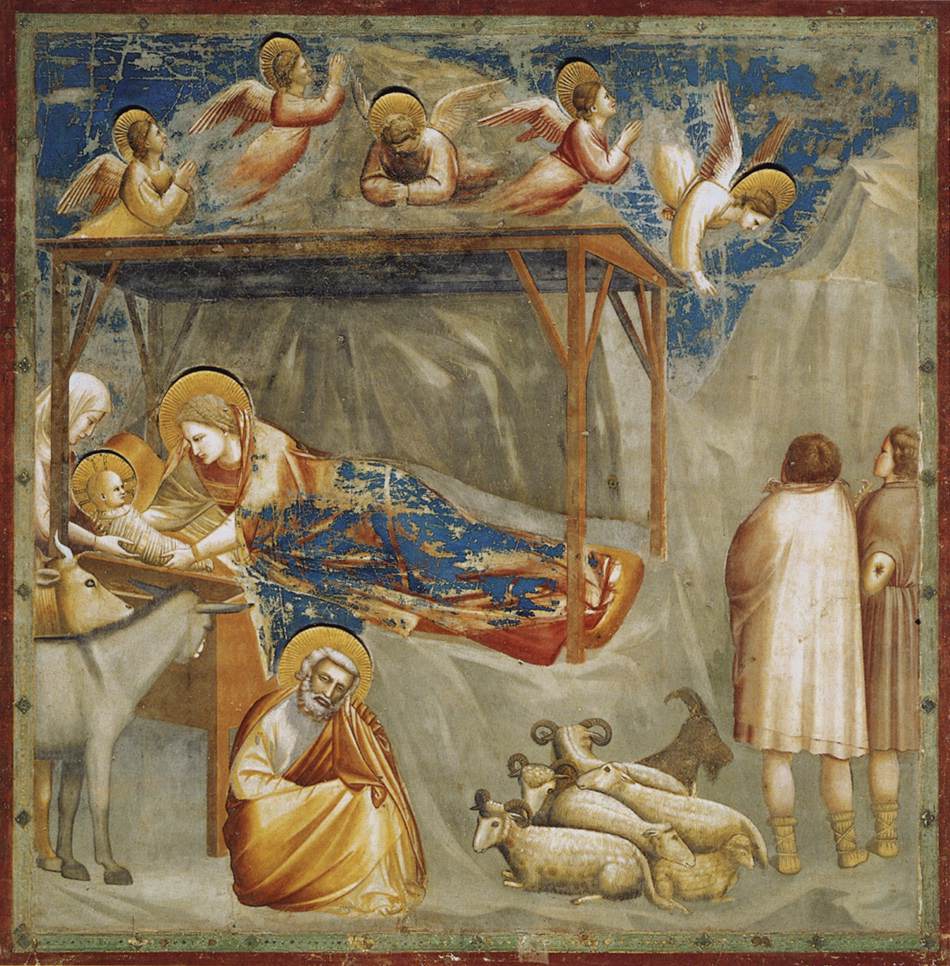
    Two frescos by Giotto, the artist whose genius and contemplation of the Christ story opened up new ways of artistic expression, pushed the boundaries of aesthetics and religious sensibility, and pushed out new trajectories in exegetical imagination.

    Again Elizabeth Jennings gives every impression of having gazed and wondered at the human experiences depicted in these paintings. And from them she has articulated the inner life and emotion of those caught up in the drama of redemption. She was a devout Catholic, and her poetry has a remarkable quality of sophisticated simplicity about the the things of faith. And she manages this while also articulating that creative frustration of the poet who is trying to expound mystery, and finds herself ultimately rendered inarticulate by that which is incomprehensible yet has to be contemplated.

    In that sense Giotto and Jennings, (there names have a fitting alliterative sound!) are artists of mystery, prophets in search of a medium adequate to their message, which is what makes their work so attractive to those who also contemplate the incomprehensible with eyes that wonder, hearts that gasp and a mind made humble by immensity.  

    In Praise of Giotto

    Giotto, lover of tenderness, you were

    The first great painter who showed man as man

    Not icon or pure spirit but entire

    For through the flesh the best compassion ran.


    You taught this, when you painted Joachim

    And Anna, Mary's parents, standing with

    Their faces close and intimate. In him

    Was gratitude, in her, surrender. Death


    You also knew was glad surrendering

    Without a dread. So God himself was laid

    Gently in his tomb, all suffering


    Wiped from his face. You understood men prayed

    And found right peace when they could speak and sing

    As Francis did for whom the birds delayed.

    Elizabeth Jennings


    Giotto | Lamentation of the Death of Christ


  • Putting Your Ipad in the Dishwasher

    John chapter 13 shows Jesus at his most dangerously embarrasing. There's something scary about someone who picks up the esablished social norms as if they were our Iphones, Ipads and laptops and puts them in the dishwasher for the full cycle, with the stated intention of purifying and re-setting them to a different set of apps and programmes. I know. That sentence is ludicrously overwritten. But ordinary reasoned exposition can't get near the smack in the face reality of what Jesus did that night.

    John the Evangelist has argued, hinted, illustrated, spelled out the truth of who Jesus is. The Word made flesh. The Light of the World the darkness cannot extinguish. The Good Shepherd, Heaven's Door, Living Water, the Resurrection and the Life, the Son of God. How many images and concepts does it take? So, by chapter 13, there's no ambiguity, no excuses for even the thickest disciple. Jesus is the great I AM.

    Jesus-washing-peters-feet-ford-madox-brownNow before the feast of the Passover, when Jesus knew that his hour had come to depart out of this world to the Father, having loved his own who were in the world, he loved them to the end. And during supper, when the devil had already put it into the heart of Judas Iscariot, Simon’s son, to betray him, Jesus, knowing that the Father had given all things into his hands, and that he had come from God and was going to God, rose from supper, laid aside his garments, and girded himself with a towel. Then he poured water into a basin, and began to wash the disciples’ feet, and to wipe them with the towel with which he was girded. (John 13.1-5

    Jesus had just put the IPads in the dishwasher. All the carefully installed apps have just been wiped. New songs have been downloaded from Itunes. New direction finding apps now point in a different direction,  Golgotha, the empty tomb, a world changed forever by the kenosis of God. The basin and the towel, the kneeling Jesus, point upwards, to the downward movements of Love and Light into a world darkened by the sin that refuses to touch the other with service and love and recognition of the human. "He did not count equality with God a thing to be clung to, but emptied himself, took on the form of a servant  and humbled himself…..(Phil 2).

    Graham Kendrick's greatest hymn has the memorable paradox, "hands that flung stars into space, to cruel nails surrendered." John's Gospel knows and tells of the nails; but before then he gives us this unsettling and disorienting story. The Son of God washes feet. The great I AM kneels before disciples. The Living Water pours Himself out. Hands that flung stars into space, dry between the toes of his disciples' feet, washing away the sweaty grime of those who follow Him as their Lord and Teacher.

  • Poetry as a Rescue Remedy: Mary Oliver’s Snow Geese

    DSC_0014SnowGeese122512_filteredMany of mary Oliver's poems make the connection between the loveliness of the world, the mystery and intrigue of birds, the rhythms of nature and of our lives, and those hard to name longings that murmur just below the surface of the routine and ordinary in our lives. She has the unusual gift of expressing deep contentment, but through the experience of surprise and unlooked for joy which tugs us away from the contented familiar to want newness. The great poets do this – they reassure and disturb, they keep us alert to our mortality and the one off opportunity that is our life; they prevent contentment becoming complacency, and teach us that delight may be the most serious thing we will ever feel. 
    Snow Geese by Mary Oliver
    Oh, to love what is lovely, and will not last!
    What a task
    to ask
    of anything, or anyone,
    yet it is ours,
    and not by the century or the year, but by the hours.
    One fall day I heard
    above me, and above the sting of the wind, a sound
    I did not know, and my look shot upward; it was
    a flock of snow geese, winging it
    faster than the ones we usually see,
    and, being the color of snow, catching the sun
    so they were, in part at least, golden. I
    held my breath
    as we do
    sometimes
    to stop time
    when something wonderful
    has touched us
    as with a match,
    which is lit, and bright,
    but does not hurt
    in the common way,
    but delightfully,
    as if delight
    were the most serious thing
    you ever felt.
    The geese
    flew on,
    I have never seen them again.
    Maybe I will, someday, somewhere.
    Maybe I won't.
    It doesn't matter.
    What matters
    is that, when I saw them,
    I saw them
    as through the veil, secretly, joyfully, clearly.
  • Remembrance Sunday: Peace and the Grammar of Justice.

    Poppy card                             Poppies and Bennachie, Photo by Ellice Milton

    On a day like this I want to hear a poem about peace. Not idealised, romantic utopias, but peace made possible in the midst of conflict, peace imagined into possibility by those whose speech and thought are peace-building, whose dispositions and actions are peaceable, whose motives and emotions are peace-making. This is such a poem:
     
    Making Peace
     
    Denise Levertov
     
    A voice from the dark called out,
    “The poets must give us
    imagination of peace, to oust the intense, familiar
    imagination of disaster. Peace, not only
    the absence of war.”

    But peace, like a poem,
    is not there ahead of itself,
    can’t be imagined before it is made,
    can’t be known except
    in the words of its making,
    grammar of justice,
    syntax of mutual aid.

    A feeling towards it,
    dimly sensing a rhythm, is all we have
    until we begin to utter its metaphors,
    learning them as we speak.

    A line of peace might appear
    if we restructured the sentence our lives are making,
    revoked its reaffirmation of profit and power,
    questioned our needs, allowed
    long pauses. . . .

    A cadence of peace might balance its weight
    on that different fulcrum; peace, a presence,
    an energy field more intense than war,
    might pulse then,
    stanza by stanza into the world,
    each act of living
    one of its words, each word
    a vibration of light—facets
    of the forming crystal.