- "And we know that in all things God works for the good of those who love him, who have been called according to his purpose."
- "Who shall separate us from the love of Christ? Shall trouble or hardship or persecution or famine or nakedness or danger or sword?"
- "No in all these things we are more than conquerors through him who loved us."
- "For I am convinced that neither death nor life, neither angels nor demons, neither the present nor the future, nor any powers, neither height nor depth, nor anything else in all creation, will be able to separate us from the love of God that is in Christ Jesus our Lord."
Category: Uncategorised
-
When a Biblical Text Is Guilty of Disturbing the Peace.
Like a number of others who I know pop into this blog, I'm waiting impatiently for the release of Beverley Gaventa's commentary on Romans, in the New Testament Library.
Having just finished three sermons on Romans 8 I've been discovering the strengths and weaknesses of some of the standard commentaries. I deliberately omitted N T Wright's new volume on chapter 8, as I wanted to have a conversation with the various exegetical friends I've made over the years – Cranfield, Dunn, Moo, Fitzmyer, Witherington, Longenecker, Kruse, Gorman, and Wright's full commentary from 20002 (in the NIB).They all have something worthwhile to say, but what I missed in a few of them was the "so what?" question. Several of them did ask "so what" with compelling urgency and theological clarity. The challenge is not to reduce the power of the text to disrupt our intellectual status quo; a text does this by deconstructing our assumptions and recreating a vision of God adequate to such texts as:No commentary can, or should, do all our work for us as we wrestle with texts that must always come at us demanding our full attention, disturbing the peace of a mind made up, and daring us to make our own very personal response and risk the truth of the text. Two important questions 1) What are we to make of texts like these? 2) What will texts like these make of us if we take them to heart, think them through, and live into the realities they express?On this occasion, on 8.28-39, I found it was mainly Wright, Dunn and Gorman who helped with the "so what" questions. But I gained from that wider conversation with those others I invited to my desk. -
A Kingdom that Cannot Be Shaken: Being Seriously Hopeful and Hopefully, Serious!
This photo was taken in Back Wynd, just a few yards from the Oxfam Book shop and the Mcbean Coffee shop. I was heading for my usual quick browse in the book shop. It had been raining, and the wetness had highlighted the different tones of the stones.
The cobbles were refurbished some years ago, but the street itself is one of the oldest in Aberdeen. Along its side for its complete length is the high stone wall that separates Back Wynd from St Nicholas' Kirkyard. For centuries folk have walked along that street, and for at least a couple of those centuries that wall has been a borderline, a clear division between the Kirk and the city at whose heart it sits.
The Kirk of St Nicholas is not used any more as a regular place of worship. This massive and dominant building now has no continuing purpose, other than as a monument, an architectural memory of a faith diminished in its social and cultural influence. But the decline of the influence and visible presence of the Church is not the only disconcerting perception. Back Wynd itself, like the heart of the City of Aberdeen, has fewer people walking through it, and has a much reduced sense of vibrancy, community, commerce and what I would call the social economy of relationships, conversations, and even that basic urban and human interchange of negotiating space on the pavements.
For a brief moment I had a surprising sense of sadness. Not so much nostalgia for what used to be; I think it was more like an anxious uncertainty in facing the question, "What now?" Not primarily, and not only "What now for the Church in our land?" More a feeling that we are living through historic changes in city, country church and world. Such feelings invest the question "What now?" with a combination of low-grade but persistent uncertainty, but also with an inner defiance of hopefulness. It may well be that what is being asked of us as Christians at this particular moment in time, this kairos moment, is renewed resilience of faith, a defiant hopefulness and a determined refusal to let the seeds of resignation take root in the soil of despair.
I happen to be spending time with that enigmatic, but emergency tract for the times, the Letter to the Hebrews. One of its texts spoke powerfully into my uncertainties, and my hoped for resilience. "Therefore, since we are receiving a kingdom that cannot be shaken, let us be thankful, and so worship God acceptably with reverence and awe, for our God is consuming fire." (Hebrews 12.28-9) My friend and mentor for many years, used to use that word 'shaken', in a particular way. If someone acted in a totally unexpected or hurtful way, or said something shocking, or powerfully challenging, he would say "I was shaken to the core."
What if God should also speak in an unexpectedly shocking and powerfully challenging way? And what if the language God uses is historical contingency, the things that happen, the changes in circumstance we can't control, the happenings around us that alter our sense of security, continuity and cultural stability. Hebrews was written to people whose faith was seriously shaken, whose inner core was being destabilised by events around them, and often against them. The preacher-pastor who wrote this long letter of encouragement and warning, aimed at hope building, faith strengthening, with the goal of instilling community resilience in the face of threatening change and felt inadequacy.
In the midst of all that is shaking, "we are receiving a kingdom that cannot be shaken…" To put it in the equally astringent words of Jesus, "I will build my church, and the gates of hell will not prevail against it." T. S. Eliot echoed these words in The Rock:
There shall always be the Church and the World
And the Heart of Man
Shivering and fluttering between them, choosing and chosen,
Valiant, ignoble, dark and full of light
Swinging between Hell Gate and Heaven Gate.
And the Gates of Hell shall not prevail.Darkness now, then
Light!
(From 'The Rock.')
The future of the church, as the Body of Christ, as the community built on the Rock of faith in Christ crucified and risen, is not in our all too human hands. A week after his death, I recall the first three volumes of Jurgen Moltmann's theological contributions. Taken together the titles, despite our legitimate questions about how he spells out his experiments in theological construction; taken together, those three titles are deeply embedded in the New Testament, and woven throughout that letter sent to the struggling-to-hang-on-in there Christians, and the great cloud of witnesses into which we ourselves, here and now, are incorporated: Theology of Hope, The Crucified God, The Church in the Power of the Holy Spirit.
These are the things that cannot be shaken, in all the changes with which we are forced to come to terms. A theology of hope in the God of hope; a trust in the crucified God, the crucified and risen One whose purpose to renew and restore was unleashed into the cosmos in resurrection power; and an openness to the call and the cost and the consequence of a life to be lived in the community of Christ, the church in the power of the Spirit.
How does all this happen? The encourager of those long ago discouraged Hebrew Christians was no sentimentalist. "Our God is a consuming fire." (12.29) Fire cleanses, purifies and energises. God is not our pal, our buddy, and certainly not our ultimate back-up position. Awe and reverence are demanded and required. And from awe and reverence, worship that is so genuinely self-forgetting, that we bow and we wonder, we praise and pray, we surrender our own agendas, and we seek the wisdom and the energy, the life and the light, to act as who we are – children of the kingdom that cannot be shaken.
We are called to be those who hear in our hearts the reverberations of the Word of God in Christ. We are called to be self-evidently those who bow before the consuming fire of God's holy love, and emerge tempered and toughened, shaped and reshaped to whatever purposes God has for each of us and for every community of this coming and becoming kingdom that cannot be shaken.
Or so it has seemed to me, as I've reflected on Back Wynd, the Kirk of St Nicholas, and that unknown but brilliant pastor who some time after the fall of Jerusalem in 70 CE, wrote 'Hebrews' to struggling Christians to rebuild their hopes, lift up their hearts, and forge in them and in us, a more resilient faith.
-
TFTD June 10-16: “O Lord, it’s hard to be humble, but I’m doing the best that I can.”
Monday
Matthew 11.28-29 “Come to me, all you who are weary and burdened, and I will give you rest. Take my yoke upon you and learn from me, for I am gentle and humble in heart, and you will find rest for your souls.”
Meek and humble does not mean weak and docile. The word ‘gentle’ is also used for the yoked ox, which displays strength harnessed to purpose. The humility of Christ is shown in his gentleness of heart and the resilience of his love. Christian humility is likewise a willingness not to be served, but to serve, and a readiness to give rather than insist on receiving. “Lord, help me to take your yoke, and learn of you.”
Tuesday
Matthew 18.3-4 Jesus said: “Truly I tell you… whoever humbles himself like this child is the greatest in the kingdom of heaven.”
To take the lowest position goes against the natural grain of the ego. We are so used to the competitive stance; we like to be given our place; and we enjoy asserting our independence. Jesus’ words were given as an answer to the question, “Who will be the greatest in the Kingdom of Heaven?” The child who trusts, says Jesus. The one who hasn’t yet been educated in cynicism. Humility is to know we have a lot to learn about God, our hearts, our neighbour, and how each one connects to the others!
Wednesday
1 Peter 5.5 “All of you, clothe yourselves with humility towards one another, because, “God opposes the proud but gives grace to the humble.”
Peter has been talking about spiritual leadership, and how we relate to other people. He is describing what it means to take responsibility for each other, by being the kind of person who is an example of God’s care. Humility is not thinking less of yourself; it is thinking of others more. God can never bless arrogance, entitlement or power-seeking – he pours his grace into hearts open to others and full of the grace of Christ.
Thursday
Philippians 2.3 “Do nothing out of selfish ambition, or vain conceit, but in humility count others better than yourselves.”
That sounds like a counsel of perfection! Surely we have a right to have a good sense of ourselves, our gifts, our value, and what we bring to the table of those around us? Yes, but Paul is talking about when that sense of personal value becomes so important we don’t notice or deliberately ignore the gifts and value of others, whether in church, where we work, or in our families. C. S. Lewis gave good advice: “Humility is not thinking less of yourself, it’s thinking of yourself less.”
Friday
Colossians 3.12 “Therefore, as God’s chosen people, holy and dearly loved, clothe yourselves with compassion, kindness, humility, gentleness and patience.”
Humility sits at the centre of the cluster of the well-dressed Christian mind and heart. When fastened together these five ways of thinking and feeling about others will transform relationships within any community. To have empathy, to act kindly, to think of the interests of the other, to show both concern and respect, and to take your time with people – that’s how the community called, sanctified and loved by God goes about its business of being and building the Body of Christ.
Saturday
James 3.13 “Who is wise and understanding among you? Let him show it by his good life, by deeds done in the humility that comes from wisdom“.
This is about lifestyle, the life as an argument and witness to our faith in Christ, who is the wisdom of God. To serve others in the love of Christ, to look to the interests of others rather than our own interests, to bear one another’s burdens in obedience to the law of Christ, to welcome one another as God in Christ has welcomed us, to love as Christ has loved us – that is the humility that comes from wisdom.
Sunday
Philippians 2.5-8 “In your relationships with one another, have the same mind-set as Christ Jesus: Who, being in very nature God, did not consider equality with God something to be used to his own advantage; rather, he made himself nothing by taking the very nature of a servant, being made in human likeness. And being found in appearance as a man, he humbled himself by becoming obedient to death—
even death on a cross!”The humility of Christ is the inspiration and pattern of Christian humility. These profound words give us the merest glimpse into the heart and mind of God in Christ. At the eternal centre of God’s loving plan of salvation is the triune love of God, revealed in the humble obedience of Christ Jesus, his death and resurrection, in the power of the Spirit. “He was rich, but for our sakes became poor, that we through his poverty might become rich…thanks be to God for his indescribable gift.”
May the mind of Christ, my Saviour,
Live in me from day to day,
By His love and power controlling
All I do and say. -
The Golden Rule vs the Social Media Meme.
"Life is too short to waste your time on people who don't respect, appreciate, and value you." This advice has been going the rounds on social media. It sounds sensible, the words of someone who has life and other people sussed out. I can see why it's an attractive sound-bite, and why it might seem like the best way to deal with the difficult and challenging people in our lives.
But, and it's quite a significant but. I can't for the life of me hear Jesus saying this to his disciples. Oh, I know. He did say if people don't listen to your message of the Kingdom of God, move on and find people who will listen. But that isn't the get out of jail free card we might think.
Jesus said "Love your neighbour as yourself." For his homework, Jesus told Peter to do the maths and work out how much 70×7 was, and be ready to forgive that many times! And in case that isn't clear enough, "Love your enemies, bless them that curse you, do good to them that hate you, and pray for those who despitefully use you, and persecute you.”
None of this was ever meant to be easy. But according to Jesus, the sign of the Kingdom of God is when we refuse to retaliate, write people off, or think taking time to work on difficult relationships is a "waste of time."
We all want to be valued, appreciated and respected. Maybe that's why Jesus also said, "Treat others the way you expect each person to treat you." Loving others is to value, appreciate and respect each person, precisely because that's how we hope to be treated by them.
-
The Good Samaritan: Compassion as Default Social Attitude.

Monday
Luke 10.25-27 “On one occasion an expert in the law stood up to test Jesus. “Teacher,” he asked, “what must I do to inherit eternal life?” “What is written in the Law?” he replied. “How do you read it?” He answered, “‘Love the Lord your God with all your heart and with all your soul and with all your strength and with all your mind’; and, ‘Love your neighbour as yourself.
So a lawyer cross-examines Jesus on the law. Jesus replies with his own questions, and the scribal expert on the law answers exactly and correctly. Before jumping ahead it’s worth weighing that answer. Love God, unequivocally and with all that you are, and love your neighbour as your very own self. That’s a big ask. But a vertical God-directed love that is wholehearted, and a horizontal love directed at those wee meet on the road that is our life – there’s the basis for a life pleasing to God!
Tuesday.
Luke 10.28-29 “You have answered correctly,” Jesus replied, “Do this, and you will live.” But he wanted to justify himself so he asked Jesus, ”And who is my neighbour?”
Trust a lawyer to insist on a clear definition of terminology! As soon as we ask “Who is my neighbour?” we are on the hunt for excuses, exclusions and evasions. Jesus will have none of it. So he tells the story we know as The Good Samaritan. One of the conditions of obedient discipleship is the refusal to reduce the demand of what God requires. Love your neighbour. No ifs and buts, no qualifiers. Just get on with it!
Wednesday
Luke 10.30 “In reply Jesus said: “A man was going down from Jerusalem to Jericho, when he was attacked by robbers. They stripped him of his clothes, beat him and went away, leaving him half dead.”
Bad things happen. None of us are immune to unexpected hardship, whether illness, loss of a job, times of low income and anxiety about how to manage, loneliness and depression. It’s a long list. “Love your neighbour as yourself” is one of those social and personal principles that can make the world safer, life less hard, and can produce in our communities a safety net of kindness and compassion for those who are struggling. In various ways life beats up people. They, in their need, each one, is our neighbour. A follower of Jesus can never ask, “And who is my neighbour?”
Thursday
Luke 10.31-32 “A priest happened to be going down the same road, and when he saw the man, he passed by on the other side. So too, a Levite, when he came to the place and saw him, passed by on the other side.”
“Passed by on the other side.” The person who doesn’t want to get involved. The ‘not my problem’ brigade. We shouldn’t assume this was only about religious scruples. The Law id full of instructions to care for the stranger, show mercy, provide refuge and practical care for those who are suffering. The motives don’t matter. The injured man matters. Levite and priest both saw the man, and walked on. Don’t miss the shock that those words had on the first hearers. If those supposedly closest to God don’t love the neighbour, then nobody else needs to bother either.
Friday
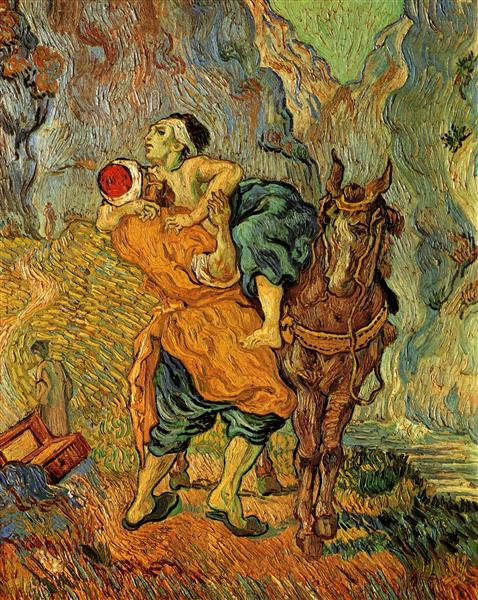
Luke 10.33-34 “But a Samaritan, as he travelled, came where the man was; and when he saw him, he took pity on him. He went to him and bandaged his wounds, pouring on oil and wine. Then he put the man on his own donkey, brought him to an inn and took care of him.”
Follow the verbs – saw him, took pity, went to him, bandaged, poured oil and wine, put him and brought him. This is compassion in action. Verbs are what obedience is about, they are doing words. Love your neighbour as yourself is about what we do!
Saturday
Luke 10.35 “The next day he took out two denarii and gave them to the innkeeper. ‘Look after him,’ he said, ‘and when I return, I will reimburse you for any extra expense you may have.’”
Loving your neighbour is about doing words, including the verb ‘to give’. This isn’t small change which will never be missed. This is signing up to someone else’s need, and honouring the promise. “Love your neighbour as yourself” is miles away from feelings of sympathy, or ‘thoughts and prayers’! In the acts and gifts of agape love, there is an open-endedness that replicates the compassion of Jesus.
Sunday
Luke 10.36-37 “Which of these three do you think was a neighbour to the man who fell into the hands of robbers?” The expert in the law replied, “The one who had mercy on him.” Jesus told him, “Go and do likewise.”
Question answered. Terminology defined. The neighbour is whoever needs our kindness, compassion, practical support. Neighbourliness is a sign of the Kingdom, no need to ask (WWJD) “What would Jesus do?” – you know perfectly well! Just do it!
-
Intercession as a Process of Kenosis, and a Lesson in Unselfishness.
Last night we met for an hour in church to pray for and with our asylum-seeking friends, and to pray for a more just, compassionate and efficient system of responding to those who arrive on our shores, often traumatised, alone and in desperate need of a safe place to recover, and rebuild their lives.
The Scottish theologian P T Forsyth wrote important words about what happens when we pray for others and with others: “Trusting the God of Christ, and transacting with him, we come into tune with men [and women]. Our egoism retires before the coming of God, and into the clearance there comes with our Father, our brother.”Intercession is a process of kenosis, a relinquishing of our own claims, and in their place a commitment to sponsoring the needs of others. Intercession is practised unselfishness in the presence of God. I and others prayed in English – a number of our Iranian friends prayed in Farsi, the one word we all recognised being 'Amen!'That single word of "May it be so", said together and responsively, welded hearts together in shared hope and human sympathy. I know that migration is a huge issue facing our world, and immigration is a complex and controversial issue facing our country. But those shared times of prayer touch deeply into who we are as a community of Christians seeking to be the presence of Christ in our City."He has shown you O man what is good, and what does the Lord require of you? To act justly, and to love mercy, and to walk humbly with your God." (Micah 6v8) For myself the question mark is the criterion for judging how I look at the world, and those I meet on the road – what does the Lord require of me? The answer informs my prayers – I pray that our Government, of whatever colour, will act justly, love mercy, and walk humbly in a world that belongs to God before any of the rest of us. -
TFTD May 27-June 2: Spirit of Truth, Counsellor and Advocate.
Monday
John 3.5-7 “Very truly I tell you, no one can enter the kingdom of God unless they are born of water and the Spirit. Flesh gives birth to flesh, but the Spirit gives birth to spirit.”
New beginnings cannot happen without radical change. Jesus is describing the new creation of the human heart, mind and will, by an inner transformation of our identity. We become God’s children because we are born again because born of God. This is John’s way of saying that to believe and trust and follow Jesus as the Son of God, is to be made a new person, born of God by the Spirit of God; or as Paul would day, “if anyone is in Christ – new creation happens!” (2 Cor. 7.17)
Tuesday
John 3.8 “The wind blows wherever it pleases. You hear its sound, but you cannot tell where it comes from or where it is going. So it is with everyone born of the Spirit.”
God can’t be pinned down to our categories. The work of the Spirit is as invisible and mysterious as the wind blowing through a forest. And when we are once touched and made new by the Spirit, we too are called to a freedom of movement that is at the call and calling of Jesus. There will always be something incomprehensible about the love and grace and mercy of God, and how the Spirit shapes our lives in ways we cannot predict or control. That’s the adventure of discipleship!
Wednesday
John 4.24 “God is Spirit, and those who worship him must worship in spirit and in truth.”
Truth lies at the very heart of John’s Gospel. The work and ministry of the Spirit of truth leads us into the truth of who Jesus is. Jesus even says “I am the Way, the Truth and the Life.” So when it comes to our worship and service to God, what is essential is “truth in the inward parts”, integrity, a complete connection between what we believe and what we do. God sees to the deep core of who we are, and we are called to live up to the truth that we are born of the Spirit, children of God.
Thursday
John 14.15-16 “If you love me, you will obey what I command. And I will ask the Father and he will give you another Counsellor to be with you forever – the Spirit of truth.”
These words were spoken to disciples dreading a future without Jesus. Two things will keep them faithful and keep them going. Love for Jesus, shown in their willingness to live into and out of Jesus’ teaching. And the gift and presence of the Holy Spirit who will make Jesus real and present with them. The words Paraclete, Counsellor, Comforter – they are all attempts to translate this ministry of coming alongside to strengthen, to guide, and yes, to make possible the very obedience that marks out every disciple of Jesus as a follower of the truth as it is in Jesus.
Friday
John14.26 “All this I have spoken while still with you. But the Counsellor, the Holy Spirit, whom the Father will send in my name, will teach you all things and will remind you of everything I have said to you.”
The Spirit is sent in the name of the Son. The triune love of God is expressed and expressly shared by the generous outgoing gift of the Holy Spirit. It is the ministry of the Holy Spirit to educate the Church in the truth of all that Jesus means as the gift of the Father’s love. It is the Spirit who guides us in our reading of Scripture, deepens our understanding of our own hearts, and sends us into the world. The Spirit of Truth opens our eyes to interpret the culture we live in, empowers us to embody and speak the truth that in Jesus is the fuller life we crave, and who is the guiding luminous light we need, who tells us the God’s honest truth that sets us free.
Saturday
John 16.12-13a “I have much more to say to you, more than you can now bear. But when the Spirit of truth comes, he will guide you into all truth.”
Just as with the disciples, there are truths we are not yet ready to hear. They couldn’t know what it would be like when Jesus was crucified, then risen, then no longer with them. But when that time comes, the Spirit who is the guiding comfort of God, will bring them to trust and peace. And we cannot know all that lies ahead of us, but we have Jesus’ promise of the Spirit who is ahead of us as the Counsellor-Comforter.
Sunday
John 20.21-22 “Peace be with you! As the Father has sent me, I am sending you. And with that he breathed on them and said, “Receive the Holy Spirit.””
The Holy Spirit is not mere gift, but gift that brings purpose, responsibility and mission. The Spirit is the breath of Jesus in the church, the source of energy and life. That energy is to be expended in becoming the living, loving community of Jesus in the world. In Jesus was life, and the life was the light of all people. That life is now flowing through the Body of Christ, energising the community of the Spirit, overflowing with the Father’s love to a God-loved world.
Breathe on me breath of God, fill me with life anew;
that I may love as Thou dost love, and do as Thou wouldst do.
-
Trinity Sunday: The Triune God of Love.
A preview ne of the TFTD entries for the coming week, because it's appropriate too on Trinity Sunday. The tapestry, titled "Perichoresis", is the first theological abstract I ever attempted (2011). See the wise counsel of George Hunsinger below!John14.26 “All this I have spoken while still with you. But the Counsellor, the Holy Spirit, whom the Father will send in my name, will teach you all things and will remind you of everything I have said to you.”The Spirit is sent in the name of the Son. The triune love of God is expressed and expressly shared by the generous outgoing gift of the Holy Spirit. It is the ministry of the Holy Spirit to educate the Church in the truth of all that Jesus means as the gift of the Father’s love.It is the Spirit who guides us in our reading of Scripture, deepens our understanding of our own hearts, and sends us into the world. The Spirit of Truth opens our eyes to interpret the culture we live in, empowers us to embody and speak the truth that in Jesus is the fuller life we crave, and who is the guiding luminous light we need, who tells us the God’s honest truth that sets us free.……"God's cognitive availability through divine revelation allows us…to predicate descriptions of God that are true as far as we can make them, while God's irreducible ineffability nonetheless renders even our best predications profoundly inadequate."George Hunsinger, 'Postliberal Theology' in Cambridge Companion to Postmodern Theology, ed. Vanhoozer, (Cambridge, 2003) p.47 -
I am the Good Shepherd: In Defence of Stained Glass
We had just driven for miles through a landscape of valleys and hills, passing flock after flock of sheep, most of them with lambs. After the cup of tea and fruit loaf in a busy Hawkshead Tea Room, a wander around St Michael and All Angels.A single panel stained glass image of the Good Shepherd, with a transparent panel each side looking across the village to the fields. A coincidence of image and the real world, of art and story, and a moment in which spirituality becomes a fusion of our own experiences, a remembered story, an artist's imagination, a biblical text, and a world in which sheep and lambs are crucial to the local economy.Oh I know, the stained glass window can be dismissed as Victorian sentimental wish it were so; and quite right, it isn't high art, though I personally think it is both naive and effective.But on a May afternoon,in a church that has stood here since 1300,and recalling my own background in farms that had cows and sheep,and that meandering car journey along single lane roads,there I was,looking at and through this window which was itself a moment of prayer –not of words, but of memories and mood,emotion and remembered experiencesof being one of those the Good Shepherd knows, and calls by name.Now all I needed was an organist to play Bach's "Sheep May Safely Graze." But not to be, so I hummed it a bit -
St Michael and All Angels, Hawkshead 1. Visitor and Host.
Today we visited St Michael's and All Angels in Hawkshead. It has been there since around 1200. It was enlarged in 1300 and again in 1500, and the building today is much as it was 500 years ago.The latch on the door is a bit tricky, but I got inside and loved the silence and peace of the place. Then the latch rattled, and rattled again, followed by a knocking on the door. I went over and opened it from the inside and in the unlit vestibule the gentlemen said "Thank you Father." Then he saw me and smiled, and went and lit a candle, which he placed next to the one I had just lit, and then to the pews to pray.There's much to say about the church interior, another longer post later. For now, it was one of those interludes that was unscheduled (we'd gone looking for the tearoom), but there's something amusingly poignant about opening a church door from the inside when someone is so audibly rattling and knocking, to get in. There's a parable there, somewhere, which I leave you to find