Category: Uncategorised

  • NY walk 2Just about at the centre, partly hidden by reeds, a parent swan and cygnet. One of the parent birds disappeared over the summer, but we're always uplifted in seeing these two making their way through the winter.

    It was W H Vanstone who nearly 50 years ago in Love's Endeavour, Love's Expense, made me think more deeply about how we become invested in that which we love and labour over, and how over time we are shaped by that in which we invest our lives.

    You could walk past this lochan any day, watch the various waterfowl, then walk on till the next time. But once you stop to look, to imagine the precarious early weeks of a cygnet, to watch it grow stronger, swim more independently, it begins to matter that it should flourish, grow and come to be just what a swan is made to be.

    It's such attentiveness to life and the individual lives around us, a cultivated caring about outcomes for people, animals and our living world, that can help us back to the place where we confer value and worth on each life as God-given gift – and invest in life and the lives around us as gifts for which we bear personal responsibility, a duty of stewardship care, if you will. Or so it seems to me 

  • When Newness Pushes Against the Status Quo.

    357906625_1346652322727178_2582360058916766799_n

    Monday, New Year’s Day

    2 Corinthians 5.17 “Therefore, if anyone is in Christ, the new creation has come: The old has gone, the new is here!”

    New beginnings are part of life. The new job, a new relationship, our new role as parent or child as life moves on. Even a new car, kitchen, or cat, changes the way we feel and live our lives. It’s harder for us to change who we are inside, though. Only God the Creator can recreate, make new, transform and change us from the heart outwards. To be in Christ and know Christ in us, is the core experience of Christian faith. Paul calls it new creation; Jesus calls it being born again. It’s what God does.

    Tuesday.

    Acts 17.19 “Then they took Paul and brought him to a meeting of the Areopagus, where they said to him, “May we know what this new teaching is that you are presenting?  You are bringing some strange ideas to our ears, and we would like to know what they mean. They said this because Paul was preaching the good news about Jesus and the resurrection.”

    Get used to it. The Gospel is good news and will sound strange to those who have no idea what you’re talking about. Jesus was God’s Son come amongst us as a man. On the cross Jesus bore and carried away the weight of the world’s sin. Jesus confronted hate with love, violence with peace, guilt with forgiveness. The resurrection was both God’s No! to sin and death, and God’s Yes! to new life in Christ. Strange ideas indeed, for a world like ours. Christ is risen! That’s the good news. Live it and speak it.

    Wednesday

    John 13.34 “A new command I give you: Love one another. As I have loved you, so you must love one another.”

    The new command isn’t new at all. What’s new is how Jesus demonstrated what it means to love one another. “As I have loved you.” The bar is raised beyond what we can manage without the grace of God, and the power of the Holy Spirit who pours the love of God into hearts made new. Jesus commands us to be like him in the way we love others – self-giving, generous, forgiving, faithful, persistent – “Having loved his own, he loved them to the very end…As I have loved you so you must love…”

    364003732_167955386303762_984606689067987593_n

    Thursday

    1 Corinthians 11.25 “This cup is the new covenant in my blood. This do as often as you drink it, in remembrance of me.”

    The new relationship between God and the believer in Jesus, reconciliation through the blood of Jesus, God’s ancient promise to put a new heart into his people – all of this proclaimed, prayed and received in faith as the gracious gift, and forever faithful promise of God. That’s what Holy Communion is, living out the love and mercy of God in a new relationship of covenanted love. Love is a doing word, doing the will of God. “Love so amazing, so divine, demands my soul, my life, my all.”

    Friday

    Matthew 13.57 “Every teacher of the law who has become a disciple in the kingdom of heaven is like the owner of a house who brings out of his storeroom new treasures as well as old.”

    Continuing Professional development. Lifelong Learning. Annual appraisals. In the world of work it’s expected that we will extend our skill set, improve our professional performance, and hold on to and learn from important experiences. Jesus is saying that discipleship is no different in its demands that we be the best disciple of the kingdom we can be. Learning what’s new, building on what we already know, growing and maturing as ‘workmen who need not be ashamed.” New Year is a good time to reset our priorities in the light of the Kingdom of God, and the call of Jesus.

    Saturday

    Mark 2.21 “No one sews a patch of unshrunk cloth on an old garment. Otherwise, the new piece will pull away from the old, making the tear worse.”

    The new life in Christ isn’t a patchwork of the old and the new. When we are clothed with Christ we put on a new garment. You can’t mix them. A Christian can’t love and hate, bear a grudge and forgive, be selfish and generous, claim to be truthful while lying, ignore suffering and show the love and compassion of God. You can’t keep your old clothes and patch them up with good intentions. To be new in Christ is to wear the uniform of Jesus’ followers – the new unshrunk cloth of a new life in Christ.

    P1010309

    Sunday

    Revelation 21.5 “He who was seated on the throne said, “I am making everything new!” Then he said, “Write this down, for these words are trustworthy and true.”

    I’m not sure we take those words seriously enough. Everything! New! God will take the whole creation and repristinate it. I know! It sounds like one of those big words a writer uses to impress the readers. But it’s the right word. It means “to restore something to its original state or condition.” God’s promise is to renew the creation that “groans, awaiting its redemption.” To reverse the ravages of sin, restore the brokenness of relationships, to dry the tears of the heartbroken, to end suffering and make possible again the joy and fulfilment of a creation dancing once more to the Creator’s music of love, life and fellowship. How? I’ve no idea! But John was told, “Write this down, for these words are trustworthy and true.”  And God knows!

  • Five Books I Don’t Regret Reading in 2023

    Several books I don't regret reading this year. I know, damned by faint praise you might think. But I guess when your age gets on a bit you start to be more selective in what you read, and you hope for worthwhile rewards of time and effort given to this or that book. I like to think that in later years there's less shame in being utilitarian, self-interested, more careful in spending time wisely, not to mention spending money on that which is bread for the soul and the intellect.

    Reading this book am I learning more? Am I being taken to other places in my human experience, or gladly spending a few days absorbed into an imaginative world of story? Is my heart being retuned by poetry or well written theology, which are sometimes not so very different from each other? 

    So here are five books from this year's shelf that I don't regret reading for one or other of the above reasons.

    Book 2I so wish I had been able to read this book when I wrote a paper in 2028, on Martha and Mary, with the title "Masterchef or Mastermind. A Reception History of Luke 10.38-42 in Art." I know Helen Bond from her time in Aberdeen, and there are few New Testament historians more thorough, incisive and alert to how the way history is written and taught, serves agendas other than truth in its treatment of, and constructions from available evidence. The chapters on Martha and Mary, on Mary Magdalene, on Mary the Mother of Jesus, and on Phoebe and Junia and the Women of the Roman Church, are simply superb, and I now read these texts more attuned to damaging historical silences, significant nuances and valuable sidelights.

    "Martha was on such familiar terms with Jesus that she reprimanded him and told him what to do!"  Apart from Amy Jill Levine, no other commentary on Luke that I read while writing my paper takes at face value the familiarity of Martha in Jesus' presence in her own home. This whole chapter is an exegetical and social-contextual eye-opener.

    Women Remembered is written by Joan Taylor and Helen Bond, and it is a highly effective collaboration between Edinburgh School of Divinity and Kings College, London.

    Book 1 2023By far the most enjoyable novel of the year was Robert Harris's Act of Oblivion. The execution of Charles I reverberated across Europe, and just over a decade later the Restoration of Charles II created in Britain a climate of fear and menace for those guilty of aiding the regicide.

    The novel follows the efforts of Richard Nayler, Secretary of the Regicide Committee, to apprehend those who had signed the death warrant of King Charles I. Two of them flee across the Atlantic, but even there their nemesis pursues them. It's a story well told, but what makes Harris such a gripping writer is detail, atmosphere, historical theatre as he recreates life in 17th Century London, and the new colonies.

    By the way, I find it odd that this year another novel, this time by S G Maclean, is telling a very similar story. Maclean is a good novelist, and having a wee gift token I've just ordered The Winter List – it will be interesting to compare two novelists, recreating the same historical context and events, and with some of the same characters woven into the texture of the story.


    Book 6I read commentaries, It takes a while, and can often feel like being on an archaeological dig where every care is taken to discover tiny clues which may be significant details in reconstructing the original context, intent and social environment that underlie the multiple layers of the text. Of the three I read this year I don't regret the time taken for the long read through Amy Erickson's commentary on Jonah, in the Illuminations series.

    The book is in two parts. After about 70 pages of the usual introductory questions, there are over 170 pages devoted to the History of Consequences. This is an approach unique to the Illuminations Series. How has this small Hebrew prophetic pamphlet been read, received and explained in sermons, art, novels, music, film and in marginalised communities? The after-effects of an influential text significantly impact on later interpretations – this is fascinating and essential knowledge if we are to understand the use and misuse of sacred text. 

    The interpretation section builds on the first Part. Two hundred pages exploring the literary artistry, historical and religious context, theological claims and puzzles of the text. Superb!  

    Women scholars are at the forefront of Jonah scholarship, and especially the reception history and history of interpretation; Erickson has carefully excavated this history of interpretation, and has used that information to examine the consequences, impact and after effects of certain interpretations. In doing so she unearths surprising, at times shocking, ways the text of Jonah has been preached, received, interpreted and how it has shaped (at times misshaped), cultural norms and theological conclusions, for good and ill. 

    Book 5Every year for many a year I read Walter Brueggemann. Do I agree with all he writes – of course not, uncle Walter himself would scoff at such an obedience of the intellect! The very titles of Brueggemann's books make me interested. Truth and Hope. Essays for a Perilous Age, has been my Advent reading these past few weeks. It has been vintage Brueggemann – provocative exegesis, clearly delineated targets for prophetic comment of judgement or mercy on the illusions, pretensions, abuses and ethical failures of a world so devoted to consumerism it is consuming itself.

    The chapters on 'Prayer as Neighbour Love', 'Justice as Love of God', and 'Prayer and Justice as Disciplines of Identity Maintenance', represent some of the best political spirituality, (or spirituality for politically perilous times) rooted in the ethical imperatives of the great Hebrew prophets, and expounded in the light of incarnation, Calvary and resurrection. These are gathered and republished essays, as most of the recent Brueggemann volumes have been. They are none the worse for that. And as a feature of Brueggemann's pastoral scholarship, the Endnotes in this and his other books, are an education in wide-ranging, interdisciplinary exploration of insights that help to drive our enthusiasm for the text. For Brueggemann, always the text. You might not always like what he does with said text, but this is a scholar and Christian who has wrestled at Jabbok and limped away towards the dawn.  

    Book 7I have always liked the honesty and forthrightness of Rory Stewart. In the leadership contest of the Conservative Party he accepted nomination as a candidate. He was never going to win. The febrile political shenanigans of a political Party in crisis because of serial serious crises of its own making, already made the leadership contest a foregone and foreboding conclusion.

    The tone and content of Stewart's account of his time as an MP, Minister and Cabinet Minister is fairly summed up in the publisher's surprisingly restrained description:

    "Tackling ministerial briefs on flood response and prison violence, engaging with conflict and poverty abroad as a foreign minister, and Brexit as a Cabinet Minister, Stewart learned first-hand how profoundly hollow and inadequate our democracy and government had become.

    Cronyism, ignorance and sheer incompetence ran rampant. Around him, individual politicians laid the foundations for the political and economic chaos of today…Stewart emerged with…a deep, direct insight into the era of populism and global conflict."

    Not only do I not regret the time reading this book; I have spent some time since revisiting it, pondering the how and why of a political machinery that can chew up good people and spit them out as if integrity, courage of conviction, valuable life experience, intelligence harnessed to moral character, were vices rather than virtues. When I ask myself which politicians should be gifted the support of those holding Christian convictions, leaving party affiliation aside, I am looking for virtues rather than vices, character rather than personality, constituency concern rather than the convenience of a safe seat, and yes, a concern for truth and integrity in public life.  

  • The Gospel of John, George Herbert and a Gift to Myself.

    Book johannineTwo of my happy research areas come together in one book; Seventeenth Century poetry and the Gospel of John, brought into conversation by an author steeped in both. If you're going to buy yourself a book for Christmas make it a good one!
     
    The influence of the Gospel of John and the First Epistle of John on the poetry, theology and spirituality of the 17th Century English Church remains mostly unexplored in detail. That is perhaps because the Fourth Gospel and 1 John have largely been eclipsed by scholarly concentration on Pauline theology as the paradigm for theological construction and as the primary lens for viewing, indeed inspiring, Christian soteriological experience.
     
    Cefalu argues for a substantial adjustment of perspective, and an important revisiting of some of the most important voices in English religious literature. The flip side of this is a rich exposition of Johannine theology as co-opted into some of the greatest devotional poetry in the English language.
    Every once in a while the right book comes along, the one you hoped someone might write. In my wee world, this is one of them
  • New Tapestry in the Making.

    Tapestry 3The new tapestry is well on its way now; this is about a fifth of the planned design. The latest phase was a festival of strand mixing, which kept me out of mischief for a few wee whiles.
     
    It's based on an imaginative reflection on a favourite hymn and favourite poem with a shred theme. As always with these reflective pieces, each day I read the poem and allow its images, rhythms and sounds to soak into my way of thinking. Likewise I read yhe hymn or listen to it on Youtube. 
     
    The work is done on my usual 22 count canvas, the finished piece will be 7×7 inches with a 1/4 inch rainbow border. As in the more recent work, the fun starts when I get to the metallic threads 🙂 – but that's a long way off yet.
     
    "This life is one,
    and in its warp and woof
    there lies a thread of gold,
    and sometimes in the pattern shows most clear,
    where there are sombre colours."
     
    I learned those lines what seems like a hundred years ago – they still help me make sense of some of our most difficult life experiences.
  • Some Christmas and Post-Christmas Pondering.

    Organ light

    Monday

    Luke 2.14 “Glory to God in the highest, and on earth peace to all in whom God delights.”

    Lord George McLeod, the minister who instigated the renovation of Iona Abbey mid-20th Century, famously called the churches to become communities that brought “Glory to God in the High St.” Christmas only brings light to the world when those who worship the Christ-child, also worship the Crucified Christ and the Risen Lord. Bethlehem, Calvary and a Garden with a tomb, which was empty; these are the places where peace on earth is made. This Christmas Day we give glory to God, and promise to proclaim, embody and work for peace and goodwill amongst all peoples.

    Tuesday

    Matthew 2.1-2 “After Jesus was born in Bethlehem in Judea, during the time of King Herod, Magi from the east came to Jerusalem, and asked, “Where is the one who has been born King of the Jews? We saw his star in the east and have come to worship him.”

    Epiphany comes in the Church year 12 days after Christmas. In Matthew, the Magi appear as the first significant event after Jesus is born. So it became part of the Christmas story. These three travellers were not Jews, they were Gentiles, a sign that Matthew’s Gospel is about the spread of the good news far beyond the boundaries of Israel. The Great Commission to go preach to all nations had its origin here.

    Wednesday

    Matthew 2.10-11.  “When they saw the star, they were overjoyed.  On coming to the house, they saw the child with his mother Mary, and they bowed down and worshiped him. Then they opened their treasures and presented him with gifts of gold, frankincense and myrrh.”

    Every nativity play has the three Magi, usually with tin foil crowns and robed in curtains! How does the wide world respond to the birth of the Messiah? Shepherds wondered, Mary pondered, Joseph did as he was told, Herod trembled – only the Magi worshipped. Post-Christmas there can be a flatness, a sense of anti-climax. At which point maybe we keep on singing, “O come let us adore him, Christ the Lord.”

    Snow 4

    Thursday

    Luke 2.19 “But Mary treasured up all these things, and pondered them in her heart.”

    These are two important words. To treasure experiences that change our lives, is to acknowledge God’s blessings and providence. To ponder them, is to take time to understand, to be grateful, to adjust in heart and mind to what God has done, and is doing, in our lives. Post-Christmas is a good time to treasure and ponder what our year has been like; a time to look for God’s fingerprints all over our story, and to “bless the hand that guided, and bless the heart that planned.”

    Friday

    Luke 2.20 “The shepherds returned, glorifying  and praising God for all the things they had heard and seen, which were just as they were told.”

    Back to work as usual. Even though they had just witnessed the most unusual sight the world could ever see. A poet later described it all like this:

    “Welcome, all wonders in one sight! Eternity shut in a span,
    Summer in winter, day in night, heaven in earth, and God in man!
    Great little One, whose all-embracing birth
    Lifts earth to Heaven, stoops Heaven to earth.”

    (Richard Crashaw, from ‘On the Nativity of Our Lord.”

    Saturday

    John 1.9 “The true light that gives light to every person, was coming into the world.”

    John 1.1-14 is John’s Christmas story, or as near as he ever comes to it. He shares the astonishment of that other poet, and “welcomes all wonders in one sight.” In a world of darkness, like ours today, Jesus is the Light of the world. The darkness of hate and mistrust, of cruelty and violence, of greed and deceit, of sin and guilt; that darkness in its totality and diversity, is defeated by the Light that shines in the darkness, and the darkness has not, cannot, overcome it. Post-Christmas, ponder that.

    IMG_3702 (3)

    Sunday

    John 1.14. “The Word became flesh and made his dwelling among us. We have seen his glory, the glory of the only begotten of the Father, full of grace and truth.”

    This is as good a description of the hidden meaning of Jesus birth as you will ever find. It took Jesus' ministry, teaching, death, resurrection and ascension for the church to begin to grasp what Paul called the mystery of the ages. “For in him all the fullness of God c hose to dwell…” Once we’ve told the Nativity story, beautiful in its humanity and ordinariness, we then tiptoe to the brink of mystery, “God was in Christ, reconciling the world to himself.” Jesus, Immanuel – God with us, full of grace and truth. Aye, post-Christmas treasure that, and ponder these things in your heart.

  • Some of the Theology from Some of the Carols We Sing

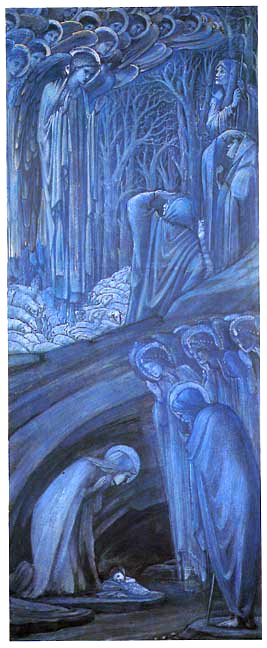
    The Nativity (Burne-Jones) - Wikipedia

    A thought for each day of Week 3 in Advent.

    Monday

    “He came down to earth from heaven, who is God and Lord of all.”

    When I was minister of Coat’s Memorial Baptist Church in Paisley, the midnight service always began with the robed choir processing by candlelight into the church, singing ‘Once in Royal David’s City”. Whether the weather was cold, wet, windy, or all three, this was pure theatre, drawing us all into the mystery and wonder that what God does is who God is. And what God does, is come to us in the human form of Jesus, to show us exactly who God is, and what God does.

    Tuesday

    O Come, bright Daybreak, come and cheer, our spirits by your advent here.”

    I regularly pray this hymn throughout Advent, or play it, and Lord have mercy, occasionally even sing it! We’ve almost lost the art of longing, that long wait in anticipation for what we hope for. Either we look to have what we want as soon as we can get it, or we distract ourselves from the awfulness of the world we live in. Try praying these words to the Light of the World, the true light that lightens every human being ever born. “Lord give us a holy longing, and cheer us with new hope.”

    Annunciation

    Wednesday

    “Born your people to deliver, born a child and yet a king; born to reign in us forever, now your gracious kingdom bring.”

    Wesley wrote ‘Come, Thou long expected Jesus’, in response to the poverty and suffering of orphans in England in the 1740s. It was a hymn that looked for better days, and deliverance from the injustices, oppressions and brokenness of the human community. As an Advent hymn it asks exactly what we pray in the Lord’s Prayer: “Thy kingdom come, Thy will be done on earth as it is in heaven.” You may never have thought about it, but in its forward look, the Lord’s Prayer is pure Advent!

    Thursday

    “Veiled in flesh the Godhead see! Hail the incarnate deity.”

    Never let the wonder drain out of well-known carols. If we know them by heart, it’s also important to know them as truth that wins and holds the heart. Wesley is recalling the words of John’s Gospel, “The Word became flesh and made himself at home amongst us.” The creative Eternal Word is articulated in a human life, is announced and pronounced in a baby’s cry. The little Lord Jesus, contrary to what we sometimes sing, much crying he makes, because God in Christ fully and for love’s sake entered into that human struggle to breathe and live!

    Friday

    “Pleased as man with man to dwell, Jesus, our Immanuel.”

    It’s Matthew who makes the lovely word Emmanuel the keynote of his Gospel. Not only God is with us, but God is for us. Throughout the four Gospels Jesus is on the side of the broken and the fearful, the children and the excluded, the sinners and anyone else who recognised life wasn’t working for them, and sensed that coming to Jesus would give them another chance. Emmanuel has come that we might have life, and life more abundant, purposeful, free and lived in the company of God with us.

    The Nativity by Sir Edward Coley Burne-Jones, Bt ARA

    Saturday

    “Silent night! Holy night! Son of God, love’s pure light.”

     Christmas tree lights, Advent wreath candles, illuminated nativity scenes – light is Christmas made visible. Just as the glory shone around the angels and the shepherds, and the star led the Magi, so in Advent we are called to hear again the angel song of peace on earth and goodwill to all people. Because the light is the light of love. “Lord the light of your love is shining, in the midst of the darkness shining,. Make time for glad silence before the mystery of love’s pure light, Jesus the Light of the world.

    Sunday – Christmas Eve

    “How silently, how silently the wondrous gift is given!

    How silently. Silence again, but this time broken by the cry of the Christ child, against the background chorus of angels, interrupted by the stumbling steps of shepherds, and, accompanied by the exhausted breathing of Mary. This Christmas Eve, we open our hearts, our minds, and the private spaces of our lives, to the coming of God in Jesus, who is “Pleased as man with man to dwell, Jesus our Immanuel.” In Jesus “God imparts to human hearts the blessings of his heaven.” Fifty years later Paul would write, “Thanks be to God for his indescribable gift!” Amen to that.

    ……………..

    Prayer for the Week

    O Holy Child of Bethlehem, descend to us we pray;

    Cast out our sin and enter in, be born in us today.

    We hear the Christmas angels the great glad tidings tell;

    O come to us, abide with us, our Lord Emmanuel.

  • Advent and Hymnology: Come, Thou long-expected Jesus.

    1. Come, thou long expected Jesus,
    born to set thy people free;
    from our fears and sins release us,
    let us find our rest in thee.
    Israel's strength and consolation,
    hope of all the earth thou art;
    dear desire of every nation,
    joy of every longing heart.

    2. Born thy people to deliver,
    born a child and yet a King,
    born to reign in us forever,
    now thy gracious kingdom bring.
    By thine own eternal spirit
    rule in all our hearts alone;
    by thine all sufficient merit,
    raise us to thy glorious throne.


    Findochty 1This simple hymn reads and feels like an Advent Maranatha. It is sometimes sung as two 8 line stanzas, as printed above. The second stanza is possibly based on a prayer current at the time, around 1744 when the hymn was published. The whole hymn is a cry of the heart in the face of a world restless, joyless and afraid. The suggestion that it was written in response to the plight of the poor, and especially of orphans, is part of a broader argument about hymns and social issues – see especially Class and idol in the English Hymn, Lionel Adey.

    The first line, "Come, Thou long-expected Jesus" is a prayer rooted in explanations of who Jesus is, culminating in the final line, 'Joy of every longing heart'. Long-expected and longing, two words linked by assonance, and a bracket holding prayer and promise together – one of Wesley's characteristic word-plays.

    The three lines that begin with 'Born' are laden with divine intention behind that recurring paradox in Wesley's hymns, "Born a child, and yet a King." And they find their fulfilment and resolution in the first word of the line that follows them, Now! Immediacy of experience is one of the Wesleyan emphases in spirituality – truth is felt as well as telt!

    The carol finishes with a prayer of transferred sovereignty as the true Ruler of human hearts brings to fulfilment human longings for freedom, joy and assurance of God's love under the rule of Christ in the Kingdom of God. Though having said that, the word 'love' doesn't occur in this carol – however, it is implicit as the energising motive behind the Incarnation.

    WolvesA cover of this hymn appears in the album Midnight Clear by Christian metal band Wolves at the Gate. You can listen to it on the link below. But promise to listen to the end – how's that for click bait?? As music this is a solar system beyond my comfort zones, but I do sense the power of the words sung against a background of what sounds like rage at full volume. Advent words sung in defiance of background Thrash music, come through with powerful, forceful longing.

    If I'm half-way right, then the words of the 18th Century Oxford Classics scholar Charles Wesley, are set in a musical context so incongruous as to revive their accessibility for 21st Century sensibilities which, in the end, have the same concerns of fear, despair and longing for a world more just, compassionate and free from the fears of human indifference to suffering.

    "Come, Thou long expected Jesus…Hope of all the earth Thou art." Amen

    The link to the Wolves at the Gate version is here 

  • Advent Candles, a Rose Window, and God’s Wide Embrace of the World.

    403404027_672829548253293_1031782573696326912_nOn Sunday morning I took yet another photograph of the rose window and its surrounding text. The service included the lighting of two Advent candles, one of them by one of our many Iranian friends, tall, strong and the only thing bigger than his beard is his smile! The other by a young man whose neurodiversity so enriches the life of our church community, and whose ways of being amongst us is blessing that flows both ways. These two men together, standing across from each other, so different in life experience, tending to the lighting of our Advent candles to lighten the darknesses we all encounter and sometimes have to walk through.
     
    There were around 40 asylum seekers, mostly Iranian, some of them in their limited English either singing or body moving to the Calypso carol, and O Come all you faithful. Our preacher was Josephine, a Methodist minister from the Philippines, sharing from the texts about Mary, and reminding us Jesus the baby grew up into Jesus the Lord who calls for more than Christmas adoration, but also Calvary discipleship.
     
    Thinking about all this, my eyes drawn again to the Johannine text of hope, grace and truth: "In Him was life, and the life was the light of men." I know. The text uses gender specific language. But John meant 'all people', and indeed, because of his sense of the cosmic reach of the light and life of Christ, he meant also 'all peoples'. This is a world embracing text.
     
    That's what I felt on Sunday. So many folk for whom life has been shadow and struggle, at times hope pushing back despair, long journeys and longing for a home, and all this gathered together to worship the Life who is the Light. And that rose window, whatever the light, the varied colours gather together in focus, surrounded by the text, and below it, the Cross, around which we stand 'in humble love, and fervent praise.'
  • Advent Week 2 – Waiting for God and Waiting on God are Often the Same but Sometimes Different.

    Notre dame cruciform 2

    Monday

    Psalm 27.14: “Wait for the Lord; be strong, and take heart and wait for the Lord.”

    This advice comes at the end of the Psalm. It starts with “The Lord is my light and my salvation – whom shall I fear?” And in the middle the Psalm talks about “in the day of trouble.” We all have such days, sometimes even longer spells, of trouble. Advent is about looking into the troubles that trouble us, and waiting for the Lord who is our Light. That doesn’t make troubles disappear; it is trust that right in the middle of the biggest mess, God is with us. Whom then shall I fear?

    Tuesday

    Isaiah 40.31: “But those who wait on the Lord will renew their strength. They will soar on wings like eagles, they will run and not grow weary, they will walk and not faint.

    Both despair and hope can be exhausting. The longer we hope for something, without any sign it will happen, the harder it is to go on hoping. The word ‘wait’ can also mean hope, and the two go together when we pray. We wait in hope before God. Advent is a period of waiting hopefully, and of hoping patiently, and doing so in the strength of the Lord. Our troubled and tragic world waits for peace, justice, signs of mercy. Advent Christians wait with renewed strength before God, praying “Your Kingdom come. Your will be done on earth as it is in heaven.”

    Wednesday

    Isaiah 30.18: “Yet the Lord longs to be gracious to you; he rises to show you compassion. For the Lord is a God of justice. Blessed are all who wait for him.”

    Prayer is when we bring our longings and desires to God; it’s also when we come before a God who longs to be gracious to us. This God of compassion and justice, looks on a broken Creation, the greed and cruelty, the power games and the reckless waste of our God-given world, and does so with compassion and justice. Advent is a time to remember, to wait, reflect and ponder the truth of who God is. Immanuel, God with us. God was in Christ reconciling the world to himself. Think about that!

    DSC07445

    Thursday

    Psalm 130.6: “My soul waits for the Lord more than watchmen wait for the morning, more than watchmen wait for the morning.”

    That kind of waiting that has us obsessively looking at our watch, willing time to pass. But also that kind of waiting that has the heart beating in anticipation, because what is promised will happen as surely as darkness flees at the coming of dawn. That repeated line is not a misprint – it’s a poetic emphasis on the faith and trust of the heart and mind that waits, stayed on God, whose promised presence is as sure as the dawn. Advent is all about such waiting in expectant anticipation of God’s coming.

    Friday

    Isaiah 64.4: “Since ancient times no one has heard, no ear has perceived, no eye has seen any God like you, who acts on behalf of those who wait for him.”

    That’s an extravagant claim, and one that Isaiah repeatedly makes. The Lord God is unlike any other God, in this one thing that His people experience again and again from ancient times – God’s acts on behalf of those who wait on him in trustful hope and obedient faith. From the very beginning, from birth in nondescript Bethlehem, to Calvary and resurrection, there is no God like the God we meet in Jesus Christ. An Advent Church waits in wonder at the earth-shattering truth of the Word made flesh and living amongst us, full of grace and truth.

    Saturday

    Psalm 37.7: “Be still before the Lord and wait patiently for him; do not fret when men succeed in their ways, when they carry out their wicked schemes.”

    It’s always been a troubling question: Why do good people so often struggle and get a hard time, while ruthless folk with no principles seem to prosper and grab all the good things in life. But goodness isn’t indexed to prosperity, and obedience to God is its own reward. Not everything in life turns out as we hope. We await justice for the poor, freedom for the oppressed, and God’s righteousness to enables our shared life to flourish without fear. Advent is the time we train ourselves in patient hope, and in persistent prayer against the wicked schemes that threaten our planet, devastate human lives, and undermine God’s purpose of Shalom. Thy Kingdom come!

    IMG_1887

    Sunday

    Psalm 33.20-22 “We wait in hope for the Lord, he is our help and our shield. In him our hearts rejoice, for we trust in his holy name. May your unfailing love rest upon us, O Lord, even as we put our hope in you.”

    These verses are pure Advent! You can use them every day as an Advent prayer and you would be immersing yourself in the great Advent themes of hope, joy, trust and the waiting of those who ‘trust in his holy name.’ And that last sentence, as a final one liner prayer before surrendering to sleep, you could put it into the mouths of any of the key players in God’s Advent plan – Mary and Joseph, Elizabeth and Zechariah. To wait before God is to hope and to trust His holy name; to wait is to have our strength renewed, to soar like eagles, to run without ever being exhausted. “May your unfailing love rest upon us, O Lord, even as we put our hope in you.”

    (First image was taken by a fire fighter in Notre Dame Cathedral.)

    Second image Findochty looking across the Moray Firth, and the third from Cullen beach on a late October afternoon just after it stopped raining.