Monday
“Say to Daughter Zion, ‘See, your king comes to you, gentle and riding on a donkey, and on a colt, the foal of a donkey.’”
Palm Sunday is full of echoes from Old Testament prophets. Every event of Holy Week is embedded in the promises and purposes of God. It may seem as the week goes on that those events run out of control, and the religious authorities and Roman power have a master plan to work together to crush and finally silence Jesus. But Isaiah had already pointed beyond human scheming to divine wisdom: “For my thoughts are not your thoughts, neither are your ways my ways…my word will not return to me empty.” The anointing, the upper room supper, Gethsemane, a friend’s betrayal, the show trial, public crucifixion, secret burial, – the whole sorry story of human scheming and political expediency gets the last word. But in all the machinations of human choices, God’s majesty is being revealed, unfolding before their eyes and ours.
Tuesday
Ride on, ride on in majesty; hark, all the tribes Hosanna cry.
Thine humble beast pursues his road with palms and scattered garments strowed.
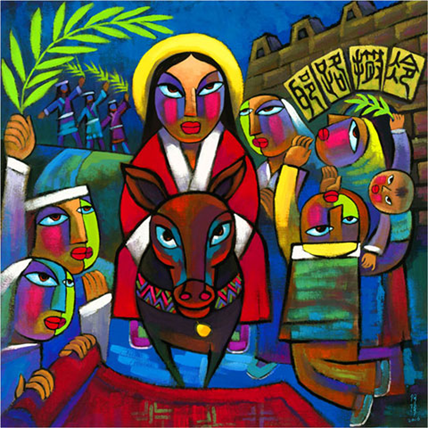
Many hymn books edit out the humble beast and write “O Saviour meek, pursue thy road.” But the donkey is essential. This is the Messiah coming gently, not to conquer but to redeem. The crowds see Jesus as the conquering deliverer and liberator the Romans feared. But God’s ways are not their ways, or ours. Jesus rides in majesty, but it is meekness and majesty, a public show of strength under constraint of love for all to see. In a world ruled by power and domination, this King comes with redemptive purpose, in obedience to the Father, as the Prince of Peace. The Hosannas of the crowd will soon take on the language of the Empire, “Crucify him!” And the Empire will, as it always does, crush and silence opposition. But only till Sunday morning, when the Son will rise!
Wednesday
Ride on, ride on in majesty; in lowly pomp ride on to die.
O Christ, thy triumphs now begin o’er captive death and conquered sin.
I’m convinced Paul knew the scandalous splendour of this story. “For the foolishness of God is wiser than man’s wisdom, and the weakness of God is stronger than man’s strength.” The triumphal entry is theological theatre, the enacted drama of God’s redemptive purpose. The lowly pomp of a Messiah hailed by Hosanna-yelling crowds, and riding a donkey, carried a message that went right over the heads of the powerful and wise. The triumph is hidden but will become obvious. Jesus was captured and conquered and crucified. But in Jesus’ death, death itself is captured and sin is more than conquered. The foolishness of the cross is the wisdom of God, its weakness God’s strength, and on Easter Sunday morning, to the surprise of the whole creation, the tomb will be as empty as the cross!
Thursday
Ride on, ride on in majesty; the winged squadrons of the sky
look down with sad and wondering eyes to see the approaching sacrifice.
Every verse of this hymn is ironic. The repeated ‘Ride on, ride on in majesty’ emphasises the determined, purposeful journey of Jesus towards Gethsemane, Pilate and Golgotha. Even the angels are helpless to intervene. For this is the wisdom of God. The deep and eternal mystery of God’s redemptive purposes for sinful humanity is hidden even from the angels. God is restoring a broken creation and quelling the disruptive powers of evil busy undoing God’s initial judgment on Creation that “it was very good.” Holy Week from start to finish is the condensation into time of an eternal plan unfolding in human history. We could well be amongst the crowd wishing for a Messiah of triumphant power. Or be looking on with the angels, knowing the story, dreading with them, ‘the approaching sacrifice.’
Friday
Ride on, ride on in majesty; the last and fiercest strife is nigh.
Thy Father on the sapphire throne, expects thee, loved, anointed Son.
It is easy to sink into sad despair by having to revisit, accompany, and think through the Passion story yet again. We know about the fiercest strife, gratuitous cruelty, and the normalised institutional violence of powerful forces and people who think they are doing God’s work in crucifying the Lord of Glory. But the hymn opens a forward and upward looking window. The Father awaits the homecoming of the Son. John’s Gospel repeatedly talks of Jesus being glorified by being ‘lifted up’ on the Cross, the same Cross that culminates in the final movements towards death and resurrection. The return of the Son to the Father is here imagined as the prepared welcome and enthronement of the Son at the right hand of the Father.
Saturday
Ride on, ride on in majesty; in lowly pomp ride on to die.
Bow thy meek head to mortal pain; then take, O God, thy power and reign.
The Triumphant entry to Jerusalem now gives way to the anticipated triumphal entry of Jesus to heaven. There is no avoiding the mortal pain, though. ‘He who knew no sin was made to be sin.’ ‘He became obedient to death, even death on a cross.’ ‘My God, my God, why have you forsaken me?’ That question mark is there for every human heart that has ever asked in bewildered pain, “Why?” The day after the crucifixion Jesus was in the grave. Dead. Buried. But not finished. Just as our hymn anticipates the real ending, we too become impatient to sing of the triumph of the Crucified: “Death is dead, love has won, Christ has conquered.” ‘Then take, O God, thy power and reign.’ That last line of our hymn hints at the resurrection and ascension of Jesus, the theological pivot-point of the Gospel story of Christ’s victory.
Sunday
Lo! Jesus meets us, risen from the tomb.
Lovingly He greets us, scatters fear and gloom;
let His church with gladness hymns of triumph sing,
for her Lord now liveth; death hath lost its sting. [Refrain]
Thine be the glory, risen, conqu’ring Son;
endless is the vict’ry Thou o’er death hast won.
‘Thine be the glory’ seems like the ideal hymn to sing after ‘Ride on, ride on in majesty.’ Why? Because the Palm Sunday hymn anticipates the resurrection as the final, definitive, revolution of human thought about the cross as mere instrument of capital punishment. On Golgotha, ‘place to lose all hope of living’, Jesus bowed his head and said, “It is finished!” From that moment the fiercest strife was ended, the power of death was broken, sin was borne in the judgment and mercy of God, and the Light of the World would blaze out of an empty tomb scattering fear and gloom. That line, “Lo! Jesus meets us, risen from the tomb”, makes all of this personal, real, and for the here and now of our lives. “No more we doubt Thee, glorious Prince of Life.” May our hearts vibrate with hope, and our lives be daily renewed by the presence of the risen Lord.
Images.
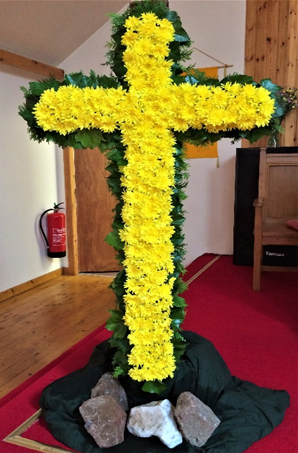
- Easter Cross, display by Isobel Sinclair, Montrose Baptist.
- Palm Sunday, Chinese artist, He Qi.
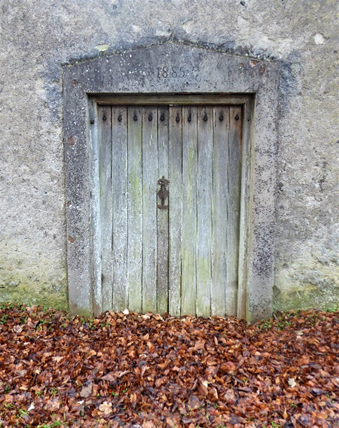
- Door of Walled Garden, Echt Estate.
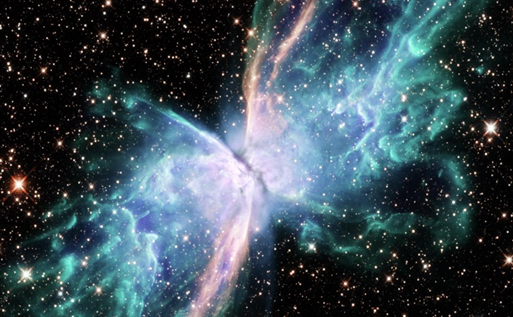
- Two Planetary Nebulae, Hubble Image.
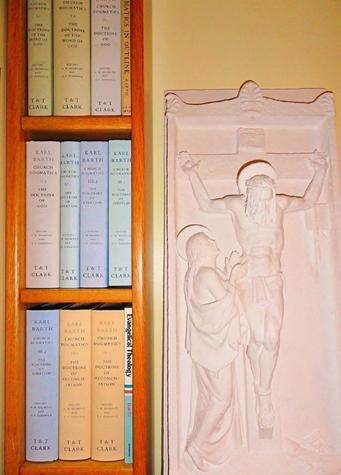
- Studio model of Christ and Mary, by Sandy Stoddart.
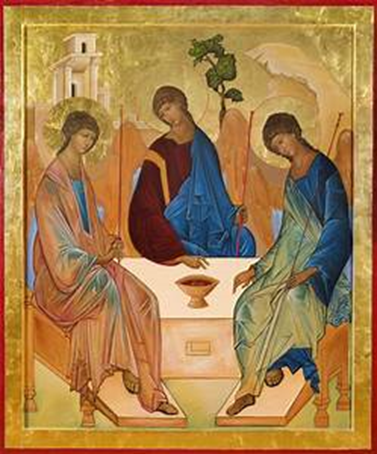
- The Trinity, icon by Andrei Rublev, Russian, 15th century.
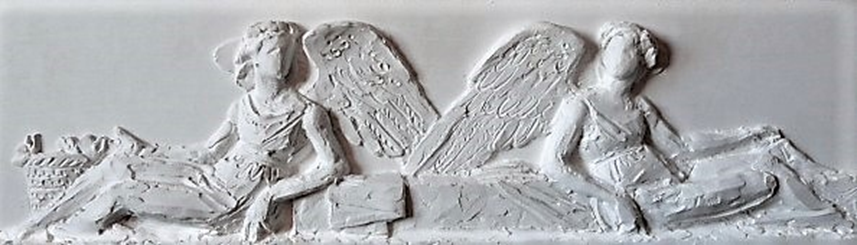
- Studio model of Resurrection Angels, by Sandy Stoddart.
Leave a Reply