Blog

  • SPAM = Sin Pervades All Media. Or Stupid, Pointless, Absolutely Mindless

    Howdy, i read your blog from time to time and i own a similar one and i
    was just wondering if you get a lot of spam feedback? If so how do you
    stop it, any plugin or anything you can recommend? I get so much lately
    it's driving me mad so any help is very much appreciated.


    This comment came in last week and my experience of spam on this blog is exactly the same. Can anyone offer an explanation, and even better a solution? I am marking more comments as spam as the weeks pass. And yes it is an intrusion, annoying and a bit concerning that there is such easy access to self advertising – some are also offensive and almost require surgical gloves to hit the delete button!

    My own partial solution is to moderate all comments and post only the ones that are clearly interacting with the content of the blog, or which come from recognised sources.If it continues to increase it becomes a time consuming problem as well as an unasked for intrusion, and an abuse of social hospitality.

    The title of the post gives two alternatives for the Acronym SPAM. If you can think of others, make sure they are printable, I'm happy to make a collection!!!


  • Wendell Berry and the agriculture of human love and hopefulness…

    Berry

    I first read Wendell Berry in 1993 sitting under trees in Lyme, New Hampshire, while visiting our friends Bob and Becky. I bought a couple of his books in the Hanover Book Store, one of the best stocked booksellers I've ever had the joy of wasting a day in. Just down the road were the old Stables and the clapboard Church as quintessentially New England as you get. The novels were about farming people in rural Kentucky, and as yet I hadn't discovered his poetry. But it was plain Berry understood the the land and the weather, the rhythms of growth as sun, rain, soil and human toil coincide in agricultural fruitfulness. And he understood just as deeply the agriculture of human love and hopefulness, friendship and attentiveness, the routines and the tedium necessary to allow growth to happen, and the way we each become who we are by the relationships that nourish and prune us, and draw us to live with the best we are towards that same fruitfulness. The first seventeen years of my life were lived on farms in Ayrshire and rural Lanarkshire, with their daily rhythm of milking cows and cleaning and feeding them; ploughing, sowing and then leaving alone till the season for harvest; walking across fields, climbing fences and drystane dykes, in and out of woods, across burns and up the glens – all to our hearts' content. My dad called it stravaigin – which means to wander freely, – it's also a Restaurant in Glasgow!


    DSC01484 (1)So Wendell Berry's writing immediately sent strong signals, wakening memories of hard work, farmyard smells, small communities where the unasked and assumed helpfulness of independent minded neighbours created ties amongst those humble enough to offer and receive the small gifts and courtesies of a hard life shared, and where possible, eased. My love for the open air and my own sense of belonging were woven by those years into what remains a sense of freedom, an accumulated knowledge base about our countryside, and a capacity to be stopped in my tracks by any number of intimations that I am not alone. A yellow hammer's song, (photo) the sound of a breeze playing conifers like the stringed section of an orchestra, the reduction of apparent anarchy to chevron discipline as migrating geese take off from Loch Skene and fly overhead towards the coast, the unobtrusive beauty of a dog rose evolving later into the rust red roundness of ripe rosehips – "the whole earth is full of Thy glory'.

    Here is the kind of poem I wish I could write – it's written by one who understands trees, his own heart, and therefore helps me likewise, to understand, to stand under, and wonder. 

    I Go Among the Trees

    I go among trees and sit still.

    All my stirring becomes quiet


    around me like circles on water.


    My tasks lie in their places


    where I left them, asleep like cattle.


    Then what is afraid of me comes


    and lives a while in my sight.


    What it fears in me leaves me,


    and the fear of me leaves it.


    It sings, and I hear its song.


    Then what I am afraid of comes.


    I live for a while in its sight.


    What I fear in it leaves it,


    and the fear of it leaves me.


    It sings, and I hear its song.


    After days of labor,


    mute in my consternations,


    I hear my song at last,


    and I sing it. As we sing,


    the day turns, the trees move.

  • Janet Soskice on Unrealistic Spirituality

    Picture of Janet Soskice

    Janet Soskice is a philosophical theologian who gets to the point quickly, and has a healthy down to earth approach to heavenly discourse about spirituality, and devotional life, and has little patience with those who recommend contemplative reflection as a higher form of spiritual activity. She can even make theological reflection on overdone spirituality funny Here's a paragraph from  an essay on "Love and Attention", from her book The Kindness of God.

    "There are many examples of theologians and poets who have praised the daily round and trivial task. But for the most part such things as attending to a squalling baby are seen as honourable duties, consonant with God's purposes, rather than spiritually edifying in themselves. Most Christian women, for instance, think that what they do around the home is worthy in God's service – they do not think, they have not been taught to think, of it as spiritual. And here monastic figures who, apparently found Go0d over the washing up or sweeping the floor will be called to mind,; but these are not really the point, since servile tasks were recommended because they left the mind free to contemplate. What we want is a monk who finds God while cooking a meal with one child clamouring for a drink, another who needs a bottom wiped, and a baby throwing up over his shoulder." (22-3)

    You can read more about Professor Soskice in a Guardian article here.

    And by the way her book Sisters of Sinai is education as entertainment as she traces the story of two Scottish women self taught in several Semitic languages, who made fabulous finds of Gospel manuscripts at St Catherine's Monastery in Sinai.

  • In Praise of Wendell Berry

    DSC00393

    I love the simple depth of Wendell Berry's writing. His essays are an education in humane writing and words woven into patterns of reasoned argument, passionate persuasion and intellectually powered ethics. His poetry is earthed in the earth – which isn't the tautology it seems, because he is a man of the soil who understands the rhythms of growth and life, fruitfulness and dying. The combination of patient observation and words shaped to what is seen and felt give his best poems that subtle urgency that compels recognition that life is blessing, and to be cherished as such. I share his passion for trees.

    Woods

    I part the out thrusting branches

    and come in beneath

    the blessed and the blessing trees.

    Though I am silent

    there is singing around me.

    Though I am dark

    there is vision around me

    Though I am heavy

    there is flight around me.

  • “The Music of the Gates of the Morning…” – Praying and the Psalms

    Commentaries on the Psalms are yet another sub genre of spiritual reading I find all but irresistible. Some of the greatest works of scholarship and spirituality ever produced within the Christian tradition are founded on the Psalter. The history of Christian interpretation of the Psalms is a fascinating dive into the theology, spirituality, liturgy and cultural adaptability of these biblical texts as they have been appropriated by previous generations seeking the face of God.


    EatonNote I said Christian interpretation of the Psalms, not interpretation of Christian Psalms. The Psalms are the Praise Book of Israel, the core text of the Writings in the Hebrew Bible, and a thickly textured symphony of human responses of faith and questioning, of trust and desolation, of joy and lament, of peace and despair, of recovered hope and crushing loss. There are prayers and conversations, complaints and eulogies, monologues and dialogues, and the Psalmists reveal a remarkable confessional integrity of soul, hearts learning to risk transparency before the Holy One, if only because they know that they are already and inevitably deeply, intimately, knowingly, understood by the Lord. The Psalms presuppose that every experience of our lives, between gift and blessing on the one hand, and sin and suffering on the other, can nevertheless be drawn together into poems and prayers of trust, and then further drawn into the orbit of mercy and judgement, compassion and forgiveness, repentance and restoration which is the gravitational pull of the Divine Mercy.

    One of my favourite commentaries on Psalms is by John Eaton a lifelong student of these Songs of Israel. His volume has the unusual merit of being a work of accessible scholarship, by a believing critic, and which incliudes after each psalm, a brief prayer written to distil thought. Psalm 66 ends with this prayer:

    O God, whose work of creation embraces all that exists, grant us to know what it is to be brought near to dwell in your courts; cleanse and replenish our souls, that our prayer for the earth may be a song in tune with the trust of the distant seas and the music of the gates of morning and evening.

    Not a bad prayer to begin the day, after reading a Psalm which asks for a renewed ecology of a human heart forgiven, and of an uncherished earth renewed by praise.                                                                                                                                   

  • The Vast Ocean Begins Just Outside Our Church

    DSC01222

    The Vast Ocean Begins Just Outside Our Church: The Eucharist

    Mary Oliver


    Something has happened

    To the bread

    And the wine.

    They have been blessed.

    What now?

    The body leans forward

    To receive the gift

    From the priest’s hand,

    Then the chalice.

    They are something else now

    From what they were

    Before this began.

    I want

    To see Jesus,

    Maybe in the clouds

    Or on the shore,

    Just walking,

    Beautiful man

    And clearly

    Someone else

    Besides.

    On the hard days

    I ask myself

    If I ever will.

    Also there are times

    My body whispers to me

                                                          That I have.

    Commenting on her poem Oliver wrote words of wisdom for theologians.

    "Centuries ago theologians claimed they had parsed with precision how God acted on the bread and wine during the celebration of the Eucharist.

    This wasn't helpful.

    Their lust for certitude bruised a mystery which was best left alone. It eventually birthed theological wars about the nature of a meal that was ironically intended to mend, not tear apart.

    I don't need to know what happens to the bread and wine to experience the oceanic love of God that I feel when I receive it, anymore than a newborn needs to know the mother's name and address to see and feel the adoration in her gaze."

    To which I wish all God's people might say, "Amen".


  • The Victorian Church, Owen Chadwick. With Thanks for Writing Readable Church History


    41v7IB4USJL._The historian Owen Chadwick is one of those scholars who give church history a good name. I'm currently reading the two volume The Victorian Church, which I have as two breize block hardbacks. I've dipped in and consulted them often enough, but never till now read through the thousand or so pages. Unsurprisingly Chadwick writes with authority and the required skill of instinct for the significant in constructing an account of an age transformed by revolutions in thought, heightened religious sensitivities in tension with growing secular and dissenting voices, constantly moving political alignments, and the expansion of British power and influence by means of Empire.

    But add to that narrative verve, ironic but always gentle humour, the skill of a master craftsman in words to draw pen portraits of the dramatis personaeof Victorian culture which match the equally miraculous accuracy of those near photographic miniatures of the 17th and 18th centuries. Chadwick makes history a pleasure to read  through; he makes ideas matter; and he brings personality and character alive so that you make up your own mind whether you agree or disagree, like or dislike, the key players. 

    I found his account of John Henry Newman satisfyingly honest, respectful and non-hagiographic. The narrative of the Oxford Movement is one I wish I'd come across when I was studying this High Anglican movement for a return to Catholic liturgy and ritual as a rather inexperienced young Baptist wondering what all the fuss was about because in my then less than humble opinion, both sides were wrong!!

    When I've finished both volumes I'll extract two or three of the best pen portraits and succinct one liners. ! 

  • Theology as an Act of Hospitality A New Theological Project

    It was 1973 when I first read Kenneth Cragg's The Call of the Minaret, while writing an essay on the Christian and Islamic conception of God. To say it was mind opening is understatement. Reading it represented a loss of innocence for a young Scottish Baptist evengelical, ignorant of the sophisticated theology and cultural depth of Islam, and guilty of narrow-minded caricature. For two years I had been reading Moral Philosophy at Glasgow University, and was now in a second year reading Principles of Religion, a cutting edge course early in that decade of the 70's when growing cultural diversity in Glasgow was forcing the recognition that Christianity was no longer the only game in town. It was during that course that I first encountered the notion of inter-faith dialogue. And by being compelled to write an essay comparing two historic, related but highly differentiated monotheistic faiths, I found myself engaged in my own head experiencing a radical makeover of ideas, and persuaded in my soul where convictions strike deep roots, of the significance of dialogue in Christian relations with people of other faiths.


    ChildrenI discovered that dialogue need not be compromise, concession, or tame conversation in search of the lowest common denominator. Rather dialogue is conversation in which listening is as important as speaking, it concerns beliefs held with integrity and deep conviction, it requires respect, humility, and willingness to learn as well as teach; it is founded on the assumption of friendship and shared commitment in the search for truth, and as its beating heart, it recognises without demur the Other's right to hold to and practice their faith with the same freedom as I enjoy, and with an agreed covenant of faithfulness in our witness to, and practice of, our own faith.

    There have been many significant formative moments in my life as a minister and theologian. There's little point in grading them in degrees of significance; indeed the importance we attribute to events, circumstances, encounters, experiences, thoughts, memories, conversations, books, are likely to depend on which stage of the journey we look back from. But I do know, that from the time I wrote that essay and read Cragg's great book, I moved from Christian mission as declaratory theological monologue to Christian witness as Holy Spirit enabled hospitable dialogue. If I haven't always lived up to that key principle of Christian witness in a pluralist world, then that is my own failure to live out of what remains a central Christian conviction: namely, bearing witness to Jesus requires us to relinquish the places of theological, intellectual and cultural power, and to sit down next to those who share our world and our lives. In that disposition of recognition and accompaniment as a faithful follower of Jesus, I am free to bear witness in a conversation which is a sharing and searching for the truth that sets free. And to do so as one who seeks to live under the rule of Christ, in the power of the Spirit, and in the love of God.


    868534_w185All of which brings me to a book I've been asked to review for the Regent's Reviews online Journal. Christ and Reconciliation. A Constructive Christian Theology for the Pluralistic World, Veli-Matti Karkkainen (Grand Rapids: Eerdmans, 2013). This is one of the most promising theological projects to come along for some time. It is one desperately needed by a Western-Northern Post Most Things Christianity in danger of recycling its own in-house theological discourse and history, talking its own talk to an increasingly disinterested culture, and in a linguistic currency increasingly distorted and devalued by the absence of defining voices from other cultures and contexts of globalChristianity.

    Karkkainen has for years been writing theology from global and contextual perspectives. He is unafraid of the clumsy, even ugly term "glocal", because it's very awkwardness highlights the need to recognise the complex interaction of local and global perspectives which now impimge on Christian theologies. Here is a brief paragraph which makes a very obvious connection between my earlier encounter with Bishop Kenneth Cragg's plea for dialogue, and this major new theological project.

    "Theology, robustly inclusivistic in its orientation, welcoming testimonies, insights, and interpretations from different traditions and contexts, can also be a truly dialogical enterprise. It honors the otherness of the other. It also makes space for an honest, genuine, authentic sharing of one's convictions. In pursuing the question of truth as revealed in the triune God, constructive theology also seeks to persuade and convince with the power of dialogical, humable and respectful argumentation. Theology then becomes an act of hospitality, giving and receiving gifts." (page 29)

  • A Wee Bit from A Prayer of George Macleod

    DSC00215

    God the Creator

    Thou hast changed us.

    Christ the Redeemer,

    Thou hast changed us.

    Holy Spirit the Binder,

    Thou dost keep us changed:

    Even as our lives are bound together in Thee.

    George F MacLeod, from The Whole Earth Shall Cry Glory.

    As one trying hard to accomodate my books in a modest house, I have come to love slim books more than ever. Macleod's wee book of prayers is half a centimetre thick, and one of the gems of Scottish spirituality. I wouldn't part with it. He laboured over his prayers more than his sermons. There are prayers sketched on envelopes, on the back of utility bills, and even an occasional scrap of cereal packet – saved for the nation in the National Archives where his papers are held. They are holy fragments of a man's life, and even if Presbyterians don't do relics, and even less so us Baptists, these prayers, addresses, sermons and miscellaneous notes are amongst the treasures of the Kirk. I spent a couple of half days in Edin burgh going through them, and imagining this pipe clenching cleric hammering them out on a typewriter, or outlining them with a blunt pencil (making them a challenge to decipher), and sensing the spiritual passion of a man who made the vision of Iona more than a pipe dream.

    The book is still in print from Wild Goose, and available on Amazon.

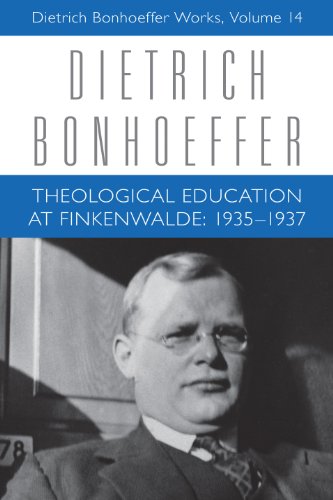
  • And we complain at the cost of theological education – and sometimes at the inconvenience caused by some years of ministry formation.

    For students of Bonhoeffer yet another milestone is about to be passed. The English translation of volume 14 of Bonhoeffer's works is due to be released by the end of October. Between 1935 and 1937 Bonhoeffer was engaged in theological education and pastoral formation at the underground seminary in Finkenwalde. The slim book, Life Together, is as near a Rule for that Christian Community as he ever came to write. It is a passionate exposition of the disciplina arcana of a Christian pastoral spirituality resilient enough to resist the Nazification of German culture and the widespread collaborative capitulation of vast swathes of the German Church.

    This new volume gathers together for the first time Bible studies, sermons, lectures on pastoral theology and preaching, a huge collection of writing from the rapidly maturing Bonhoeffer who wrote at this time Life Together and Discipleship. At over 1250 pages I did wonder if it might come in two volumes – so I asked the good folk at Fortress – but no, it will be one very thick and heavy book. Cumbersome, but only in the sense that gold bricks are. I'm finishing off the other stuff I'm reading just now so that when this book is unloaded onto my desk there will be room for it, and time to join the seminary classes out of which came some of the most courageous pastors, many of whom would not survive the war.