Blog

  • The Resurrection is a doctrine of utter discontinuity…..

    Stuart Townend writes too many hymns, just like Charles Wesley and Graham Kendrick. And yes I do mention them all in the one sentence, because at their best the have given the Church some of the finest hymns in the worship repertoire. What makes a hymn  good, great, even classic is a seriously contested question and no obvious answers forthcoming. Rhythm, imagery, tune, resonant experience, affective power, words – yes, and perhaps the precise cultural moment the hymn is composed and first sung.

    Stuart Townend's "See what a morning", is one such hymn – theologically spacious, glistening with the imagery of hope, utterly Christocentric and rooted in Trinitarian faith, affirming of life and new beginnings and possibilities. I can't sing it without recognising the disjunct between this hymn and the litanies of despair and negativity that now dominate global news prostrate at the altar of The Economy. The irony is that the spacious, generous, inclusive safety of the term 'economy' is now lost in our worship of wealth, growth, the possession of power and the power of possession. The economy of salvation works quite differently in Christian theology, 'wrought in love, borne in pain, paid in sacrifice.'

    With a defiance every bit as unflinching as Paul in 1 Corithians 15, the hymn finishes each verse with the resurrection cry: "For he lives: Christ is risen from the dead!". Likewise the sixth line of each verse trumpets the great reversal of the Gospel, when all that ruins God's loving creative purposes is confronted with a power it can neither comprehend nor overcome. And the last verse is programmatic for the Church of Christ facing a world wearied and worn thin by human activity that is singlemindedly self-serving, and therefore resolutely destructive. To sing in such a world, "death is dead, love has won, Christ has conquered", is to experience a trnasfigured worldview, to speak a different narrative, to look for a different ending that is in effect a new beginning.

    The scandal of the resurrection remains for all sophisticated cultures, the late post-modern West included, the most radical questioning of what matters most, the most outrageous statement of what is ultimate, and the clearest most compassionate reticence about all explanations of purpose and meaning in the face of human suffering and the pain of all creation. Resurrection is not a statement that it all worked out in the end; it is a doctrine of utter disconinuity, a divine reversal of the order of things, the working out of a different economy in which cost, sacrifice and loss are borne in a transfiguring act of Eternal Love.

    The Church is a resurrection community; a place where we are speaking life, stirring hope, bringing peace: a place where we sing and shout, "death is dead, love has won, Christ has conquered"; for he lives, Christ is risen from the dead.  


    See what a morning, gloriously bright

    With the dawning of hope in Jerusalem;


    Folded the grave-clothes


    Tomb filled with light,


    As the angels announce Christ is risen!


    See God's salvation plan, wrought in love,


    Borne in pain, paid in sacrifice,


    Fulfilled in Christ, the Man, for He lives,


    Christ is risen from the dead!

    See Mary weeping: 'Where is He laid?

    As in sorrow she turns from the empty tomb;


    Hears a voice speaking, calling her name:


    It's the Master, the Lord raised to life again!


    The voice that spans the years,


    Speaking life, stirring hope,


    Bringing peace to us,


    Will sound till He appears,


    For He lives, Christ is risen from the dead!

    One with the Father, Ancient of Days,

    Through the Spirit


    Who clothes faith with certainty,


    Honour and blessing, glory and praise


    To the King crowned


    With power and authority!


    And we are raised with Him,


    Death is dead, love has won


    Christ has conquered;


    And we shall reign with Him,


    For He lives, Christ is risen from the dead!


    Stuart Townend & Keith Getty
    Copyright ©
    2003
    Thankyou Music
    – See more at: http://www.stuarttownend.co.uk/song/see-what-a-morning/#sthash.MqYmBmvz.dpuf
     

    See, what a morning, gloriously bright,

    With the dawning of hope in Jerusalem;


    Folded the grave-clothes, tomb filled with light,


    As the angels announce, "Christ is risen!"


    See God's salvation plan,


    Wrought in love, borne in pain, paid in sacrifice,


    Fulfilled in Christ, the Man,


    For He lives: Christ is risen from the dead!


    See Mary weeping, "Where is He laid?"


    As in sorrow she turns from the empty tomb;


    Hears a voice speaking, calling her name;


    It's the Master, the Lord raised to life again!


    The voice that spans the years,


    Speaking life, stirring hope, bringing peace to us,


    Will sound till He appears,


    For He lives: Christ is risen from the dead!


    One with the Father, Ancient of Days,


    Through the Spirit who clothes faith with certainty.


    Honor and blessing, glory and praise


    To the King crowned with pow'r and authority!


    And we are raised with Him,


    Death is dead, love has won, Christ has conquered;


    And we shall reign with Him,


    For He lives: Christ is risen from the dead!

    "See, What a Morning" (Resurrection Hymn)
    Words and Music by Keith Getty and Stuart Townend
    Copyright © 2003 Kingsway Thankyou Music

    See what a morning, gloriously bright
    With the dawning of hope in Jerusalem;
    Folded the grave-clothes
    Tomb filled with light,
    As the angels announce Christ is risen!
    See God's salvation plan, wrought in love,
    Borne in pain, paid in sacrifice,
    Fulfilled in Christ, the Man, for He lives,
    Christ is risen from the dead!

    See Mary weeping: 'Where is He laid?
    As in sorrow she turns from the empty tomb;
    Hears a voice speaking, calling her name:
    It's the Master, the Lord raised to life again!
    The voice that spans the years,
    Speaking life, stirring hope,
    Bringing peace to us,
    Will sound till He appears,
    For He lives, Christ is risen from the dead!

    One with the Father, Ancient of Days,
    Through the Spirit
    Who clothes faith with certainty,
    Honour and blessing, glory and praise
    To the King crowned
    With power and authority!
    And we are raised with Him,
    Death is dead, love has won
    Christ has conquered;
    And we shall reign with Him,
    For He lives, Christ is risen from the dead!


    Stuart Townend & Keith Getty

    Copyright ©
    2003
    Thankyou Music
    – See more at: http://www.stuarttownend.co.uk/song/see-what-a-morning/#sthash.MqYmBmvz.dpuf

    See what a morning, gloriously bright
    With the dawning of hope in Jerusalem;
    Folded the grave-clothes
    Tomb filled with light,
    As the angels announce Christ is risen!
    See God's salvation plan, wrought in love,
    Borne in pain, paid in sacrifice,
    Fulfilled in Christ, the Man, for He lives,
    Christ is risen from the dead!

    See Mary weeping: 'Where is He laid?
    As in sorrow she turns from the empty tomb;
    Hears a voice speaking, calling her name:
    It's the Master, the Lord raised to life again!
    The voice that spans the years,
    Speaking life, stirring hope,
    Bringing peace to us,
    Will sound till He appears,
    For He lives, Christ is risen from the dead!

    One with the Father, Ancient of Days,
    Through the Spirit
    Who clothes faith with certainty,
    Honour and blessing, glory and praise
    To the King crowned
    With power and authority!
    And we are raised with Him,
    Death is dead, love has won
    Christ has conquered;
    And we shall reign with Him,
    For He lives, Christ is risen from the dead!


    Stuart Townend & Keith Getty

    Copyright ©
    2003
    Thankyou Music
    – See more at: http://www.stuarttownend.co.uk/song/see-what-a-morning/#sthash.MqYmBmvz.dpuf

    See what a morning, gloriously bright
    With the dawning of hope in Jerusalem;
    Folded the grave-clothes
    Tomb filled with light,
    As the angels announce Christ is risen!
    See God's salvation plan, wrought in love,
    Borne in pain, paid in sacrifice,
    Fulfilled in Christ, the Man, for He lives,
    Christ is risen from the dead!

    See Mary weeping: 'Where is He laid?
    As in sorrow she turns from the empty tomb;
    Hears a voice speaking, calling her name:
    It's the Master, the Lord raised to life again!
    The voice that spans the years,
    Speaking life, stirring hope,
    Bringing peace to us,
    Will sound till He appears,
    For He lives, Christ is risen from the dead!

    One with the Father, Ancient of Days,
    Through the Spirit
    Who clothes faith with certainty,
    Honour and blessing, glory and praise
    To the King crowned
    With power and authority!
    And we are raised with Him,
    Death is dead, love has won
    Christ has conquered;
    And we shall reign with Him,
    For He lives, Christ is risen from the dead!


    Stuart Townend & Keith Getty

    Copyright ©
    2003
    Thankyou Music
    – See more at: http://www.stuarttownend.co.uk/song/see-what-a-morning/#sthash.MqYmBmvz.dpuf

    See what a morning, gloriously bright
    With the dawning of hope in Jerusalem;
    Folded the grave-clothes
    Tomb filled with light,
    As the angels announce Christ is risen!
    See God's salvation plan, wrought in love,
    Borne in pain, paid in sacrifice,
    Fulfilled in Christ, the Man, for He lives,
    Christ is risen from the dead!

    See Mary weeping: 'Where is He laid?
    As in sorrow she turns from the empty tomb;
    Hears a voice speaking, calling her name:
    It's the Master, the Lord raised to life again!
    The voice that spans the years,
    Speaking life, stirring hope,
    Bringing peace to us,
    Will sound till He appears,
    For He lives, Christ is risen from the dead!

    One with the Father, Ancient of Days,
    Through the Spirit
    Who clothes faith with certainty,
    Honour and blessing, glory and praise
    To the King crowned
    With power and authority!
    And we are raised with Him,
    Death is dead, love has won
    Christ has conquered;
    And we shall reign with Him,
    For He lives, Christ is risen from the dead!


    Stuart Townend & Keith Getty

    Copyright ©
    2003
    Thankyou Music
    – See more at: http://www.stuarttownend.co.uk/song/see-what-a-morning/#sthash.MqYmBmvz.dpuf

    See what a morning, gloriously bright
    With the dawning of hope in Jerusalem;
    Folded the grave-clothes
    Tomb filled with light,
    As the angels announce Christ is risen!
    See God's salvation plan, wrought in love,
    Borne in pain, paid in sacrifice,
    Fulfilled in Christ, the Man, for He lives,
    Christ is risen from the dead!

    See Mary weeping: 'Where is He laid?
    As in sorrow she turns from the empty tomb;
    Hears a voice speaking, calling her name:
    It's the Master, the Lord raised to life again!
    The voice that spans the years,
    Speaking life, stirring hope,
    Bringing peace to us,
    Will sound till He appears,
    For He lives, Christ is risen from the dead!

    One with the Father, Ancient of Days,
    Through the Spirit
    Who clothes faith with certainty,
    Honour and blessing, glory and praise
    To the King crowned
    With power and authority!
    And we are raised with Him,
    Death is dead, love has won
    Christ has conquered;
    And we shall reign with Him,
    For He lives, Christ is risen from the dead!


    Stuart Townend & Keith Getty

    Copyright ©
    2003
    Thankyou Music
    – See more at: http://www.stuarttownend.co.uk/song/see-what-a-morning/#sthash.MqYmBmvz.dpuf

  • This too is the day that the Lord has made, let us rejoice and be glad in it….


    DSC01433 (1)So been up on Schiehallion and spent a wonderful day enjoying scenery, making the long trek up (enjoying is a misleading word here – satisfying, healthy, aerobically effective) – I may walk rather differently tomorrow!

    Encountered a couple of mountain hare showing off their moves in the rocks, saw a timid ptarmigan spooked by the crunch of our boots, meadow pipits larking around, a skylark whose song is my favourite bird song ever. Forget Classic FM's obsession with Lark ascending; the real thing is sublime and unimprovable.

    Earlier we met a noisy in your face jay behaving like a bad tempered I'm a celebrity get out of here, or a postmodern ned, and later a red legged partridge with 15 chicks moving along the path ahead of us! She is a wonderful mother – one of the chicks had fallen off the path and couldn't get up – I caught it gently and lifted it up beside its siblings, and the mother was right over at me, outraged at the criticism of her parenting skills. 

    What a great day.


    DSC01447 (1)


  • Schiehallion from the Sun Lounge Window

    DSC01392


    The Pilgrm Psalm 121 has always raised my spirits by lifting my eyes. And when it comes to lifting my eyes to the hills, Schiehallion is about as impressive as they come. I've seen it in snow, a glistening majestic peak clothed in ermine with the occasional rocky outcrop showing; I've seen it in autumn with the colours muted and warm; and I've seen it at sunset in the afterglow of a summer day. Today I saw it from the window of the place we are staying. I lift my eyes to the hills. From whence doth my help come. Statement or question, the answer is the same – the Lord who made haven and earth.

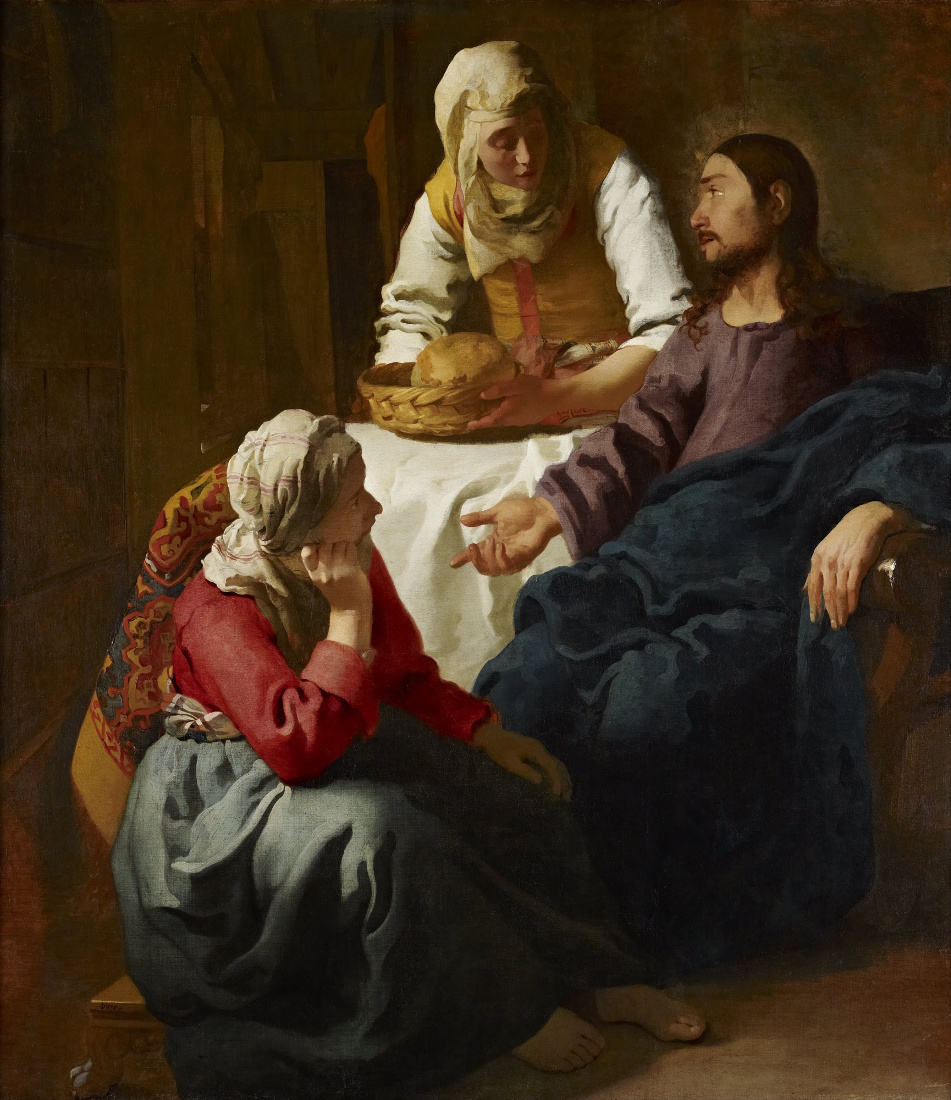
  • Martha and Mary; The Genius of Vermeer


    A friend introduced me to Vermeer's art some years ago, and ever since I've shared the enthusiasm for his work, each painting a masterpiece in its own right. I've seen several of them, and Jesus in the Home of Martha and Mary (in the National Galleries of Scotland) is the only surviving work on a biblical theme.

    The detail is astonishing from the thread work of the table cover, the woven basket, the folds of the drapery and the understated and uncluttered background. The biblical narrative is itself vivid, emotionally charged, relationally tense, and I personally find it's resolution not entirely satisfying. My sympathies lie firmly with Martha, and if she is guilty of flustered activism on behalf of the guest, then Mary's concentrated attention also ignores the problem of bread. Who baked that loaf? You can't eat contemplation! And I think Vermeer is well aware that the bread at the centre is freighted with ambiguity, daily bread and eucharist. Hallowed be thy name is balanced in the Lord's prayer by give us this day our daily bread, – a balanced life requires both – bread and eucharist, action and contemplation, work and rest, physical and spiritual.

    Vermeer I think is aware of the tensions of unfairness, contrasting temperaments, different ways of saying welcome, and the ambiguity and diversity of devotion which swings between rapt contemplation and the sweat and flour encrusted hands of the kitchen. Amongst the interesting but unanswerable questions is why Vermeer chose this incident from the Gospel? Perhaps because he is the finest artist of domestic detail and the immense human significance of the ordinary routines of home life. The painting is a wonderful commentary on the incarnation, a depiction of the Word become flesh, and a celebration of relationships which always have to be negotiated, understood and open to the necessary caution of not jumping to conclusions about what the other person is thinking, feeling and trying so hard to achieve.


  • Luther at his best ( I refrain from quoting Luther at his worst)


    Resurr41"It is not we who sustain the Church, nor was it those who came before us, nor will it be those who come after us. It was, and is and will be the one who says 'I am with you, even to the end of time…' As it says in Hebrews 13 'Jesus Christ the same, yesterday, today and forever. And in Revelation 1, 'Who was, and is, and is to come. Truly he is that one, and no one else is, or ever can be."

    Quoted in A McGrath, Roots that Refresh, 192.

    Now there's a presupposition that should inform every missional decision, preface every strategic review, edit every agenda for change, reassure every discipleship risk assessment. And there's a presupposition that should alleviate anxiety, prevent paralysis, dissolve complacency, and negate negativity by the positive assertion of the eternal reliability of who God is in Christ.

    Frederick Hart's Christ Rising is one of my favourite images. The cruciform shape and the bursting energy show a figure transcending humanity, but profoundly human.

  • Trinitarian Reflections: The Mislaid Foundation of Much Missional Urgency.

    For a number of years now I have taught a module entitled Rediscovering the Triune God. The title was borrowed from the book of the same name by the late Stanley Grenz, a Baptist scholar of remarkable learning, wide theological sympathy and an intellect graced by spiritual integrity. His book isn't easy reading, but it gets the job done in reviewing the 20th century developments in Trinitarian theology. Alongside Grenz we read our way through Moltmann's The Trinity and the Kingdom of God, not because Moltmann is the last word on Trinitarian theology, but because his construal of a social doctrine of the Trinity provokes theological discussion over a wide range of doctrinal issues from ecclesiology to Christology, from the incomprehensible suffering of God to the incomprehensible but all too apparent suffering of humanity, as the crucifixion of the Son of God is brought into salvific relation to the crucifixion of creation through sin, by the unprecedented and unimaginable action of the Triune God.

    It's a tedious and intellectually lazy cliche that the Christian understanding of God as Trinity is an exercise in abstract speculative or systematic theology with little relevance or practical value in Christian life and existence. My own experience has been one of deepening love for the Triune God, an awakened hunger not only for understanding and appreciation, but for the love grace and fellowship that flow within and beyond the life of Father Son and Spirit. The Holy Trinity is less about relevance than revelation, less about abstraction than adoration, less about speculation than spirituality, less about our pragmatism than our prayers and God's perfections.


    RublevAnd yet. Ironically once grasp the mystery and glory of the Trinity and we discover that the reality of God is an eternal mutual exchange of self-giving love, which reaches out beyond that life in creative purposeful action which is love's continuous expression; well, then we realise the practical import of an adequate theology of the Triune God. In a more recent paper Moltmann ends by a characteristic call to Christians to live in the experience of the grace, love and fellowship of the Triune God of suffering, redeeming and hope-filled love.

    The fellowship of believers lives mystically in the Triune God. The triune God is the broad place in which we embrace each other, it is the field of force of the love which makes us, together with each other, living people; it is the open future which invites us to hope.1

    The new module I'm teaching from September is Trinity and Community, and while some of the content of the earlier module will be included, it will be from a quite different pastoral and theological perspective. If today's high powered buzz words (especially in Evangelical circles) are to be preserved from becoming verbal idols at worst, or pragmatic solutions to church decline, or secondary focal points of community efforts which displace the primary and central focus of God in Christ in the power of the Spirit, then it will be through a recovered, resurgent and embodied Trinitarian theology. Mission, discipleship, worship, evangelism -some of the high powered buzz words – and their grammatically dubious cousins missional and discipling, are indeed key theological urgencies for the Church, for the churches and for Christian people seeking to be obedient to God in a post most things culture that routinely displaces and confuses the Church and its historic forms of witness.

    But in seeking to be obedient to God, the first priority is to know God well enough to bow before mystery, to embrace the rich complexity of loving reality that is the God revealed in Jesus Christ. That, as the Church early came to discover, involves us in contemplative wonder, thoughtful adoration, reverent experiment, joyful intellectual toil, conceptual humility, and the fear of God which is the beginning of wisdom, and which reminds us, with our unabashed impatience with mystery, to take our shoes off. The Holy Trinity is the life of God, into which we are drawn by the grace of Christ, the love of God and the communion of the Holy Spirit. And for myself, discipleship, mission, worship, evangelism and all other defined activities characteristic of Christians, draw their relevance, importance and ultimate significance from the God whose Triune life of creative, redemptive and consummative love seeks to reconcile all things unto Himself.

    1See his paper "The Church in the Power of the Spirit", in The Holy Spirit in the World Today. Jane Williams (ed.), (London: Alpha, 2011), 28.

  • Hippolytus on the Cross… “the binding force of the world…”


    12899a559cb69bc6

    The tree is my everlasting salvation. 
    It is my food, a shared banquet.  Its roots and the spread of its
    branches are my own roots and extension… Its shade I take for my resting
    place; in my flight from oppressive heat it is the source of refreshing
    dew for me… Food for my hunger and wellspring for my thirst, it is also
    covering for my nakedness, with the spirit of life as its leaves… Fearful
    of God, I find in it a place of safety; when unsteady a source of stability. 
    In the face of a struggle, I look to it as a prize; in victory my trophy.


    Jacobs-ladder


    It is Jacob’s ladder, the passage
    of angels, at whose summit the Lord is affixed.  This tree, the plant
    of immortality, rears from earth to reach as high as heaven, fixing the
    Lord between heaven and earth.  It is the foundation and stabilizer
    of the universe, undergirding the world that we inhabit.  It is the
    binding force of the world… It is riveted into a unity by the invisible
    bonds of the Spirit, so that its connection with God can never be severed. 
    Brushing heaven with its uppermost branches, it remains fixed in the earth,
    and between the two points, its huge hands completely enfold the stirring
    of the air.  A single whole, it penetrates all things and all places.

  • The Art of Biblical Commentary – Exegesis by Word and Image

    Student supervision, a preaching request, and a long interest in the Epistle to the Hebrews have encouraged me to tackle G L Cockerill's new commentary on Hebrews. Published in the New International Commentary on the NT series, it runs to 760 pages and will take a while to work through. I've done this kind of thing before with Hebrews – 30 years ago with the commentary by F F Bruce in this same series.

    I know all kinds of folk come past this blog and not everyone will be interested in everything posted here. Poetry or tapestry, Renaissance Art and Kirekegaard, photos and haiku, books of all kinds on many subjects from spirituality to biography, to systematic theology to novels, and most anything else that seems interesting to share. So every now and then a piece of self-indulgent bibliphilia, often on that expensive genre of the biblical commentary.


    F f bruceF F Bruce mentioned above was a remarkably humble and even more remarkably learned Christian scholar who almost singlehandedly in the 1950's into the 1960's demonstrated that it is possible to be a convictional evangelical and an academic professor of Biblical Studies holding his own in scholarly integrity in a secular institution. His background in the Christian Brethren, his deep and wide knowledge of the New Testament world and the classical languages, his expertise in New Testament Greek and intra-biblical knowledge meant that his commentary on Hebrews was one of the great written gifts to preachers and Bible students keen to do justice to this vibrant and urgent document from the early church.


    Weyden-depositionSo I bought it for £3.25 (not cheap in the early 1970's), and I read it, one of the first full length commentaries I read, and realised that such daily increments of conversation with expert exegetes accumulated in the mind, enriching, expanding and transforming my approach to the biblical text. That's why I put in the sidebar the commentary I'm reading – a gentle corrective for those who might wonder at my tedium threshold, and an assurance that such disciplined understudying is no more tedious than a shower after a long day, or before another one starts!

    And now Cockerill – who is persuaded, so far as any guess has credibility, that Apollos wrote Hebrews. A long slow summer read, another exercise in incremental gains in 'the grace and knowledge of God'. The painting is Rogier Van Der Weyden's 'Deposition'. This is one of the masterpieces of Renaissance Art, amongst the most remarkable depictions of human sorrow in its diversity and the concentrated anguish of loss which feels utterly, and ultimately, irreversible and irredeemable. Hebrews explores the heights and depths of divine mercy, suffering, judgement and love – Van der Weyden depicts the heights and depths of human suffering, compassion, sorrow and love.

  • Praying for what I want, or need – then there’s what God wants…..


    DSC01326“Prayer is not for getting what we want, but rather for
    bending our wants toward what God wants.” (Stanley Hauerwas)

    Wanting is one of the
    strongest drives in our nature. The Lord's Prayer recognises this. Our wants can be as daily as bread, as needful
    as forgiveness, as desperate as a cry for deliverance from whatever might hurt
    and harm us. We want the material things we need to live; we want to have
    satisfying relationships with other people; we want to be kept safe and to live
    as well as we can. And at times we live as if achieving all that was entirely
    up to us.

    But each of these wants is part of basic prayer. We pray to
    God for what we need to live our lives – bread to nourish our bodies, the
    security of home, enough money to provide what’s needed, a job to give us a
    place and a purpose. We pray to God about marriage, friendships, family
    relationships, people we work with, neighbours. Time and again these
    relationships need to be salvaged, renewed, cleansed, recycled.

    That same prayer deals with needs as well as wants: forgive us when
    we get it wrong, as we forgive those who get it wrong with us. In life there are alos givens, those circumstances that come to us, or at us. So we pray to God
    about those experiences that test our integrity and our faith, that face us
    with hard choices, when it’s easier to do wrong than pay the price for doing
    right. So we bring our wants to God; often we want, mostly we need, those things we can’t live without,
    or at least can't live well without – bread, forgiveness, strength to survive the traps and tests and temptations of life that often feels way too complex, demanding and confusing. 

    The Lord's Prayer is a remarkably clarifying agenda to start, and end, each day.

    The photo looks towards Stirling from Gartmore – the sense of space and distance help put this small person in  perspective!

  • Another prayer to read patiently, gently and with inward honesty.

    220px-Kierkegaard

    Below is Kierkegaard's prayer as he sets out to write The Works of Love. It's a long time since I read Kierkegaard, and I have to confess I've picked up Works of Love more by accident than design, which could mean more by providence than accident! He is never a comfortable read, always subversive of the ego's search for affirmation and critical of its imaginative strategies to secure opportunities for self promotion, self-comfort, and self advancement into the places of human power and praise.

    Geroge Pattison in the introduction encorages a reading one by one of these discourses, each to be considered as effectively a series of scripts for self examination, requiring a response of intentional transformation. This takes place under the discipline of a Love that is the sum and substance and source of all other genuine loves, which are made real in acts, works and habits of performance, sustained by the eternal energy core in the life of the Triune God.

    How could love be rightly discussed if You were
    forgotten, O God of Love,

    source of all love in heaven and on earth,

    You
    who spared nothing but gave all in love,

    You who are love, so that one
    who loves is what he is only by being in You!

    How could love properly be
    discussed if You were forgotten,

    You who made manifest what love is,

    You, our Savior and Redeemer, who gave Yourself to save all!

    How could
    love be rightly discussed if You were forgoteen, O Spirit of Love,

    You
    who take nothing for Your own but remind us of that sacrifice of love,


    remind the believer to love as he is loved, and his neighbor as himself!

    O Eternal Love, You who are everywhere present

    and never without
    witness wherever You are called upon,

    be not without witness in what is
    said here about love or about the works of love.

    There are only a few
    acts

    which human language specifically and narrowly calls works of love,

    but heaven is such that no act can be pleasing there unless it is an
    act of love–

    sincere in self-renunciation,

    impelled by love itself,

    and
    for this very reason claiming no compensation.