Blog

  • Lament for a Church With Way Too Low Expectations of God


    "We have lost our nerve and our sense of direction

    and have turned the divine initiative into a human enterprise…

    And all these drab infidelities are committed

    not because too little power is available to us

    but because the power so far exceeds the petty scale we want to live by.

    God has made us a little lower than the angels,

    while our highest ambition is to live a little above the Joneses.

    We are looking for a sensible family-sized God,

    dispensing pep pills or tranquilisers as required

    with a Holy Spirit who is a baby's comforter.

    No wonder the Lord of terrible aspect

    is too much for us…..

    (John V Taylor, The Go Between God (London: SCM, 1972) 48.

    Slightly dated now in its langauge, but this remains a powerful and original exploration of the work and reality of the Holy Spirit in creation, church and human experience. This remains an early milestone book in my theological awakening.


    DSC01550

    The photo of a battered Bible in a country church notwithstanding, the Word of the Lord endureth forevermore!

  • Brambles and Victoria Plums – as good as it gets!

    What a year for blackberries, brambles as i call them. I can remember one year picking brambles after a hard frost and it was the easiest picking ever. Mind you the fingers were numb in minutes. But the frozen brambles came away so easily and into the margarine tub. There are few tastes from my childhood more vivid and memory jogging than bramble jellly. I still love it.

    Obviously so did Seamus Heaney – is this poem not a marvel of long ago reminiscence, remembered delight, mouth-watering recall of those moments when our taste-buds learned how to explode?

    Blackberry Picking, Seamus Heaney

    At first, just one, a glossy purple clot
    Among others, red, green, hard as a knot.
    You ate that first one and its flesh was sweet
    Like thickened wine: summer's blood was in it
    Leaving stains upon the tongue and lust for
    Picking. Then red ones inked up and that hunger
    Sent us out with milk cans, pea tins, jam pots
    Where briars scratched and wet grass bleached our boots.
    Round hayfields, cornfields and potato drills
    We trekked and picked until the cans were full…

    While on the subject of wonderful fruit – it's the Victoria plum season, and oh my goodness, apart from chocolate, I happily forego all other sweets and treats to eat my fill of these fruits of Eden. You think an apple is a temptation……. 🙂

  • An email from America from a Rowan Williams Fan!

    The other day I received an email from Meri, who came across this blog by accident. It seemed to me to be the kind of response that makes blog writing worthwhile rather than a self-indulgent personal platform. The following is her email and my reply – I marvel at the way friendship, fellowship and shared experience are possible and made rich with meaning through such serendipitous actions as Googling a ridiculously erudite ex-Archbishop of Canterbury and ending up with, well, me :))
    ………………………….
    "Serve God wittily in the tangle of their minds"

    I love that.

    Hi
    James,

    My name is Meri.  I came upon you by way of searching for Rowan Williams.  I found him as holy fool with a delightful photograph of  him
    looking quite mad.  If it were not for reading Rowan Williams  "Writing in
    the Dust"  contemplations after 911,  I would not have become the lonely
    G-d botherer that I am.  This kind of writing was  nothing like the messages
    in the church of my youth,  Church of England.  That kind of religion never
    "took" on me and I left as soon as I was able.  But,  the biblical
    narratives and Christian values are deeply embedded in
    me.

    Loneliness and loss has dogged me all my life,  leading me to a love of literature and a life of the mind.  Reality has disappointed. Fate
    has not been kind.  Now, I see myself as an isolated, literary and poetic
    soul who has never found a place to fit in.  Certainly not in
    establishments.

    I discovered theology through RW and it spoke to me, made
    sense, was not simplistic. I am not an academic, but reasonably
    educated, literate and thoughtful.  If I am to untangle my mind,  I need help.   Where to find it?  I believe my only option is to reach out on-line to those with similar interests.  The idea of an on-line holy book
    club is appealing.  Have you heard of such a thing?  Do you know of any
    serious theology forums? and would they allow a novice in?  (I am 82 years
    of age) a little slower, but still teachable…… Do you think this is a
    good idea?

    I have a dog eared copy of "Open to Judgement"  which has
    been invaluable for my sanity.  An essay on "The Abbe Huvelin"  a theology for neurotic and suffering souls was written especially for me.  I am 
    indebted. I used to follow Dr. William's web site when he was
    Archbishop, and I miss it.  Have you read any of his recent books, and
    would you recommend one?   Perhaps he has written another phrase or
    paragraph  especially for me………

    My devotions are eccentric. 
    They are connected with a humming bird I feed and will help through the
    winter.  And with the barns I visit where the police horses live.  Last
    week Dalton, the horse,  was all gussied up ready to visit a dying child at
    the hospital.  These kinds of things let in the light and help with the
    untangling.

    The photo of the heather is lovely,

    best
    wishes,  Meri

    And my reply
    Hello Meri!

    What a
    delightful letter, thank you! You are precisely the kind of person for
    whom much of the blog is written. I'm glad it's of some help.

    I too miss
    Rowan Williams. The fact that some said he was too clever to be Archbishop says
    more about dumbing down leadership to management, than it does about someone who
    is chosen under God to be a spiritual leader. Have you had a look at his book
    Tokens of Trust? Apart from his more substantial theological work, he writes
    some books as a brilliant man whose intellectual power is used in the service of
    faith seeking understanding. This is a really good introduction to the Christian
    faith through the thick glasses of Rowan!

    Can I also suggest you get a
    hold of Benjamin Myers book Christ the Stranger. The Theology of Rowan Williams.
    I think it will give you a lot to think about because it is what a good
    introduction does – it gives you Rowan Williams rather than someone else's much
    less interesting opinions about it!!

    Now I haven't personally gone
    looking for an online theological forum but there must be such things. An online
    theological reading group – now that's a good idea though again not one I've
    pursued, so can't help much there. You may see yourself as a novice, but someone
    whose life experience is a rich tapestry of light and shadow, and whose
    spirituality is formed in the hard places as well as the comfort zones, is no
    novice in theology, if theology is to be lived as well as thought.

    I
    wonder – would you allow me to put your letter on the blog – I can remove your
    name if you wish. I think it would encourage others who struggle with other
    people's claimed certainties and closed timidity in the face of the mystery and
    meaning of that Reality whom we name as God, and have come to know through
    Christ. No pressure whatsoever if you feel hesitant. Just let me
    know.

    Shalom, and give dalton an apple on my
    behalf,


    Well as you can see, Meri was happy for our correspondence to be published, and she sent a photo of Dalton – I need to convert it from a bitmap file to one this platform supports – I can't work it out, any suggestions? 
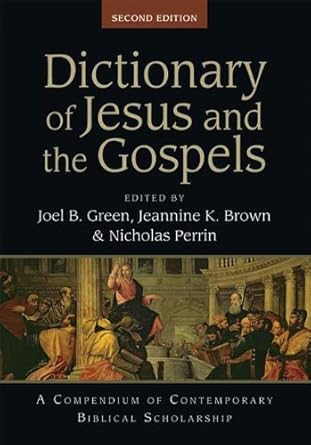
  • Dictionary of Jesus and the Gospels (Second Edition) – a no brainer purchase.


    You know you're getting on a bit when you are excited about a complete revision and expansion of a book you bought in its first edition over 20 years ago, and have used regularly and gladly all that time. Generations of theological students and pastors keen to do their own exegetical digging have benefited from the IVP black dictionaries on the New and Old Testaments. The Dictionary of the OT Prophets was published a year or two ago completing the full set of Black Dictionaries. The Dictionary of Jesus and the Gospels was published 21 years ago, and now needs updating and made consistent with the rest of the set. I guess what we have is a changing continuity with this project, aiming to keep the scholarship current – and for that IVP are to be congratulated.

    I've used every one of the IVP Black Dictionaries frequently, profitably and I can think of fewer big volumes that are such value for money. They have well conceived subject indices at the back making it possible to pursue obscure or minor themes through the lens of the major articles. The Jesus and the Gospels volume has a detailed index of gospel texts allowing for further chasing of exegetical detail (a full scripture index would be much too cumbersome).

    The pre-publication description on Amazon shows the scope and quality of what is on offer. No I haven't seen the revised edition. It has almost the same number of pages, but as you'll see from the pre-pub. extract below, it is almost entirely a new book:

    How can undergraduate students, seminarians, people in professional
    ministry, leaders in local churches and other Christian organizations,
    even academic scholars, stay abreast of the range of contemporary study
    of Jesus and the Gospels? How can the fruit of vital study of Jesus and
    the Gospels in recent years help to animate our reading of and
    interaction with the Gospels?

    When it first appeared some twenty
    years ago, the 'Dictionary of Jesus and the Gospels' was concerned to
    address exactly these kinds of needs. This revision of the Dictionary
    follows the same path, though now with new content and up-to-date
    bibliographies, as well as a host of new contributors. Some ninety
    percent of the original material has been replaced, with most previous
    entries assigned to a fresh list of scholars. A number of new articles
    have been introduced, and a handful of articles from the first edition
    have been updated in light of ongoing research.

    I await the arrival of the second generation of this Dictionary with impatience. What will I do with the old one – well what do you do with old friends? You don't sell them, recycle them, dump them or pulp them! You look after them, you find space for them, and if you can find a caring home for them, that would be good!

  • The Sermon on the Mount in Scotland!

    DSC01591
    In Scotland there aren't many lilies of the field – maybe some red poppies growing wild. But if Jesus had preached the Sermon on the Mount near Banchory (The Sermon on Scolty Hill), he'd still have said, 'Not even Solomon in all his purple glory can compete with Scottish heather in August.

    The idea that Jesus might speak with a Scottish accent makes for interesting exegesis and fresh translation – when the disciples gave the weans a row for giving Jesus hassle, Jesus said to the disciples, "Gonnae no dae that!"

    DSC01588

  • Writing and Sanctity


    _38153905_potok_ap300I first read a Chaim Potok novel when I was 23. I opened the orange penguin edition of The Chosen on the top deck of a Glasgow bus on its way from Sauchiehall Street to Glasgow University. It was raining, mid afternoon and the street lights were already on. I was in the front seat, and I've never lost the child's fascination with travelling upstairs with a drivers-eye view, and particularly the wavy swing of the bus going round a tight corner, more exaggerated from on high.

    I was soon immersed in a very different world of Hasidic Jewish culture, in pre-war Brooklyn, a society of Talmudic Judaism which was intense, fervent, strange and fiercely defensive. That book changed my entire view of Judaism, Jewishness and provided me with an entry into a world I have come to value, to some extent understand, and to sense at times a deep affinity with those who take prayer, worship, obedience and reverent love for the sacred texts of the Hebrew Bible with life affirming seriousness. Since then I've read Potok's novels, studied A J Heschel's volumes of philosophy and theology, much of Martin Buber's philosophy, immersed myself in Denise Levertov's poetry and essays, consulted Shalom Paul and Moshe Greenberg's commentaries on Amos, Isaiah and Ezekiel, revelled in Robert Alter's literary studies and translations, wrestled with the moral dilemmas of Elie Wiesel holding a world to account for the attempted murder of a people, and worked through the often dense but brilliant writing of George Steiner.

    It wouldn't be true to say I owe all these intellectual field trips to discovering Potok's work. But there's no doubt my own theological worldview has been positively enriched by such encounters; my awareness of the truth and value of other faith traditions has been sensitised, and in turn my own learned lessons in humility have encouraged an openness and receptiveness to the truth that others bring to us as their gift. All this triggered by reading Conversations with Chaim Potok, in which he explains why and how he wrote the novels, and in particular, his concern to explore the experience of modern Jewish communities  where people live at the core of two cultures, and in a nexus of colliding values.

    Here is his apologia for writing 'at its best':

    "Writing at its best is an exalted state, an unlocking of the unconscious and imagination and a contact with sanctity."

    I have a feeling that Heschel, Buber, Levertov, Shalom Paul and George Steiner would underline that passage with a tick in the margin. If you haven't read Potok, be it far from me to tell you what to do, but….

  • Meditation on a Window on a Vanished Past.

    This is a photo taken earlier this summer.

    I was going to write a poem about it.

    On reflection it is already a poem – visual, evocative, suggestive.

    Weathered paint, cracked pointing, crumbling stone,

    sashes, lintel and frame worn away with the wind.

    A window of opportunities taken? Perhaps not, now lost.

    No mere hole in the wall, an apperture of light,

    illuming the human,the homely, the holy.

    DSC01344
    In 200 years, what has been seen looking through this window? Who lived and left here? Whose stories unfolded, now forgotten? This weather worn window once welcomed someone home.
  • Spiritual Scunneration and a Good Devotional Hymn


    Vienna 079What is it that leads us to describe an experience, a poem, a hymn, a talk, a book as 'devotional'? Devotional can mean it makes me feel better, or its purpose is to awaken emotions of love to God, or it creates in us a desire to serve  God better, or repent and turn away from our sins. But an equally important question for me is what makes a hymn, picture, book or whatever else 'devotional'? I started thinking about this when I came across a hymn I haven't sung for years, but even reading it I felt something deeply stirring, a mixture of memory and resonance, faith and familiarity, love and longing, desire and determination, regret and renewal. 

    The word devotional is an essential word in Christian theology and spirituality. It refers to those experiences and encounters, those moments of intimate significance in our journey with God, when our deepest hopes encounter love inexhaustible, and when therefore our greatest failings are gathered up into grace sufficient.

    Sometimes I don't know what to pray when most fully aware of my humanity, and the apparent impossibility of being other than a recurring disappointment to God. (The apostle above portrays this kind of spiritual being scunnered!) That of course is itself a lack of trust in the power of God's love and grace to renew and transform and make possible a new creation. So a hymn like the one below, more or less consigned to memory like an artefact from a previous age covered over with all that has come after, retains a mysterious hold on my religious affections. It more fully expresses my faith than most ad hoc words of stammering yearning I can write in a journal, or say in a prayer. This is a hymn which isn't about how I feel, as if God didn't already know all that anyway. This is a hymn of spiritual aspiration, of ethical re-affrimation and of discipleship which takes seriously inner disposition as well as outer behaviour.  It will find its way into an order of service soon, as I am privileged to preach around and choose some of the hymns – to choose this one would be to choose a hymn undeservedly neglected, but which is, in the richest senses, devotional. 


    1. May the mind of Christ, my Savior,
      Live in me from day to day,
      By His love and pow’r controlling
      All I do and say.
    2. May the Word of God dwell richly
      In my heart from hour to hour,
      So that all may see I triumph
      Only through His pow’r.
    3. May the peace of God my Father
      Rule my life in everything,
      That I may be calm to comfort
      Sick and sorrowing.
    4. May the love of Jesus fill me
      As the waters fill the sea;
      Him exalting, self abasing,
      This is victory.
    5. May I run the race before me,
      Strong and brave to face the foe,
      Looking only unto Jesus
      As I onward go.
  • God’s Passion to Multiply Joy


    DSC01589Two sentences from P T Forsyth, This Life and the Next – showing why it's always wise to read him with a pencil to underline and retrace our footsteps to such throwaway theological sense….. the photo is from Scolty Hill looking towards Aberdeen, where Forsyth was born. Wonder if he did his hill-waliking around here?

    "We were created by God not out of his poverty and his need of company, but out of his overflowing wealth of love and his passion to multiply joy."

    "The pursuit of perfection is a greater moral influence than the passion for power."