Blog

  • The High Calling of the Holy Fool – Ben Myers on the Theology of Rowan Williams

    Ben Myers' study of the theology of Rowan Williams is a good read for three reasons, well it would be three wouldn't it, given that Williams is one of the most subtle Trinitarian theologians writing today.
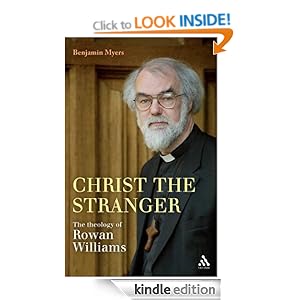
    Christ the Stranger: The Theology of Rowan Williams: A Critical Introduction

    First, Williams' theology is explored with sympathy, explained with clarity and expounded with critical affection. Myers traces the intellectual mileposts of Williams' theological itinerary so far, taking time to look at the landscape before moving on. The study is both chronological and thematic. Some of the chapters are significant theological reflections in their own right, underpinned by Williams' theological style and convictions, but in conversation with a sharply observant friend.

    Second Myers brings the theology of Rowan Williams into the rich and at times bewildering company of those who have shaped and stimulated, shaken and stirred, subverted and converted the ideas and insights of a mind too much in love with God to settle for simplicity, tidiness or finality in theology. Williams' travelling companions are as diverse as they come: the Russian Orthodox theologian Bulgakov, the German philosopher Hegel, Augustine and Von Balthasar with Barth, the granite polymath Donald Mackinnon and the Eastern Orthodox theologian Vladimir Lossky, Gillian Rose the French scourge of post-modern philosophy, Ludwig Wittgenstein, T S Eliot and Dostoevsky, and from a different but no less powerful theological genre, Andrei Rublev and his Icon of the Trinity.

    Third, this study allows Rowan Williams to speak, and creates both space and congenial environment for him to be heard. The endnotes to each chapter direct the reader to Williams' scattered corpus. One of the features of Williams thought is that much of it is occasional, thought out and thought through in the midst of discussion, debate and not a little controversy. But always, you have a sense of a mind that is original and unafraid of the inconvenience of hesitation, qualification and deferred answers. This can make him a frustrating provisionalist, a thinker reluctant to claim more than can be rightly said. Intellectual humility seldom goes with such high intelligence, and when it does in a Christian leader, it is usually one of the more persuasive criteria for holiness. I think Myers is right to suggest that Williams is deeply influenced by, and is himself an example of, the holy fool.


    Rowan 2To be a fool for Christ's sake is no small achievement in the scale of sanctity. Diplomacy and political nous, administrative acumen and managerial competence, religious entrepreneurship and judicious statement, strategic foresight and relational leadership – all these are desirable in an Archbishop in an established church. Unlikely a search consultancy will put holy fool amongst the essential attributes, indeed it may, rightly, be reason enough to quietly drop a name from the long list let alone the short list.

    But Myers uses the phrase in its strongest biblical sense of a prophet who speaks a different language and come from a different country and sees things we don't, because we are all so busy we cannot be bothered looking. In that sense the fool is the one who sees the folly of our seriousness; the one who refuses to prioritise the wisdom of the world; the one who speaks truth to power from a place where the view is different; the one who is never seduced into going along with the crowd who are so duped they aren't prepared to see, let alone say, that the emperor is naked.

    In his retirement I hope Rowan Williams has time, space, energy and opportunity to leave to the church a substantial corpus of uncomfortable theology. Goodness, not because I would nod assent to everything he says and writes – just as often I find him frustrating, at times annoying, frequently hard to follow, but seldom trite, predictable or irrelevant. Because deep springs of prayer and a contemplative intellect dedicated to loving God give life and reality to Williams' theology.

    I still remember years ago reading The Truce of God, an Archbishop of Canterbury Lent Book, when Williams was a young academic theologian. It too was a tough read, but it changed the way I look at movies, it alerted me to the fears that pervade consumerist culture, and it converted me to a view of Christian discipleship in which reconciliation, justice and peacemaking are essential digits in the bar code of Christian lifestyle. Since then I have read Williams with gratitude and anticipation – with considerable respect, and with just about equal measures of agreement and disagreement. And maybe I've learned most when I have disagreed with him, and had to clarify in my own mind and heart why.

    One last thought – how can you not like an Archbishop who describes the impact of hierarchical church leadership on his soul by saying it's like 'the effect of coca-cola on your teeth'!

  • Shalom – a Tapestry of Psalms – Psalm 1

    DSC01177 (1)

    Since Christmas I have been working on a large six panel tapestry which brings together the word Shalom, and the Book of Psalms. During Advent I completed a small tapestry featuring the Hebrew word 'shalom ', and it was based around some passages from Isaiah. I wrote about it while it was still in progress, which you can read here and get some idea of what I'm playing at. I don't mind the phrase 'playing at', it combines fun, recreation and experiment.

    In due course I will do a second small one with the Hebrew word 'hesed'. I have chosen these two words because they open theological horizons, no one definition or statement of meaning comes close to expressing the 'thick textual textures'  they create. That's why they are fertile theological ground, rich in possibility for exploring through the texture of textile colour and image. I have chosen six psalms which separately and together celebrate the God of shalom and hesed. And the two smaller panels will celebrate the equally rich poetry of Isaiah. When they are finished, the long Shalom column and the two small Hebrew tablets will hang in a cruciform pattern.

    The panel above is on Psalm 1. The imagery is mostly self-evident, once you're told what the psalm text is. The stability of the life founded on study of Torah, meditation on the word of God, contemplative attentiveness to the gracious command and commanding grace of God. In the foreground the sylised orderliness of the landscape contrasts with the flowing rapids of life-giving water. The fecund trees with evergreen foliage and sound abundant fruit make blessing both visble and extravagant. Shalom is continual fruitfulness and roots irrigated from constant living water. Shalom is stability and constancy that comes from deep roots, plunged like anchors into the ground, the tree in its ideal environment. Torah is the ideal environment for the human heart, will, conscience and mind – no wonder the wise delight in such reflective obedience and reverent enquiry.

  • A Beautiful Day and U2 are Beautiful Smudge!

    The morning was so beautiful, frosty, misty, pastel sky, sunlight that began as white and turned slowly to a crystal clear light and blue sky. I put on U2, Beautiful Day and heard it with the clarity that comes from two new hearing aids!

    By mid morning it was warm at the back door and Smudge had the sense to lie on the garden table and soak up some vitamin D.

    I came out with my camera and the first photo she co-operated but by the time I wanted one or two more her mood changed. Here is photo 1, with her indulging my intrusion. The request for more photo-shots was greeted by the face on the second photo! Phot 3 is Smudge's opin ion of camera in your face!

    That's why I love cats – their eyes let you know what they're thinking – inscrutable sometimes, utterly to the point at other times.

    DSC01166


    I'm a Celebrity….


    DSC01168


    Don't push it…..


    DSC01169


    Look I've done the celebrity bit…get out of here!


  • Foreign Aid, Foreign Policy and Outlandish Suggestions


    12899a559cb69bc6Aid money could go to defence. That's a headline on BBC News Online. Now I can think of a number of moral arguments which demonstrate the ethical minefield (excuse the inappropriate metaphor) the Prime Minister proposes to walk across. And I could quote a few sayings of the OT prophets who had a thing or two to say about the collision of military hardware and works of mercy, or the hubris of the powerful protecting the interests of economics at the cost of humane politics.

    But it's late. And this is just a wee blog with a few hundred readers. So I guess there's little point in going into either a long reasoned argument or and even longer gratifying rant. So I'll content myself with the words of Isaiah 58. Perchance these could be offered as some questions for Prime Ministers Question Time…

    “Is not this the kind of fasting I have chosen:
    to loose the chains of injustice
        and untie the cords of the yoke,
    to set the oppressed free
        and break every yoke?
    Is it not to share your food with the hungry
        and to provide the poor wanderer with shelter—
    when you see the naked, to clothe them,
        and not to turn away from your own flesh and blood?
    Then your light will break forth like the dawn,
        and your healing will quickly appear;
    then your righteousness[a] will go before you,
        and the glory of the Lord will be your rear guard.
    Then you will call, and the Lord will answer;
        you will cry for help, and he will say: Here am I.

    “If you do away with the yoke of oppression,
        with the pointing finger and malicious talk,
    10 and if you spend yourselves in behalf of the hungry
        and satisfy the needs of the oppressed,
    then your light will rise in the darkness,
        and your night will become like the noonday.
    11 The Lord will guide you always;
        he will satisfy your needs in a sun-scorched land
        and will strengthen your frame.
    You will be like a well-watered garden,
        like a spring whose waters never fail.
    12 Your people will rebuild the ancient ruins
        and will raise up the age-old foundations;
    you will be called Repairer of Broken Walls,
        Restorer of Streets with Dwellings.

    .

  • The Amritsar massacre – Some Lenten reflections on Empire

    The Amritsar massacre in 1919 was "a deeply shameful event in British history" said our Prime Minister yesterday.

    The events of that day were described in 1920 by Winston Churchill as "monstrous", and in political realities Churchill was not averse to the brutal use of force.

    In 1997 the Queen described the event as a "distressing" example of the "moments of sadness" in the history between Britain and India.

    In 1982 Ben Kingsley played the role of Ghandi in a film which I think is still the high point in his career. In that film, directed by Sir Richard Attenborough, the Armitsar massacre was portrayed as the logistical and inevitable consequence of blind loyalty to Empire, equipped by military capability and fuelled by racist brutality and unexamined claims of moral right founded on power and might.

    I still remember the sickening dread of those scenes as the British Army moved into position, blocked exits, and opened fire. I was sure this was an outrageous distortion of history, a Hollywoodisation which falsified truth and exaggerated fact as a technique of audience control, a deliberate black contrast to the saintly non-violent Ghandi.

    But we know it was nothing of the kind. The argument about whether the casualties reached 379 or 1,000 is obscenely irrelevant. Amritsar remains a crime against humanity on any arithmetic. And if soldiers fired until they ran out of ammunition, and the crowd were trapped in a square, assuming professional competence even skill in the soldiers ( and perhaps for some, such revolt at the murderous order that they aimed high or wide), the numbers can at least remain contested with the likeliehood of revision upwards.

    I mention all this during Lent. A season of creative self-criticism, a time to examine our story and our history and ask life-encouraging questions about what is good and to be striven for, and what is wrong and to be renounced. That Britain through its Parliament, Prime Ministers, and Monarchs including Queen Elizabeth II, has never named its shame, has never apologised to the Indian people for that particular event.

    The opportunity to do so seems once again to have gone. Ironically the British Prime Minister is now visiting an independent India seeking to build trade relations with a country that was once an Imperial subject, its goods plundered by bthe occupying power. And its people at times brutally suppressed for daring to wish their freedom.

    I accept that what I've written is one viewpoint. That values have changed, and I can be accused of moral anachronism by overlooking the realities of Imperial history, and not mentioning the enormous economic and geo-political benefits from which Britain still benefits. It was still a crime against humanity. It remains one for which we have not formally and genuinely accepted responsibility, apologised and sought reconciliation. That saddens me, and shames me. The nemesis of such violence was a small man spinning cotton by hand, and winning the heart of a people. The acknowledging such violence as an atrocity for which we apologis, would require an equally humane human being.

  • What Good Music Should Do – A Very Personal View

    Does anyone out there still listen to John Michael Talbot? I first bought a vinyl album yonks ago called The Quiet, and loved the quiet instrumental music played at contemplative pace, and with some beautiful melodies. Today I've been having a sabbatical couple of hours on a Sunday, listening to Our Blessing Cup: Songs for Liturgical Celebrations. The tracks are mainly Psalms set to music and several of them do what good music should do. But just what is it good music should do?

    In deference to the post-modern sensitivities about prescribing criteria for everyone else, here's what good music does for me, whether it should or not!

    As sound and stimulus from  beyond my own mind, it interrupts my preoccupations, and breaks the self-generated agendas of the habitually active brain. Yes there is music that fulfils the role of background sound, but I mean music that simply insists on a listener. Beethoven's Seventh Symphony, and Brahms' Violin Concerto, and Christian Forshaw's Sanctuary CD do this for me.

    Music is a mood changer. Good music coaxes me out of my complacency, persuades me to unclench hands that hold too tightly to my worries, and lifts the heart above the limited horizons that obscure the hopes and possibilities there to be imagined, felt and sought with a trusting heart. Beethoven's Pastoral Symphony, Allegri's Miserere, John Denver's Windsong Album, and Our Blessing Cup with John Michael Talbot have often rescued me.

    Good music is like the smile on the face of a friend, something that evokes joy and reminds of life's blessings so often tied to those faces we know, and who recognise us. The face of a friend seen unexpecedly in a crowd, or sought for companionship or support, however familiar, remains a transformative encounter with embodied welcome. Those melodies, lyrics, and songs that have woven themselves into our view of the world, ourselves and the meaning of love, are irreplaceable and without them we would be less than who we are.

    This is soul music, those cadences and harmonies that like the Spirit brooding over the chaos of the deeps, speaks a new order and purpose into us, those sounds and tones, notes and chords which re-shape and re-direct our hearts desires and longings. The coincidence of music and our own story creates a unique fusion of memory, emotional capital and new possibility each time we hear again that which has changed us. Mozart's Clarinet Concerto slow movement, Tallis' Spem in Alium, Bernstein's Chichester Psalms (Psalm 2,23), Mary Chapin Carpenter's 'Jubilee', The Seekers version of 'Blowin in the Wind', Simon and Garfunkel's Bridge Over Troubled Water, are just a few of those that can re-arrange the furniture of the heart for me. 

    All of which comes from sitting here listening to a Franciscan monk singing his heart out.

    On a lighter note – I had no idea why he was singing 'Forever relaxing'!

    He was singing 'Forever will I sing', but ran the words together and I was sure he was singing about heaven as an armchair with a coffee, a freshly baked scone with butter and jam, and a good book….but there you go, instead I have to sing for eternity! Lord help us all 🙂

    The photo is of tonight's sunset from our front window – taken by Aileen on her phone – I was too busy listneing to Father Talbot to notice!.


    Forver will I sing = forever relaxing!?


  • Celebrating the Oddity of Kindness


    Dont-let-the-world

    Funny thing at the petrol station -funny meaning unusual, enjoyable and amusing.


    A very
    (very) old man drove up in an enormous 4×4 and parked outside the garage shop.
    The guy came out, spoke with him, was handed a piece of paper.
    Attendant then went into the
    shop.

    I went in to pay my petrol,
    Saw that elderly gentleman had paid for his lottery
    ticket and given the numbers.
    To save him getting out the car the garage
    attendant bought it for him and took it out.
    Seems he does that every Saturday.

    Lots of kindness
    around.
    And supposing he won?
    Did wonder how an octagenarian (at least!) would spend £4.7 million so late in the game of life?
    And smiled at the hopefulness, playfulness and oddity of human behaviour.
  • Isaiah 35 – Giving up Complacency for Lent

    DSC00220

    My Lenten reading is the work of one of the greatest poets in the Hebrew language. Pushed to discuss critical issues I am persuaded that Isaiah in its canonical form comes to us from at least two authors, and that 1-39 are pre-exilic and 40-66 are exilic but anticipating the end of exile and the return home. But the book of Isaiah as we have it is itself a work of great literary and theological power. Chapter 35 is one of those dream chapters in which the prophet talks into being a different kind of world and an alternative future. And some of the images in it and in 40-66 are of the essence of spiritual hopefulness and theological adventure.

    I have the privilege (I NEVER use that word lazily as pious cliche – always it is chosen with as much humility as I can humbly claim!) – I have the privilege of leading worship in one of our churches throughout the Lenten season. Lent is the time for spiritual re-orientation, or for an internal audit, or to go through a personal appraisal in our discipleship, a kind of continuing persoanl development review that is honest, thorough and forward looking. I think what we need to give up for Lent is our secular worldview. Now both those words are contested – secular versus sacred is way out of date as a meaningful distinction in a pluralist, multic-cultural, post-Christian society where spirituality is no longer disenfranchised just because it isn't theistic. And as for world-view – that sounds too much like meta-narrative and we all know how suspicious we have all to become of meta-narratives.

    Even granted those two strident disclaimers, I want to give up that secular worldview that is itself a form of intellectual, emotional and theological exile. Second Isaiah wrote to people for whom life had become wilderness, hope had dried up into a dessicated vague complaceny, and for whom any thought of finding home again withered under the sheer heat of circumstance and the weight of the status quo. How could it be any different? Where outside of political realities of power and economic pressures of oppression and recession, were there realistic possibilities of change. Politics and economics are human sciences that have no sense whatsoever of the transcendent, of realities more ultimate than them, of visions more permanent, or hopes more human, or dreams more desirable than the ones they peddle.

    And Isaiah says, "Thus says the Lord…". And from beneath the desert ,water gurgles up in glad contradiction of all the surrounding aridity and banality; and out of the sand crocuses burst into colours of purple, gold and white and we ask where the heaven did they come from!; and across the trackless waste of a culture which has spent the last century or three removing known roads, familiar paths and moral rights of way a new moroway is under construction. That's Isaiah 35, and that's his alternative worldview, one in which change is possible and promised; one in which the transcendent tears open our sealed this worldly way of looking at things. And yes, for all our cultural analysis and social theorising, Isaiah has little interest in arguing about the sacr4ed and secular, because it all belongs to God beside whom there is no other. Forget intellectual plea bargains; this is a prophet who tells it as it is because he believes that is exactly how it is. God makes deserts blossom; gurgling springs in the wilderness are the least of his miracles; and as for the motorway across the barren trackless terrain, the One who will one day declare in the words of the Word made flesh, "I am the way, and the truth, and the life…"

    Lent is about remembering that, living into it, and looking for the God of hope.

    (The photo is of the spring in Aberdeen Botanic gardens, a hidden source of irrigation that you only find if you listen and look for where the gurgling is coming from!)

  • Pancakes, Spirituality and Naive Lenten Dreams

    I like pancakes so much that it would be a seriously formative exercise in self denial if after tonight I gave up pancakes for Lent. My favourite bought ones are Sainsbury's, the large ones. My preference are home made as long as the pancake maker knows what they are doing:)

    Tonight I will have pancakes with savoury (crispy bacon and maple syrup) and then sweet with chocolate sauce or maybe ice cream and peaches..

    TO KEEP A TRUE LENT.

    by Robert Herrick


    IS this a fast, to keep

                    The larder lean?

                                And clean

    From fat of veals and sheep?

    Is it to quit the dish

                    Of flesh, yet still

                                To fill

    The platter high with fish?

    Is it to fast an hour,

                    Or ragg’d to go,

                                Or show

    A downcast look and sour?

    No ;  ‘tis a fast to dole

                    Thy sheaf of wheat,

                                And meat,

    Unto the hungry soul.

    It is to fast from strife,

                    From old debate

                                And hate;

    To circumcise thy life.

    To show a heart grief-rent ;

                    To starve thy sin,

                                Not bin ;

    And that’s to keep thy Lent.

    Robert Herrick isn't anthologised much except for a few of his devotional poems. This one echoes the more ancient poet Isaiah, in chapter 58 who gives a comprehensive agenda for any discussion about the meaning, fruitfulness and social transformation made possible by a Lent truly kept. Made me wonder what a national Lenten period would achieve? What would a Lent in which we gave up unethical food production look like in a country where Food Banks are the fastest growing charity and £1.5 billion of food is wasted annually, and in which the scandal of processed food produces its next chapter of consumer phobias and species indifferent meat labelling? Or if everyone above the average wage donated a week's salary to the NHS? If that seems impossibly daft, how about a national mauratorium for 40 days on all language that is oppressive, discriminatory or fear mongering?

    1576871487_01_pt01__ss400_sclzzzzzzz_v11_4There is a foolishness and unreality about such suggestions. But maybe our laughter at the bizarre and naive nature of such suggestions betrays a skeptical realism and lack of moral imagination so that the status quo is so privileged we cannot even dream of a more ethical alternative. Every year I tediously point out that Lent is a time for taking up as well as giving up. This year maybe I could do both with the one change – how about giving up on habituated cynicism and taking up a patient naivete? How about giving up a reality manacled by amoral realpolitik and taking up dreams which give freedom to the moral imagination? How about me, just me, deciding that on behalf of the nation, I will give up negative diminishing discourse and take up positive edifying words of encouragement, affirmation, welcome, comfort, hopefulness, peacemaking, relation building, kindness, mercy, and truth spoken in love?

    Pancake Tuesday is about recognising the gifts of life, and understanding that they are not all shared equally; that justice and mercy and freedom are not only core values of the Kingdom of God, but criteria of the good life lived Godward. As Jesus said, not the things that go into the mouth defile it, but the things that come out. Not the food we eat, but the words we speak. A true lent would mean replacing many of our habits of speech, parts of our discourse being converted, so that what comes out of the mouth doesn't defile, but are promises we keep, the truth we tell, the lives we enhance, the injustices we challenge, the love we articulate, and the compassion to which we give voice.

    And if what goes in does not defile, then bring on the pancakes, the maple syrup, the ice cream and peaches, the crispy bacon, and hot chocolate, but make sure the equivalent expense is put aside to do what Nehemiah said, "remember the poor".

  • St Palladius – Apostle to the Scots

    DSC01162 (1)

    St Palladius Episcopal Church nestles in Glen Drumtochty near Auchenblae. We spent a cold wintry afternoon driving over the Cairn O Mount and down to the Clatterin Brig, which has a really fine Cafe and restaurant. Which by the way, we always support as a local source of fine cake and coffee – paradise cake and shortbread yesterday for those interested in these things.

    Then we came through Glen of Drumtochty where the small loch was frozen in the middle, a silver grey disc with a dark peaty border, and almost invisble against it, a silver grey heron, standing disconsolately dreaming of a slithery takeaway. Earlier we saw the Red Kite patrolling for food up the hill, just as hungry but a much more impressive hunter, and the same camouflage as the red brown bird flew against a backdrop of heather and woods.


    PalladiusYou turn the corner and this church sits as an incongruous reminder of the saint known as the Apostle of the Scots. The bleak weather and the cold feel to the photo are however quite congruent with a saint whose life was hard, whose ministry was tough and whose sense of mission makes utter nonsense of the assumption that mission is a late comer to the theology and practice of the church. In the North East of Scotland the Light shone in the darkness and the darkness did not overcome it.

    I like old churches. They are reminders that we are the latecomers to the party, that the mission of the church is 2000 years in the making and may be another many a thousand years in the fulfilling. Because it is the mission of God, and is the realisiation in time and eternity of the reconciling love of the Eternal Triune God. In that mission, which the church is called to share, the righteous mercy of the God of grace and peace, works itself out in our history; and so we trust in the God of hope in whose purposes and power the ultimate hope of the creation rests, as it and we groan awaiting our redemption.


    DSC01163This stern old apostle gazes over the glen, with either serene patience or stoic indifference. Or maybe he glowers at the mess the world has become since his day and his time. That staff and mitre aren't the usual equipment for missionally challenged Baptists. Yet I wonder, for all our talk of strategy and resources, our plans and projects, our entrepreneurial enthusiasm and spiritual rationalising, I wonder if there is something we are missing in the courage and resilience, the willingness to suffer for the Gospel, the counter cultural offensiveness of 'in yer face' holiness, that characterised those earlier Christ-followers. I'm not appealing to a romaticised early Celtic whatever, but asking about the ongoing relevance for our cutting edge theology, of those ancient pioneers of mission who, unlike modern pretensions to the title, by their hardship and sacrificial faithfulness, earned the name apostle. Or so it seems to me as I look at this grey, lichen shaded statue of the Apostle to the Scots.