Blog

  • Predictive Texts and Embarrasing Consequences

    The predictive text on my ancient Nokia (the one on the left above) which was produced shortly after cuneiform became obsolete. I once discovered only after sending that when I type 'meal' its first choice is 'neck'. If you don't check before sending that can be embarrassing.This Christmas I had to send a number of texts which informed, invited, described or intimated a meal.

    I am taking the staff out for a well earned meal.

    We had a long lesiurely meal at Cardosi's.

    Last night was the annual fellowship meal.

    For once we had a meal together without arguing.

    Are you free to come over for a pot luck meal with the rest of the house group.

    We had a hot meal, which was just what we needed.

    Need I go on. Just substitute neck for meal in any of the above.

    Always check the predictive spelling then. Does your phone do stuff like that?

  • The Expansive Mystery of God and Apophatic Humility.

    Confessing our Small-Mindedness

    We
    confess to you our Father,

    our small-mindedness and limited appreciation of
    your greatness.

    We
    confess that we scarcely consider

    your mighty movements at the beginning of
    time,

    creating the heavens and the earth;

    nor do we even barely notice

    the potential purposefulness of ordinary moments.

    Lord we have sinned:

    Forgive us and enlarge our
    understanding.


    We
    confess to you Lord of Life,

    that the life and death and resurrection of the Word made flesh,

    do
    not expand our thinking as they should:

    we are hemmed in by transitory
    interests and temporal pursuits,

    and afraid oir unaware of the essential and eternal.

    Lord
    we have sinned:

    Forgive us, and deepen our
    love,


    We
    confess to you Spirit of God,

    that we do not value

    and seldom welcome

    the gift of your Holy
    Spirit

    to liberate our tongues to praise you

    and energise our lives to serve you.

    Lord
    we have sinned:

    Father forgive us for our
    failures and our sins,

    Through the love of our Lord
    Jesus:

    And help us by the power of
    your Holy Spirit, Amen

    ((c) Jim Gordon: Please feel free to use for yourself or in worship services)

    Hubble Mosaic of the Majestic Sombrero Galaxy

    One of the more expansive minds in my poetry canon is Denise Levertov. In her poem Candlemas, economy of words contrasts with the enlarging images of open arms, light, new life, deep faith and illumination. But the theological jolt of the poem is the final turning of Simeon, who held in his arms the Light of the World, towards that deeper darkness where the ineffability of God remains eternally secure from human prying.

    A recovery of apophatic humility is now an essential dimension of a spirituality capable of withstanding the ephemeral, endlessly articulated imprecision of the noise and chatter of information, connectivity, immediacy of communication, transience of contact and superfluity of trivia. In other words, perhaps God is calling for a recovery of depth in our feeling, attentiveness in our hearing, reverence encouraging reticence in our speaking, and a reacquaintance with silence as the sign of a soul that, before God, knows its place.


    Candlemas
    By Denise Levertov


    With certitude,


    Simeon opened


    ancient arms


    to infant light.


    Decades


    before the cross, the tomb


    and the new life,


    he knew


    new life.


    What depth


    of faith he drew on,


    turning illumined


    towards deep night.

  • The Spiritual Disruptiveness of the word “If”.

    Luke 4.1-13 -  ‘If
    you are the Son of God…..’

    The word if is
    a destabilising word.

    It corrodes trust, it undermines confidence, it slackens
    our hold on our certainties.  

    If.

    ‘If you
    really cared about me…..’

    If you were
    really serious about…..

    If it had
    been me I would have…..

    If.

    A word that, used with precision and cunning,

    calls
    our integrity,

         our identity,

              our intentions,

                   our motives,

                        our core values,

                            our
    moral priorities into question.

    If you are the Son of God……

    Three times, ‘If
    you are…’.

    Three times an interrogation of the soul,

         a sifting of the heart,

              a
    politely framed enquiry,

                   disguising the fear and panic of self-promoting evil

                       encountering the obedient self-giving of the Servant and Son of God.

    If you are
    – prove it!

    If you are – live it!

    If you are – test it!


    And throughout Jesus
    ministry his response to the If you are
    question will be

    I AM….

    So why
    test a certainty?

    Why prejudice implicit trust?

    Why prove in time, what is eternally true?


    And that
    drama in the desert, the drama of If.

    It
    becomes also the drama of Christian obedience.

    If you are
    a child of God……

    If God is
    to be trusted….

    If what you
    say you believe, you really believe, then……..

    If, has
    consequences.


    In the end our obedience is rooted in the obedience of Christ.

    Our
    faithfulness in small things is made possible by his faithfulness unto death.

    Our
    victories are won, only through the final triumph of Christus Victor.


    Three final
    ‘If’ statements, which with disciplined grace, and obedient faithfulness provide
    the tension points of Christian existence:


    I am the vine, you are the
    branches…

                if you remain in me
    and I in you, you will bear much fruit….

    You are my friends  

                If you do what I command you….

    By this everyone will know you
    are my disciples,

                if you love
    one another……

    (The photo comes from here – and captures exactly the ambiguities of those disturbing questions that call our Christian identity into question. Thanks to Pastor Kyle Huber).

  • Review Part 2 – Dementia. Living in the Memories of God


    41WVKx79xRL._SL500_AA300_There are different ways of reviewing a book. There is the speed read filleting that gives the gist of the argument, homes in on a few illustrative quotes, then writes about the general theme of the book with sufficient reference to the text to make it all sound credible. Such a review is a disgrace!

    By contrast there is the conscientious reading of the book, with annotated margins / and or notes in notebook or laptop. The review is then presented as an essay that shows the book was given a fair hearing, by someone qualified to appreciate and critique, caution or commend. Such a review is a courtesy of scholarship.

    Between these two is the quickly read book, but approached with enough care for the subject and respect for the author that the review is by and large fair, and helpful to those who want to know – is this book worth my money and my time? Such a review is useful.

    In reviewing John Swinton's book Dementia, I want to do something different from these. A series of reflections or brief essays in which the overall thesis of the book is explored, and its contribution to a Christian theological understanding of dementia weighed and listened to. Make no mistake – this is a book of Christian theology, a constructive attempt to place the profound human challenge dementia poses for our understanding of our humanity, of God, and of what it means to live in the life and love of God.

    This approach inevitably means I will be responding and making comments before the whole story is told, before the thesis is stated, defended and established, before the book is read through. But bear with me. That will enable conversations in which questions asked may encounter their answer later, and before such questions allow a more patient listening.

    The Introduction plunges immediately into the depths of human experience by posing questions about the nature of our humanity. Identity, "who am I", is a far from straightforward question. Related to who I am is who loves me and what that love might mean. If I change over the years, or some decisive intervention such as dementia changes the way I am, in what sense can those who loved me be expected still to love a person who is no longer who they were? Swinton insists it is the divine recognition of who we are that is theologically decisive in questions of human identity. This is a crucial move in Swinton's approach. The book is self-consciously theological, and the question it addresses is fundamentally theological. While acknowledging the important role of other disciplines such as philosophy, psychology, psychiatry and neurology in the understanding of dementia, he is offering a different perspective. What does dementia look like, and how is the response to the person with dementia shaped by presuming  "a world created by God, broken by sin, and in the process of being redeemed through the saving work of Jesus"?

    Central to John Swinton's theology, both here and in other volumes such as Raging with Compassion is this paradigm shifting concept of the redemptive purposes of God. Swinton has professional experience as a psychiatric nurse, a mental health chaplain and as an academic theologian with an overt Christian commitment. That is why he offers not a disclaimer, but a claim that he spends the rest of the book justifying:

    "dementia is a thoroughly theological condition. It makes a world of difference to suggest that dementia happens to people who are loved by God, who are made in God's image, and who reside within creation. The task of theology is to remind people of that distinction and to push our perceptions of dementia beyond what is expected, toward the surprising and the unexpected"  (page 8)

    Reconfiguring the relation between such a theological perspective and the multi-professional perspectives derived from other disciplines will be one of the challenges of the book. Another is the need for Christian theology itself to reconfigure how to articulate the relation between God and each human being. Swinton rightly interrogates a prevalent assumption in theological writing, that the one addressed is an "individuated, experiencing, cognitively able self, perceived as  a reasoning, thinking, independent, decision-making entity". A theology of salvation based primarily on such assumptions has such far reaching consequences of exclusion and inclusion that a more viable approach is required when dealing with human beings who may be cognitively impaired. That is the theological challenge for a Christian understanding of dementia.

    Who am I when I've forgotten who I am? Who am I when others have forgotten who I am? Into such frightening questions comes the Christian good news that God knows exactly who we are, in the divine recognition there is no forgetting of us, ever.


  • Finally comes the poet – On not Getting Over the Miracle of the Word Made Flesh.

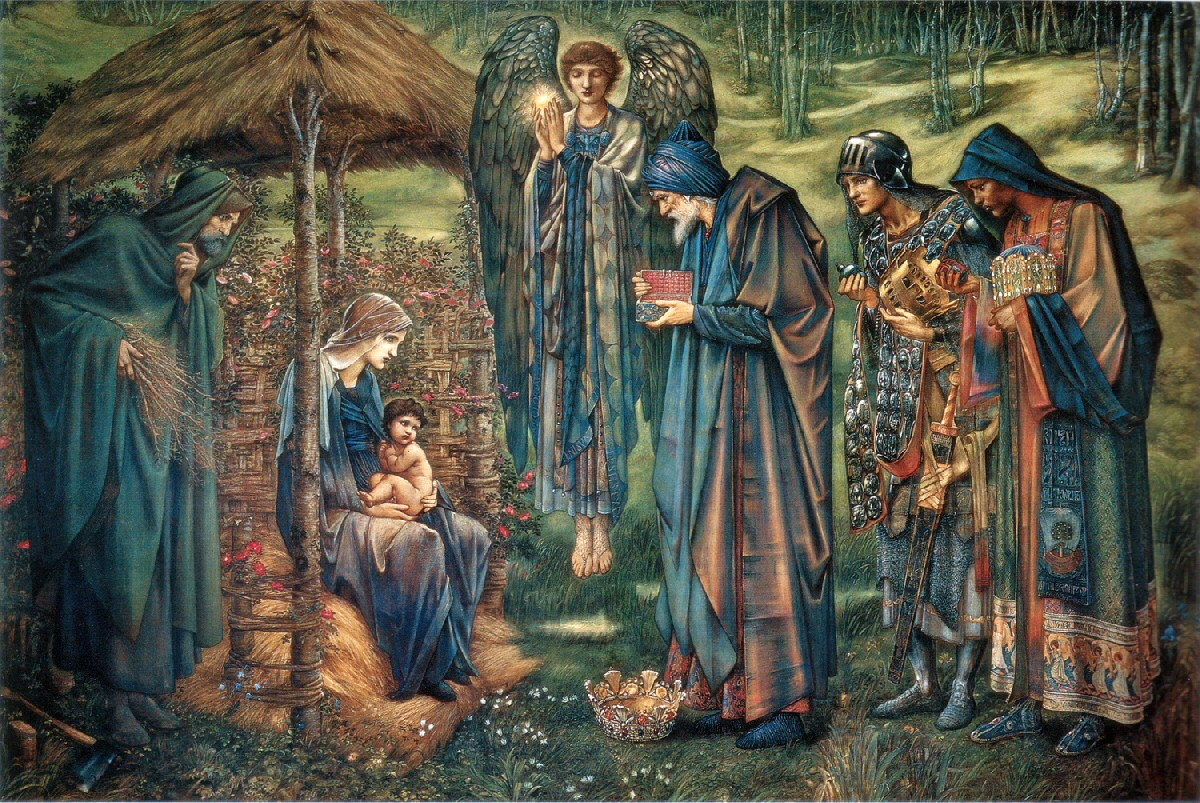
    Burne jones nativity


    Christmas has come and gone. The birth of the Prince of peace has been celebrated.

    Epiphany and the Magi, representatives of human searching for that which is beyond our knowing and beyond our reach, those wise, thoughtful, perplexed travellers, they too have come – and gone.

    And in Syria Assad still murders the innocents.

    In Northern Ireland fear and hatred still takes to the streets and hurls destruction.

    In Newtown Massachussets the children go back to school, another school, to learn, and pray God to see the world through eyes that will recover a sense of beauty, wonder and goodness.

    And in a world like this, "finally comes the poet", those gifted prophets for whom the Word not only describes, but redescribes the world.

    Levertov is such a poet.


    Denise Levertov (1923–1997)

    On the Mystery of the Incarnation


    It's when we face for a moment


    the worst our kind can do, and shudder to know


    the taint in our own selves, that awe


    cracks the mind's shell and enters the heart:


    not to a flower, not to a dolphin,


    to no innocent form


    but to this creature vainly sure


    it and no other is god-like, God


    (out of compassion for our ugly


    failure to evolve) entrusts,


    as guest, as brother,


    the Word.

  • Malala Yasufzai and the Joy of Hopefulness

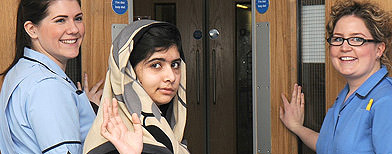
    Malala Yusufzai and two nurses

    Malala Yasufzai is well enough to leave hospital.

    This is news that rejoices my heart and adds to the celebration of Good News.

    Her courage and determination, the professsional exp[erience and care of nurses, the skill and resources of the surgeon, all made available for this one life at Queen Elizabeth Hospital.

    She is an inspiration and a symbol of hope to millions of women.

    She has learned to talk again, walk again and wave her hand again – and much restorative surgery still has to be endured.

    A young teenager's desire to learn, and her intelligence and hopefulness, outweigh the entire weight of Taliban hatred, violence and religious vengefulness.

    The Lord bless her and keep her; the Lord make his face to shine upon her and be gracious unto her; the Lord lift up the light of his countenance upon her and give her peace.

  • Epiphany and the Memory of My friend Stewart.

    A year ago my good friend Stewart suffered a catastrophic stroke, from which he died last May. One of his great loves was to find reasons for parties and gatherings at his home where he and Helen would arrange food and entertainment. And when Stewart organised things, they were choreographed with care and forethought, with the invited guests made welcome and expected to join in the fun and games, the food and drink and the laughter and conversation.

    Stewart and Helen introduced Sheila and I to Epiphany parties. At such parties we would have soup, home made bread and then a large cake, preceded by games inside or out, with a memorable evening of shove ha'penny on the big dinner table.

    I mention this because the season of Epiphany is here again, and memories of those Epiphany parties are still vivid and carry the emotional freight of good memories and meticulously planned fun and liturgy. Because we prayed and heard the story of the Magi and their gifts on those evenings too.

    The Nativity picture by Burne Jones is one of my favourites, and it captures the splendour and mystery of gifts being brought to the child who is the Gift of God, the God who gives of God's deepest self. This post is in memory of a man who brought much love and laughter into my life, and whose spirituality may best be described as making the welcome of God tangible. He was deeply read in Christian mysticism, and for him deep thought, strong passion and embrace of human life in its diversity and fullness, were given expression in a man whose smile was a benediction, and whose prayers made you feel intrusive yet welcome to overhear a conversation between a man and God. There are many privileges in being a pastor, not least of them coming within the companionship of those whose love for God is contagious.

    Like thos Magi of old, he was a wise man, who brought his gift, and worshipped the Christ child.

  • Review part 1 – Dementia: Living in the Memories of God.

    Dementia: Living in the Memories of God, John Swinton. (London: SCM, 2012) £25

    Dementia: Living in the Memories of God, John Swinton. (Grand Rapids: Eerdmans, 2012) £16.99

    This book is published by different publishers on opposite sides of the Atlantic, both of which are available from Amazon, at significantly different prices. I requested a review copy from SCM the British Publisher and I am grateful to them for the copy used in this series of reviews. Page references therefore are to the SCM edition

    It's
    some time since I did consecutive blogging on a theme or a book. That's why I asked for a review copy of Swinton's new book, Dementia. Living in the Memories of God. In my own circle of friends and family, and in
    years of pastoral ministry, I have watched those for whom I care begin
    to lose their sense of self, and have supported those who love them
    through the valley of deep darkness that they have sensed ahead of them,
    and the one they love. The theological and pastoral questions are
    urgent, crucial and take us to the foundation convictions of Christian
    theology and pastoral responsiveness to each human being as made in the
    image of God. Dementia is a condition that raises profound questions
    about human being, human love, the sense of personal identity and
    ultimately the meaning and worth of each human life.

    A
    blog is a good place to explore all this, and invite insights from
    others, and share and learn together something of what it means to
    cherish and celebrate the depths of our own humanity, and God's love
    beyoind understanding.

    "
    The glory of human beings is not power, the power to control someone
    else; the glory of human beings is the ability to let what is deepest
    within us grow."

    Jean Vanier, Befriending the Stranger, quoted in Swinton, page 153.

    There will be several posts reviewing Swinton's book throughout January.


  • Snowy, Smudge and a Treasured Book.


    Snowy 2Did I tell you that my favourite animal is the snow leopard?

    And that I am now a joint sponsor of a Himalayan snow leopard, a gift from my daughter.

    As part of the Worl Wildlife Fund deal, you get a small cuddly snow leopard.

    I've called him Snowy, and the picture is of Snowy and Smudge.

    Thirty odd years ago I read Peter Matthiessen's The Snow Leopard, and ever since have been Snow Leopard daft!

    It is a wise, self-revealing and brilliantly descriptive account of his journey to Nepal to try to see the Snow Leopard in its native habitat. It is travel book, autobiography, journal, and in the most serious sense, a self-help book – his journey was in the aftermath of the death of his wife. On a five week epic trek, he is genuinely on a journey, unlike the overused sentimental metaphor of journeying glibly claimed by Easyjet pilgrims.

  • Reflections on Rowan Williams and the Art of the Impossible.


    RowanOne of the more glaring ambiguities of being the Established Church is the qualities, attributes and skills required to be a leader who is able to face two different directions at the same time, work with two sets of pragmatic principles which are likely to get in the way of core convictions that don't easily survive compromise. I am thinking of Rowan Williams, a man in whom deep spirituality, theological scholarship, personal holiness and ecclesial conviction leave him deeply unprepared for the maneouverings and compromises, the moral ambiguities and relational ruthlessness that seems to be required to prosper in the arena of politics, ecclesial or state.

    He comes to the end of his tenure soon, and there will be those who will do an audit on his performance as Archbishop. For myself, I think there need to be two audits, appraisals, or reviews whichever term we prefer. And the criteria for assessment cannot possibly be the same in both spheres, the political and the ecclesial. As a spiritual leader of worldwide Anglicanism he cannot escape political engagement within and beyond the concerns of the Church; but neither can he surrender principles of spiritual conviction, theological commitment and Gospel imperatives. It is that dichotomy of foundational commitments that have always made the role of Archbishop of Canterbury impossible to fulfil to the satisfaction of everyone. That's before we talk about being the leader of a culturally diverse, theologically broad, historically compromised organisation whose foundation beliefs are vigorously contested in the postmodern marketplace of alternative narratives.


    Rowan 2Holiness has little value as political currency; prayer and spirituality by definition are not power tools at committee level, where pragmatic instrumentalism is a primary virtue; theological wisdom and erudition, even when combined with moral imagination in exploring the cultural and ethical minefields facing an ancient church travelling across the terrain of the contemporary world, do not carry decisive authority. It is near impossible to speak with Christian integrity and a political correctness all will approve. Indeed there is a plurality of political correctness which underlies the polarities and conflicts of much contemporary ethical and theological debate. Clashes of fundamentalism tend to crush those who stand between them as mediatior – Christians of all people should know that. The photo above captures someone whose surprise, laughter and sense of the ridiculous are emphatically not out of place in someone asked to do the impossible as a routine expectation.


    RowanI leave to others to judge the contribution of a good man in an impossible role, though I would ask them to be careful of Jesus words about being judged by the same measures we judge others. For myself I am grateful to Rowan Williams for accepting a vocation from God that for his years as Archbishop of Canterbury, has gone against the grain of a spiritually faithful intellect. His term has exposed him to dilemmas of labyrinthine complexity, and at times has made him in turns unpopular, ridiculed, deemed irrelevant, focus of anger. But he has demonstrated the incompatibility of being a leader in Church and State. And he has done so by speaking and arguing out of a resilient and generous faith, by manifesting holiness as both practical and costly and ultimately different from mere goodwill however astute, and by a rootedness in his own tradition that does not need to diminish or exclude those of other traditions and faiths.

    I leave you with one of those momkents of brilliance that say so much about the faith and faithfulness of Rowan Williams.

    Rowan Williams once brilliantly compared prayer to sunbathing. "When
    you're lying on the beach something is happening, something that has
    nothing to do with how you feel or how hard you're trying. You're not
    going to get a better tan by screwing up your eyes and concentrating.
    You give the time, and that's it. All you have to do is turn up. And
    then things change, at their own pace. You simply have to be there where
    the light can get at you."

    I pray that at the next stage of his ministry, there will be time for such sunbathing.