Blog


  • Kells2I remember in 1977, reading W D Davies The Setting of the Sermon on the Mount, a comprehensive examination of the background of that radical Kingdom of God manifesto.

    A few years later F F Bruce published the fruit of a lifetime's study and immersion in the life and thought of Paul, his theological mentor whom he called 'Apostle of the Free Spirit'. A year or two later E P Sanders' Paul and Palestinian Judaism forced a fundamental rethink of Pauline studies.

    In the mid 1980's Bishop John Robinson, of Honest to God fame, completed the draft of his Bampton Lectures which was published posthumously as The Priority of John. Seldom have I read a more theologically sensitive exposition of the passion of Jesus, even if the underlying thesis was brilliantly argued but with few lasting converts.

    Early 90's and John Ashton's major study Understanding the Fourth Gospel, (which cost £65 and was paid for by books tokens!) opened another vista on the theological masterpiece attributed to John.

    Then I ploughed through N T Wright's The Origins of the People of God, volume 1, published in 1992. It was, and is, a hard read, but it too changed the way I read the New Testament, more fully aware of worldview and cultural norms and codes and social context.

    Jesus and the Victory of God moved the discussion to a further level, and once again a massive book compelled new thinking, rewarded careful reading, and takes its place as a milestone in my personal study of the New Testament.

    Sometimes commentaries have the same ground-breaking and ground-shifting effects. Ulrich Luz's three volumes on Matthew in the Hermeneia series are such. Beautifully produced, replete with learning long and slowly distilled, ranging across hermeneutical disciplines, developing a particular study of 'effective history', that is the effect of the text on readers throughout history – (different from reception history). They are a joy to use.

    And now. News of another gold strike in New Testament studies! SPCK have announced N T Wright, Paul and the Faithfulness of God. Three volumes including the long awaited monograph on Pauline theology, a second volume on Paul's recent interpreters, and a third collecting Wright's most significant and seminal essays over 30 years. You can check this out for yourselves here. Me? I'm saving up!

    http://www.logos.com/product/29160/paul-and-the-faithfulness-of-god?utm_source=prepublication&utm_medium=email&utm_content=4343421&utm_campaign=prepub
  • The Defeat of Dogma by Understatement – and the Fruitful Companionship of Dictionaries

    Amongst other things this blog is a celebration of the book, a conservation area for those who, without despising Kindle, still require as a life necessity, the proximity and availability of books. I await the advent of an e-reader that is as flexible, quick and easy to flick through and back and forth, as a solid reference book. Because some of the most important books are for reference.Thumbing through a reference book is education by serendipity, and the best reference books send you chasing in all directions, to articles and topics you hadn't realised were connected to your first enquiry. A good article in a quality reference book will have cross references to other articles and treatments of similar or related material. Now I guess hyper links and other devices allow a similar cognitive tour on an e-reader but I'm now so incurably attached to those large repositories of print and picture that I'll persist with the dictionary, encyclopedia, companion, handbook, and lexicon in book form.

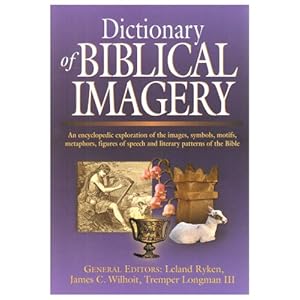
    One such dictionary I use often and am seldom disappointed. The Dictionary of Biblical Imagery, published in 1998 by IVP is according to its impressive sub-title "An encyclopedic exploration of the images, symbols, motifs, metaphors, figures of speech and literary patterns of the Bible." While working away at the Shalom tapestry I've consulted it on shepherds and sheep, moon and stars, mountains and rivers, trees and fruit, water and sunshine, cups that run over and my going out and coming in! The literary texture of Scripture is rich and dense, colourful and subversive, the range of its imagery drawing from many cultures, several languages, and centuries of history. The column and a half on stars is an eye opener to those who read biblical, texts with minds as dulled in vision as our eyes as we stand in a brightly lit street and see through a glass obscurely, missing the sheer magnificence and cosmic artistry of a night sky that should rightly reduce our utilitarian view of the world to a humbler respect for that whose vastness renders our self-importance of no intrinsic significance.


    Hs-1995-44-a-webBecause that's what Psalm 8 is saying. Human beings are made a little lower than the angels, because the Lord God made it so, not because we made ourselves so. Street lights are themselves metaphors for illuminated blindness, artificial light that obscures the billions of divinely appointed lights for the universe. Fanciful? Come on, stop being a literalist – the great Psalm poet wrote, "God determines the number of the stars; he gives to each of them their name"(147.4). In a world awash with astrological predictions, stellar worship and fear of the astral forces that fix human destiny, the psalmist upsets the game board and announces that the God of Israel, far from being subject to the whims and fates of the stars, is the one by whom they exist, the one whom they serve, and the one who gives each star its name – naming being a fundamental act of ownership. And yes, in the creation narrative of Genesis 1, as a fatal deflation of Babylonian arrogance and astrological controls, the writer says in a devastating parenthesis at the end of the story of the creation of earth and heaven, "he made the stars also". I don't know anywhere in all literature a more comprehensive defeat of dogma by understatement. 

    All of this from a dictionary. Love them!

  • Karl Barth and the Cure for Desultoriness of Spirit

    Earlier today I was desultorying. There's much to be thought about just now, life taking new turnings, decisions that involve both risk and trust, and I was looking around for a conversation partner, someone to take me out of self-pre-occupation for a while. In the corner is a tall narrow bookcase which houses Barth's Church Dogmatics, and sundry other Barthian writing, along with a number of the key monographs on Barth's theology from McCormack to Hunsinger, and Busch to Webster. I took down the Romans commentary – that angry, passionate, turbo-charged bulldozer of a book that didn't only disturb the scholars in their playground, but proceeded to demolish their school.


    DSC00447Barth is one of a few theologians who provide (for me at any rate) a theological and spiritual antidote to the debilitating condition of desultorying. Loss of impetus, boredom with transcendence, spiritual attention deficit, emotional reductionism, theological complacency, – there are plenty of phrases and they describe some forms of desultorying. Nearer where I am just now is something different – experience overload, much happening at once and the need to have time, space and energy to work through what it means, how it feels, and how best live with and through life as it is. In her wonderful Journal of a Solitude, May Sarton wrote something I adopted as a spiritual principle. She spoke of the depletion that comes from 'unassimilated  experience' – she meant those times when life is too stridently demanding, expectations of ourselves are unrealistic, too much happens before previous experience is reflected upon, learned from, made peace with.

    One way of interrupting the flow of information, experience and circumstance is to change the subject away from  yourself to that which is beyond, more than, extrinsic to, our own inner world with its worries, problem solving, calculation and self- centred attention. Open a volume of Barth, and I find myself interrupted! Romans 8 belongs in the Alpine range of Paul's theology, and Barth on Romans 8 in his commentary provides a stunning viewpoint to take in the vast vista and far away horizons of the love of God in Jesus Christ. Is it an exegesis of Romans 8? Absolutely not, more like a conductor inspiring an entire orchestra to improvise with passionate responsiveness to the composer's musical vision, and therefore to treat the script with such massive respect that it is not slavishly followed but teleologically fulfilled. The result is an artistic triumph, a virtuoso performance that is unique and arises out of the specific coincidence of musicians, conductor, musical score and historical moment.

    Barth's Romans is like that. I spent a while reading him on Romans 8.28, that massive granite rock of a verse that you either stand on because it will never move, or that falls and flattens you if you try to duck beneath it! Here is what I read, the cure for today's desultoriness:

    The Love of God stands where there is disclosed,…the pre-eminent affirmation – Jesus Christ, the Resurrection and the Life. Blessed discovery! God stands in light inaccessible. Blessed discovery! All flesh is grass and all the glory of men is as the flower of the field. When in Spirit and in Truth, one of these discoveries is made, the other is involved in it, for both are in fact operations of the One God, whose universal majesty is the 'Yes' in the 'No'. The Love of God dares to see everywhere on this side and on that side, not a 'Here' and a 'There', but wholly and altogether beyond all tension and duality, the revelation of the one Truth, proclaiming that the free and righteous, blessed and living God, knows us, prisoners and sinners and condemned and dead, to be His own. And so in our apprehension which is not-knowing,  and in our not-knowing which is our apprehension, there is shown forth the final and primal unity of visibility and invisibility,  of earth and heaven,  of man and God…Thus God rewards those who love Him. 

    Flannery O'connor loved Barth because he 'threw the furniture around'. He did, and he does. But here is an even earthier description that comes from one of those comments at the door after preaching, made by a farmer in the North East, that he was "glad to get a good kick up the backside". Not sure that was the aim of the sermon, but for him it did seem to be the outcome. And his phrase aptly describes Barth's theological impact on a desultory spirit!

    The photo is across the Mearns at early sunrise into a liquid sky.

  • Prayer for Wider Horizons and an Enlarged Heart

    Van%20eyck%20adoration%20of%20the%20lambs-resized-600

    Prayer of Response

    We
    confess to you our Father, our small-mindedness and limited appreciation of
    your greatness and almighty power.

    We
    confess that we scarcely consider your mighty movements at the beginning of
    time, creating the heavens and the earth. 

    Forgive us and enlarge our
    understanding.

    We
    confess that the life and death and resurrection of our Lord Jesus Christ do
    not infuse our thinking as they should: we are so hemmed in by transitory
    interests and temporal pursuits that we lose sight of the essential and eternal.

    Forgive us, and deepen our
    love,

    We
    confess that we do not value and often do not welcome the gift of your Holy
    Spirit to liberate our tongues to praise you and our lives to serve you. 

    Forgive us, Creating and Redeeming God, and open our hearts,

    Through the love of our Lord
    Jesus

    And by the power of
    the Holy Spirit,

    Amen

  • A Photo, a Haiku and Paying Attention as an Act of Gratitude

    PAYING
    ATTENTION

    Sunshine
    illumines

    a
    million raindrops; turning

    life’s
    kaleidoscope.

  • The High Calling of the Holy Fool – Ben Myers on the Theology of Rowan Williams

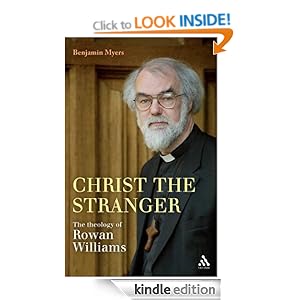
    Ben Myers' study of the theology of Rowan Williams is a good read for three reasons, well it would be three wouldn't it, given that Williams is one of the most subtle Trinitarian theologians writing today.

    Christ the Stranger: The Theology of Rowan Williams: A Critical Introduction

    First, Williams' theology is explored with sympathy, explained with clarity and expounded with critical affection. Myers traces the intellectual mileposts of Williams' theological itinerary so far, taking time to look at the landscape before moving on. The study is both chronological and thematic. Some of the chapters are significant theological reflections in their own right, underpinned by Williams' theological style and convictions, but in conversation with a sharply observant friend.

    Second Myers brings the theology of Rowan Williams into the rich and at times bewildering company of those who have shaped and stimulated, shaken and stirred, subverted and converted the ideas and insights of a mind too much in love with God to settle for simplicity, tidiness or finality in theology. Williams' travelling companions are as diverse as they come: the Russian Orthodox theologian Bulgakov, the German philosopher Hegel, Augustine and Von Balthasar with Barth, the granite polymath Donald Mackinnon and the Eastern Orthodox theologian Vladimir Lossky, Gillian Rose the French scourge of post-modern philosophy, Ludwig Wittgenstein, T S Eliot and Dostoevsky, and from a different but no less powerful theological genre, Andrei Rublev and his Icon of the Trinity.

    Third, this study allows Rowan Williams to speak, and creates both space and congenial environment for him to be heard. The endnotes to each chapter direct the reader to Williams' scattered corpus. One of the features of Williams thought is that much of it is occasional, thought out and thought through in the midst of discussion, debate and not a little controversy. But always, you have a sense of a mind that is original and unafraid of the inconvenience of hesitation, qualification and deferred answers. This can make him a frustrating provisionalist, a thinker reluctant to claim more than can be rightly said. Intellectual humility seldom goes with such high intelligence, and when it does in a Christian leader, it is usually one of the more persuasive criteria for holiness. I think Myers is right to suggest that Williams is deeply influenced by, and is himself an example of, the holy fool.


    Rowan 2To be a fool for Christ's sake is no small achievement in the scale of sanctity. Diplomacy and political nous, administrative acumen and managerial competence, religious entrepreneurship and judicious statement, strategic foresight and relational leadership – all these are desirable in an Archbishop in an established church. Unlikely a search consultancy will put holy fool amongst the essential attributes, indeed it may, rightly, be reason enough to quietly drop a name from the long list let alone the short list.

    But Myers uses the phrase in its strongest biblical sense of a prophet who speaks a different language and come from a different country and sees things we don't, because we are all so busy we cannot be bothered looking. In that sense the fool is the one who sees the folly of our seriousness; the one who refuses to prioritise the wisdom of the world; the one who speaks truth to power from a place where the view is different; the one who is never seduced into going along with the crowd who are so duped they aren't prepared to see, let alone say, that the emperor is naked.

    In his retirement I hope Rowan Williams has time, space, energy and opportunity to leave to the church a substantial corpus of uncomfortable theology. Goodness, not because I would nod assent to everything he says and writes – just as often I find him frustrating, at times annoying, frequently hard to follow, but seldom trite, predictable or irrelevant. Because deep springs of prayer and a contemplative intellect dedicated to loving God give life and reality to Williams' theology.

    I still remember years ago reading The Truce of God, an Archbishop of Canterbury Lent Book, when Williams was a young academic theologian. It too was a tough read, but it changed the way I look at movies, it alerted me to the fears that pervade consumerist culture, and it converted me to a view of Christian discipleship in which reconciliation, justice and peacemaking are essential digits in the bar code of Christian lifestyle. Since then I have read Williams with gratitude and anticipation – with considerable respect, and with just about equal measures of agreement and disagreement. And maybe I've learned most when I have disagreed with him, and had to clarify in my own mind and heart why.

    One last thought – how can you not like an Archbishop who describes the impact of hierarchical church leadership on his soul by saying it's like 'the effect of coca-cola on your teeth'!

  • Shalom – a Tapestry of Psalms – Psalm 1

    DSC01177 (1)

    Since Christmas I have been working on a large six panel tapestry which brings together the word Shalom, and the Book of Psalms. During Advent I completed a small tapestry featuring the Hebrew word 'shalom ', and it was based around some passages from Isaiah. I wrote about it while it was still in progress, which you can read here and get some idea of what I'm playing at. I don't mind the phrase 'playing at', it combines fun, recreation and experiment.

    In due course I will do a second small one with the Hebrew word 'hesed'. I have chosen these two words because they open theological horizons, no one definition or statement of meaning comes close to expressing the 'thick textual textures'  they create. That's why they are fertile theological ground, rich in possibility for exploring through the texture of textile colour and image. I have chosen six psalms which separately and together celebrate the God of shalom and hesed. And the two smaller panels will celebrate the equally rich poetry of Isaiah. When they are finished, the long Shalom column and the two small Hebrew tablets will hang in a cruciform pattern.

    The panel above is on Psalm 1. The imagery is mostly self-evident, once you're told what the psalm text is. The stability of the life founded on study of Torah, meditation on the word of God, contemplative attentiveness to the gracious command and commanding grace of God. In the foreground the sylised orderliness of the landscape contrasts with the flowing rapids of life-giving water. The fecund trees with evergreen foliage and sound abundant fruit make blessing both visble and extravagant. Shalom is continual fruitfulness and roots irrigated from constant living water. Shalom is stability and constancy that comes from deep roots, plunged like anchors into the ground, the tree in its ideal environment. Torah is the ideal environment for the human heart, will, conscience and mind – no wonder the wise delight in such reflective obedience and reverent enquiry.

  • A Beautiful Day and U2 are Beautiful Smudge!

    The morning was so beautiful, frosty, misty, pastel sky, sunlight that began as white and turned slowly to a crystal clear light and blue sky. I put on U2, Beautiful Day and heard it with the clarity that comes from two new hearing aids!

    By mid morning it was warm at the back door and Smudge had the sense to lie on the garden table and soak up some vitamin D.

    I came out with my camera and the first photo she co-operated but by the time I wanted one or two more her mood changed. Here is photo 1, with her indulging my intrusion. The request for more photo-shots was greeted by the face on the second photo! Phot 3 is Smudge's opin ion of camera in your face!

    That's why I love cats – their eyes let you know what they're thinking – inscrutable sometimes, utterly to the point at other times.

    DSC01166


    I'm a Celebrity….


    DSC01168


    Don't push it…..


    DSC01169


    Look I've done the celebrity bit…get out of here!


  • Foreign Aid, Foreign Policy and Outlandish Suggestions


    12899a559cb69bc6Aid money could go to defence. That's a headline on BBC News Online. Now I can think of a number of moral arguments which demonstrate the ethical minefield (excuse the inappropriate metaphor) the Prime Minister proposes to walk across. And I could quote a few sayings of the OT prophets who had a thing or two to say about the collision of military hardware and works of mercy, or the hubris of the powerful protecting the interests of economics at the cost of humane politics.

    But it's late. And this is just a wee blog with a few hundred readers. So I guess there's little point in going into either a long reasoned argument or and even longer gratifying rant. So I'll content myself with the words of Isaiah 58. Perchance these could be offered as some questions for Prime Ministers Question Time…

    “Is not this the kind of fasting I have chosen:
    to loose the chains of injustice
        and untie the cords of the yoke,
    to set the oppressed free
        and break every yoke?
    Is it not to share your food with the hungry
        and to provide the poor wanderer with shelter—
    when you see the naked, to clothe them,
        and not to turn away from your own flesh and blood?
    Then your light will break forth like the dawn,
        and your healing will quickly appear;
    then your righteousness[a] will go before you,
        and the glory of the Lord will be your rear guard.
    Then you will call, and the Lord will answer;
        you will cry for help, and he will say: Here am I.

    “If you do away with the yoke of oppression,
        with the pointing finger and malicious talk,
    10 and if you spend yourselves in behalf of the hungry
        and satisfy the needs of the oppressed,
    then your light will rise in the darkness,
        and your night will become like the noonday.
    11 The Lord will guide you always;
        he will satisfy your needs in a sun-scorched land
        and will strengthen your frame.
    You will be like a well-watered garden,
        like a spring whose waters never fail.
    12 Your people will rebuild the ancient ruins
        and will raise up the age-old foundations;
    you will be called Repairer of Broken Walls,
        Restorer of Streets with Dwellings.

    .

  • The Amritsar massacre – Some Lenten reflections on Empire

    The Amritsar massacre in 1919 was "a deeply shameful event in British history" said our Prime Minister yesterday.

    The events of that day were described in 1920 by Winston Churchill as "monstrous", and in political realities Churchill was not averse to the brutal use of force.

    In 1997 the Queen described the event as a "distressing" example of the "moments of sadness" in the history between Britain and India.

    In 1982 Ben Kingsley played the role of Ghandi in a film which I think is still the high point in his career. In that film, directed by Sir Richard Attenborough, the Armitsar massacre was portrayed as the logistical and inevitable consequence of blind loyalty to Empire, equipped by military capability and fuelled by racist brutality and unexamined claims of moral right founded on power and might.

    I still remember the sickening dread of those scenes as the British Army moved into position, blocked exits, and opened fire. I was sure this was an outrageous distortion of history, a Hollywoodisation which falsified truth and exaggerated fact as a technique of audience control, a deliberate black contrast to the saintly non-violent Ghandi.

    But we know it was nothing of the kind. The argument about whether the casualties reached 379 or 1,000 is obscenely irrelevant. Amritsar remains a crime against humanity on any arithmetic. And if soldiers fired until they ran out of ammunition, and the crowd were trapped in a square, assuming professional competence even skill in the soldiers ( and perhaps for some, such revolt at the murderous order that they aimed high or wide), the numbers can at least remain contested with the likeliehood of revision upwards.

    I mention all this during Lent. A season of creative self-criticism, a time to examine our story and our history and ask life-encouraging questions about what is good and to be striven for, and what is wrong and to be renounced. That Britain through its Parliament, Prime Ministers, and Monarchs including Queen Elizabeth II, has never named its shame, has never apologised to the Indian people for that particular event.

    The opportunity to do so seems once again to have gone. Ironically the British Prime Minister is now visiting an independent India seeking to build trade relations with a country that was once an Imperial subject, its goods plundered by bthe occupying power. And its people at times brutally suppressed for daring to wish their freedom.

    I accept that what I've written is one viewpoint. That values have changed, and I can be accused of moral anachronism by overlooking the realities of Imperial history, and not mentioning the enormous economic and geo-political benefits from which Britain still benefits. It was still a crime against humanity. It remains one for which we have not formally and genuinely accepted responsibility, apologised and sought reconciliation. That saddens me, and shames me. The nemesis of such violence was a small man spinning cotton by hand, and winning the heart of a people. The acknowledging such violence as an atrocity for which we apologis, would require an equally humane human being.